

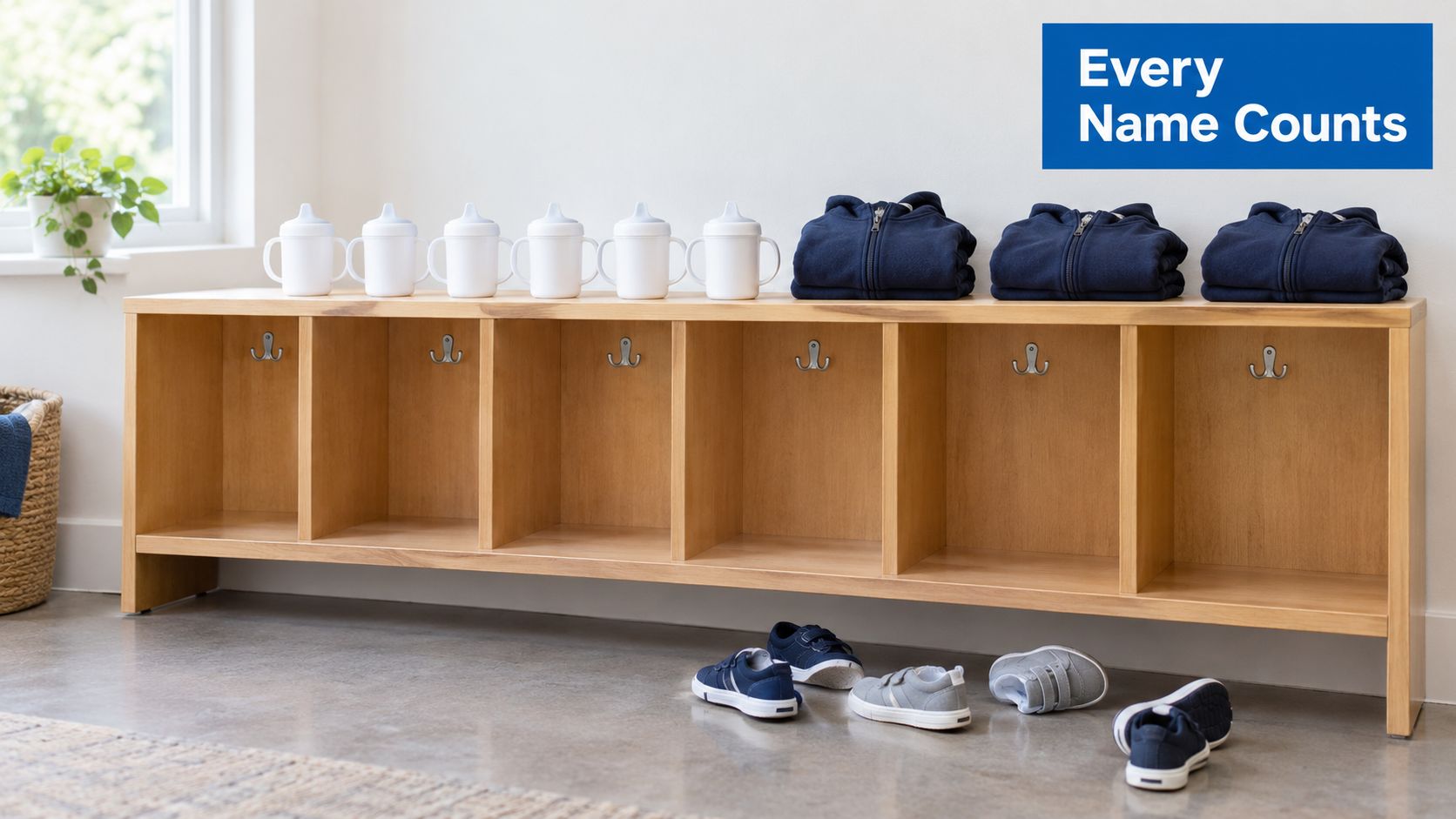
Three identical sippy cups sit on the daycare shelf, three navy jackets hang in the cubbies, and a small pile of shoes waits by the door. Your child is ready to go, but you're still trying to decide which water bottle belongs to you. That tiny search can turn a calm goodbye into a rushed hand-off.
Teddy's Rainbow name tags are useful because they put the identifying information on the item, not in your memory. The right label can keep track of bottles, lunch boxes, pacifier clips, spare clothes, shoes, and bags as they move between home, daycare, school, and the car. Teddy's Rainbow, Inc. is documented as a Washington, Pennsylvania business operating since March 2009, with personalized items including name tags, badge reels, refrigerator magnets, and custom logo and design work. The owner's professional profile provides that operating-history information.
The important decision is not just whether to buy name tags. It is which format belongs on which item. A label that works beautifully on a stainless-steel bottle may be awkward on a shoe, while a tiny sticker that looks neat on a pacifier clip can disappear on a winter coat. This guide maps those choices so you can label the things your child genuinely uses, rather than buying a pack that leaves the most troublesome items uncovered.
The Daycare Drop-Off Problem Every Parent Knows
The morning routine usually breaks down in the same place. You arrive with a child, a coat, a bag, a bottle, and perhaps a comfort item. On the shelf are several cups that look alike. In the cubby are multiple dark jackets. Near the door, somebody has left shoes that could belong to almost anyone.
A personalized tag turns that search into a glance. A caregiver can read a name on a bottle before placing it in the refrigerator, identify a jacket during outdoor play, or return a lunch box to the correct cubby without asking three families. The label travels with your child, so you don't have to.
The most troublesome items tend to be the ones that change hands or locations throughout the day:
- Water bottles and sippy cups: These move from the kitchen to the classroom, playground, and dishwasher.
- Lunch boxes: They often sit beside similar bags during meals and return home after a long day.
- Pacifier clips and comfort items: They're small, easy to misplace, and handled by several adults.
- Spare clothes: They may leave the original cubby and end up in a shared changing area.
Practical rule: Label the item where a caregiver will naturally look first. On a bottle, that may be the body or lid. On a jacket, it's usually the inside neck area. On a shoe, it's the insole or strap.
Lost belongings cost more than the item itself. You spend time searching, replacing, messaging the daycare, and checking whether another family took the wrong bag home. A label won't prevent every mix-up, but it gives the person holding the item an immediate way to correct it.
Parents assembling a broader daycare setup may also find a complete baby registry checklist useful for spotting the everyday gear that deserves identification before the first drop-off. For the emotional side of difficult hand-offs, this guide to handling difficult drop-offs is a helpful companion. The labeling decision itself becomes much simpler once you match each item to its shape, size, and surface.
Design Options and Sizing Choices That Actually Fit
A good design starts with the object, not the pattern. Teddy's Rainbow name tags can be treated as a small organizing system: shape determines placement, size determines readability, and contrast determines whether a caregiver can identify the item quickly.
Start with the shape:
- Circles suit sippy-cup lids, bottle bases, and compact accessories where a round surface gives the label room to sit flat.
- Rectangles work well on lunch boxes, backpacks, cubby bins, and the straight sides of containers.
- Mini rectangles fit narrow handles, utensils, pencils, crayons, and small toys without wrapping around an edge.
- Shoe-insert formats belong inside sneakers, sandals, or boots, where an exterior sticker may rub against the floor or peel from a textured surface.
Font choice matters more than many parents expect. A playful typeface can match a rainbow theme, but caregivers need to read the name quickly and children need to recognize it as their own. Use a heavier, uncomplicated font for a preschool cubby or classroom supply. Decorative lettering works better when the name remains clear at the actual printed size.
Color is functional, too. Pastel rainbows are gentle and easy to coordinate with clothing, but a bold primary palette offers stronger separation among siblings' belongings. A monochrome design can look tidy on a lunch box or backpack. On a dark bottle, choose a light, high-contrast background so the name doesn't disappear under dim classroom lighting.
Match the label to the surface
| Item | Recommended Shape | Recommended Size |
|---|---|---|
| Sippy-cup lid | Circle | Small |
| Water bottle | Circle or rectangle | Small to medium |
| Lunch box | Rectangle | Medium to large |
| Backpack | Rectangle or bag tag | Medium |
| Cubby bin | Rectangle | Large |
| Shoes | Shoe insert | Small or shoe-specific |
| Pencils and crayons | Mini rectangle | Small |
| Jacket or spare-clothes bag | Rectangle or clothing label | Medium to large |
Measure the usable flat area before ordering. A label that is technically small enough may still be difficult to read once placed on a curved bottle or narrow handle. For more guidance on choosing dimensions, use this explanation of name tag label sizes, then compare the printed area with the surface you plan to label.
Waterproof, Fade-Resistant, and Built for Daily Abuse
A daycare label has to survive a less forgiving environment than a desk sticker. It may face a dishwasher, a juice spill, a cold-water rinse, a warm car, playground sunlight, and repeated handling before the week is over.
The material stack matters. Independent label-industry guidance describes durable stick-on tags as using vinyl or another synthetic film facestock, a permanent adhesive suited to the target surface, and testing against repeated washing, drying, abrasion, and handling. The same guidance recommends validation for at least 30 machine-wash and dry cycles, with relevant compliance considerations such as REACH, RoHS, and CPC for children's products. The durability guidance explains why paper fails sooner: it absorbs moisture, tears, and loses its shape.
For dishwasher and wash-safe applications, the protective layer is just as important as the printed vinyl. Parent-focused label guidance describes a construction using a waterproof polymer substrate, permanent adhesive, and protective overlaminate. The laminate helps shield the print from UV exposure, scratches, and detergent attack, while polyester and vinyl are generally better suited than standard paper stock to moisture, heat, and cleaning chemistry. This dishwasher-safe label guide also emphasizes allowing the adhesive to cure before washing.
Where the adhesive works best
Smooth stainless steel, hard plastic, and clean glass usually give a permanent adhesive the best chance to bond. Clean the surface first, remove grease, press the label firmly, and avoid placing it over seams, ridges, or molded lettering.
Silicone and textured rubber are more difficult. Their flexibility and uneven surfaces can reduce contact, so a shoe-insert label or another format designed to sit in a protected location is often the better choice. A sticker can be waterproof and still fail if the surface itself doesn't let the adhesive hold.
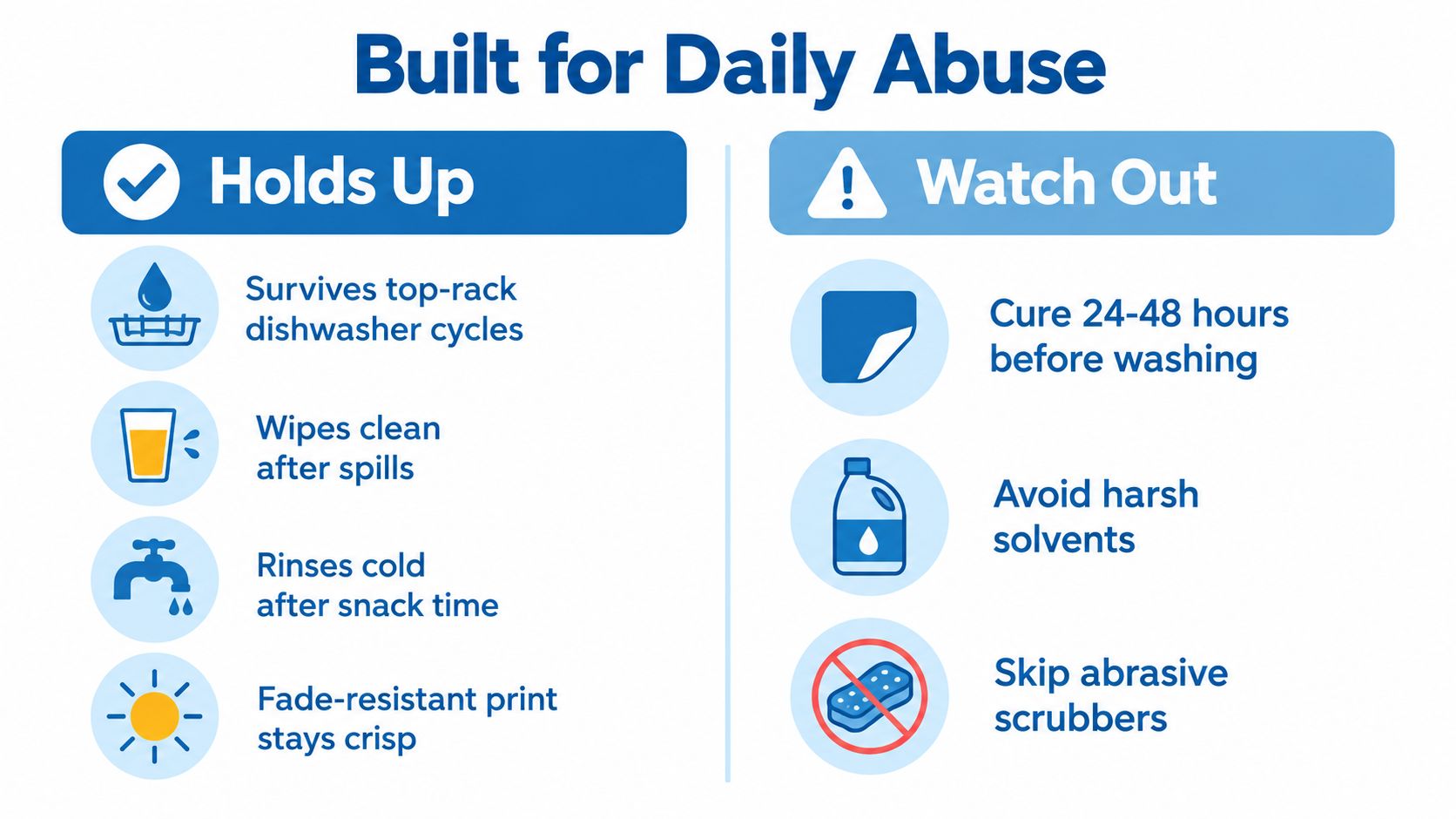
“Waterproof” also doesn't mean indestructible. High-wash items experience more stress than a backpack or cubby bin, so expect wear over time rather than assuming every label will last forever. The practical target is a readable name that stays attached through ordinary use, not a sticker that ignores heat, abrasion, and harsh cleaners. This guide to waterproof name labels for daycare offers another useful explanation of the trade-offs.
Personalizing and Ordering Without the Guesswork
Ordering goes smoothly when you treat the product preview as a quality-control step, not a formality. The sequence is straightforward.
Choose the physical format first
Select the shape that matches the item: classic rectangle, mini rectangle, circle, or shoe insert. Don't start with the color or character theme. If you choose the artwork first, it's easy to end up with a charming label that doesn't fit the bottle lid, shoe, or narrow handle you had in mind.
Enter the name and set the reading priority
Type the child's name exactly as it should appear, then choose a font weight that a caregiver can read quickly. A long name may need a wider rectangle or a simpler layout. If siblings share a cubby, decide whether each item needs a full first name, first-and-last name, or another identifying detail that your daycare accepts.
Three mistakes show up repeatedly:
- Long names get clipped: Check the preview at full size, not just the thumbnail.
- Low contrast disappears: Pale lettering on a dark lunch box can be hard to read.
- Sibling details get forgotten: Confirm that every child's items are separated before approving the order.
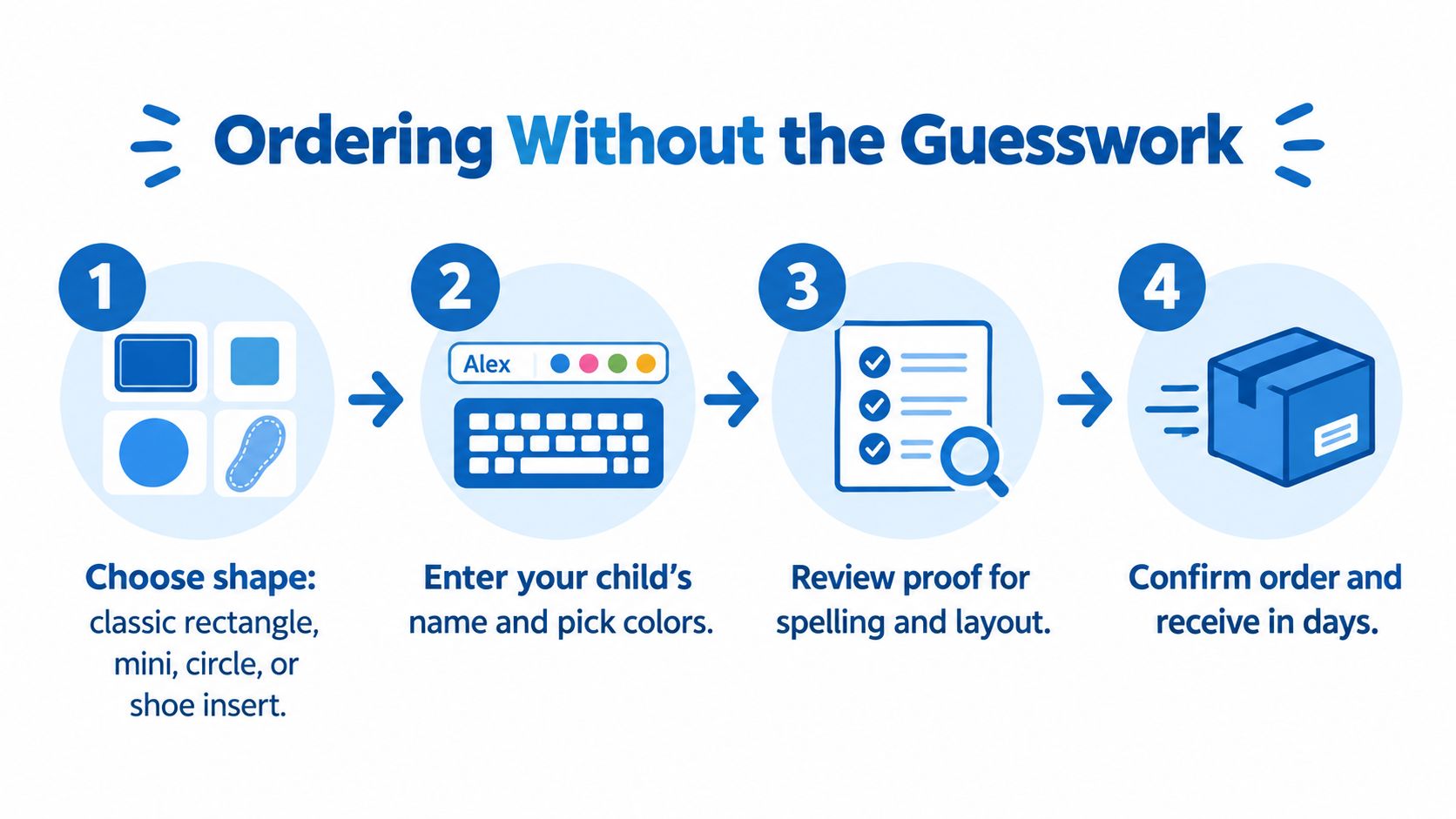
Approve the proof carefully
Check spelling, capitalization, font weight, color contrast, and the position of any icon. Production typically begins after approval, so this is the moment to catch a missing letter or a name that sits too close to the edge. Leave enough time for production and shipping before daycare starts or the back-to-school rush begins. Exact turnaround depends on the seller, order size, destination, and seasonal demand, so confirm the current estimate during checkout.
For a broader look at the ordering workflow, custom name tags online provides useful context. The best order is the one that fits the child's actual gear, not the one that looks largest on the product page.
Daycare, Preschool, and Elementary Use Cases Compared
Labeling needs change as children move from adult-managed routines to independent school habits. In an infant room, a bottle and pacifier may be the items that matter most. In elementary school, the child may need to identify a lunch box, headphones, shoes, and a water bottle without help.
A daycare infant room benefits from compact labels that stay readable on bottles, pacifier clips, and sleep sacks. Small circles and bottle-safe formats are practical because they fit curved or limited surfaces. Soft items such as loveys and sleep sacks need a placement that won't irritate the child or disappear inside a seam.
Preschool adds volume and movement. Jackets, backpacks, cubby bins, art supplies, and spare clothes all leave their assigned spots. Larger rectangles with bold type help a child recognize belongings before they can read fluently. This is also the stage when a shoe-specific label prevents a pair from being swapped after outdoor play.
Elementary school shifts the priority again. Lunch gear, water bottles, headphones, shoes, sports bags, and classroom supplies travel between locations. Children also start having stronger opinions about color and font, so letting them choose a theme can make them more willing to help with labeling.
| Age Stage | Top Items to Label | Recommended Format | Typical Quantity |
|---|---|---|---|
| Infant daycare | Bottles, pacifier clips, loveys, sleep sacks | Small circles, bottle labels, protected clothing labels | Enough for daily-use gear and replacements |
| Toddler daycare | Cups, jackets, shoes, comfort items, spare clothes | Small and medium rectangles, circles, shoe inserts | A rotating set for frequently washed items |
| Preschool | Backpacks, cubbies, jackets, lunch gear, art supplies | Medium and large rectangles, mini rectangles, shoe labels | A mixed set covering personal gear and supplies |
| Elementary school | Lunch boxes, bottles, headphones, shoes, sports bags | Rectangles, bag tags, shoe inserts, mini labels | A focused set for items that travel |
The quantity should follow the child's routine, not an arbitrary pack size. Parents often label every piece of baby clothing early on, then narrow the system to the items most likely to come home from school or get left in a shared space.
Care Instructions That Keep Labels Looking New
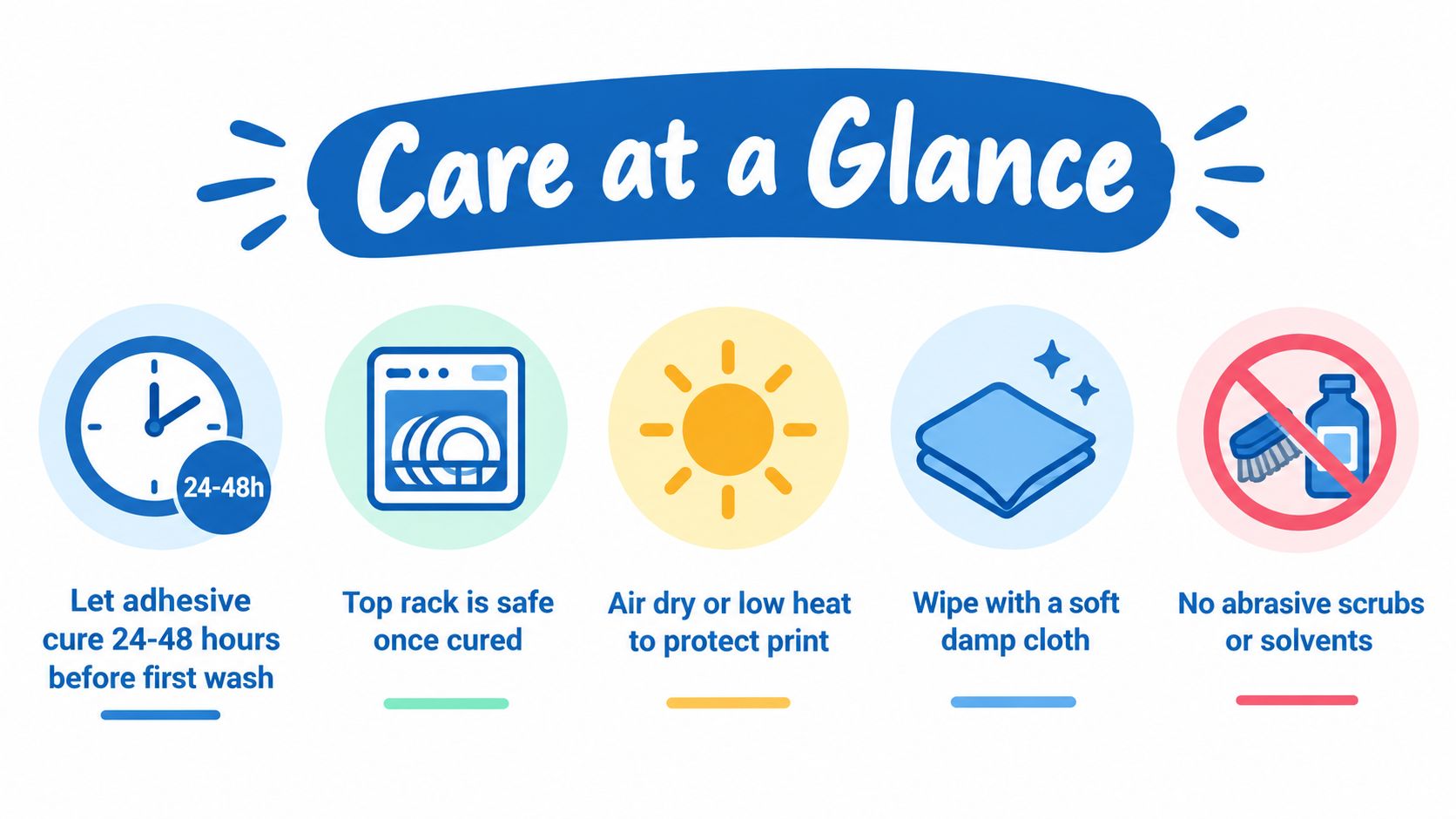
Treat label care like a short reference card. The first rule is the one parents skip most often: let the adhesive cure before the first wash. Guidance for dishwasher-safe labels recommends waiting 24 hours before washing, while other durable-label instructions use a longer 24-to-48-hour curing window depending on the adhesive and application. The label-care guidance explains why early washing can lift an otherwise sound label.
A simple care routine
- Apply to a clean, dry surface. Remove oils, dust, and residue before pressing the label down.
- Wait before washing. Give the adhesive time to develop its bond.
- Use the top dishwasher rack. This is the gentler placement for cured bottle and container labels.
- Choose low heat when possible. Excessive dryer heat and prolonged direct sunlight can stress the print and adhesive.
- Skip bleach, solvents, and abrasive scrubbers. Use a soft damp cloth for routine cleaning.
For clothing, place the label where fabric flexes as little as possible and follow the product's washing instructions. For a lunch box or bottle that you plan to hand down, warm the label gently with a hair dryer before peeling. The softened adhesive is less likely to leave a stubborn residue, though you should still remove it slowly.
If a corner starts peeling, remove the label, clean the surface with rubbing alcohol, let it dry fully, and reapply a replacement in a flat area. The failure may come from grease, texture, an edge, or washing before the bond was ready, rather than from the printed design itself.
Bundle and Up-Sell Options Worth Considering
A mixed bundle makes sense when your child's belongings span several surfaces. Buying only large rectangles may cover backpacks and cubbies but leave bottles, shoes, pencils, and pacifier clips without a workable solution. Buying only mini labels creates the opposite problem, with names that vanish on a jacket or lunch bag.
The useful way to compare bundles is by coverage, not by the number printed on the front. A daycare starter set should cover the high-touch basics. A sibling set should separate two children's gear without forcing you to place one tiny label on every large item. A back-to-school set should include formats for lunch equipment, bags, shoes, and classroom supplies.
| Bundle Name | Label Formats Included | Approx. Quantity | Best For |
|---|---|---|---|
| Daycare starter set | Small circles, medium rectangles, shoe labels | Mixed set | Bottles, cups, jackets, shoes, and spare clothes |
| Sibling set | Multiple sizes and contrasting themes | Mixed set | Shared cubbies and separated household gear |
| Back-to-school bundle | Medium and large rectangles, mini labels, bag or shoe formats | Mixed set | Lunch boxes, backpacks, supplies, shoes, and sports items |
| Single-format pack | One shape or size | Focused set | Replacing labels for one item category |
The “save” in a bundle isn't always a lower advertised price. It can come from avoiding a second shipping charge, preventing an emergency replacement order, and using one checkout to cover the whole labeling job. A consolidated order also reduces the chance that you'll discover later that the cute pack you chose has no shoe labels.
Public marketplace evidence shows that the phrase rainbow name tags is commercially established and broadly searchable. One major marketplace listed 741 results in September 2026 for that phrase, although the listings weren't specific to Teddy's Rainbow. The marketplace results show the breadth of the product theme, not a guarantee about any individual pack.
A single-format pack still wins when you're replacing labels for one child's bottles, preparing hand-me-down gear, or labeling a single classroom area. Choose the bundle when you need several formats at once and can name the items each format will cover.
Matching the Right Label to the Right Item
The easiest labeling system is a map. Once each item has a designated format, you stop testing random stickers on curved lids, fabric seams, and textured soles.
| Item | Use This Format | Why It Works |
|---|---|---|
| Sippy-cup lid | Small circle | Fits the compact top without crowding the edge |
| Water bottle | Circle or medium rectangle | Gives a clear reading area on the base or body |
| Lunch box | Large or medium rectangle | Keeps the name visible across a broad flat panel |
| Backpack | Medium rectangle or bag tag | Stays readable while the bag moves through cubbies |
| Jacket | Clothing label or larger rectangle | Gives caregivers enough surface to find the name |
| Sneakers and boots | Shoe insert or shoe-specific label | Sits in a protected position away from floor abrasion |
| Pencils and crayons | Mini rectangle | Fits narrow supplies without wrapping awkwardly |
| Small toys and accessories | Mini rectangle or circle | Identifies compact objects without covering the useful surface |
The mismatches that cause trouble
A tiny label on a puffy winter coat disappears into folds. A soft-stick label on a bottle that enters the dishwasher daily may not match the washing demands. A wide rectangle on a narrow handle can curl around the edge, while a circle on a long lunch-box panel wastes usable space.
Before labeling night, use this quick decision aid:
- Bottle or sippy-cup lid: small circle.
- Bottle body: circle or medium rectangle, placed on a smooth area.
- Lunch box or backpack: medium or large rectangle.
- Shoe: shoe insert or shoe-specific format.
- Pencil, crayon, or small toy: mini rectangle.
- Jacket, blanket, or spare-clothes bag: clothing label or larger rectangle.
- Cubby bin: large rectangle with high-contrast lettering.
- Shared sibling gear: contrasting themes or clearly different name layouts.
The design should be fun, but function comes first. Choose the shape that stays flat, the size that remains readable, and the contrast that lets another adult identify the item without handling it. InchBug offers options such as Orbit Labels, TagPal clothing labels, ShoePal shoe identifiers, Circle BagTags, medium rectangle labels, and circle labels for different children's items. Visit InchBug to compare formats, personalize the names, and build a label set around your child's bottles, bags, clothing, shoes, and school gear.