

You're standing at the classroom door with a fresh box of crayons, a stack of paper, and twenty children eager to begin. Within minutes, one child can't make a mark because the crayon is too small to grip, another has soaked through thin paper, and a third is searching for the glue that was “just here.” The problem isn't a lack of creativity. It's a mismatch between the art class materials, the activity, and the children using them.
A thoughtful supply plan makes the room calmer and gives children more control. Instead of buying the largest assortment, choose a dependable core, add optional materials when a project calls for them, and match tools to children's ages and abilities. This guide uses that approach to make shopping, storage, safety, and replenishment easier for parents, teachers, and daycare providers.
The need is ongoing. The global art supplies market was valued at $14.2 billion in 2025 and is projected to reach $21.3 billion by 2034, with a projected 4.9% CAGR from 2026 to 2034, according to Dataintelo's art supplies market overview. The school application segment represented 28.6% of 2025 revenue, while paint held 22.4% of the type share, which helps explain why paper, paint, brushes, drawing tools, and adhesives appear repeatedly on school purchasing lists.
You'll find practical ways to sort supplies by activity, decide what belongs in the core kit, read safety labels, prepare age-specific checklists, and create a labeling system that survives busy school days. For a broader starting point, compare this guide with a practical classroom supply list, then adapt it to your learners rather than copying it item for item.
Understanding the Building Blocks of Art Class Materials
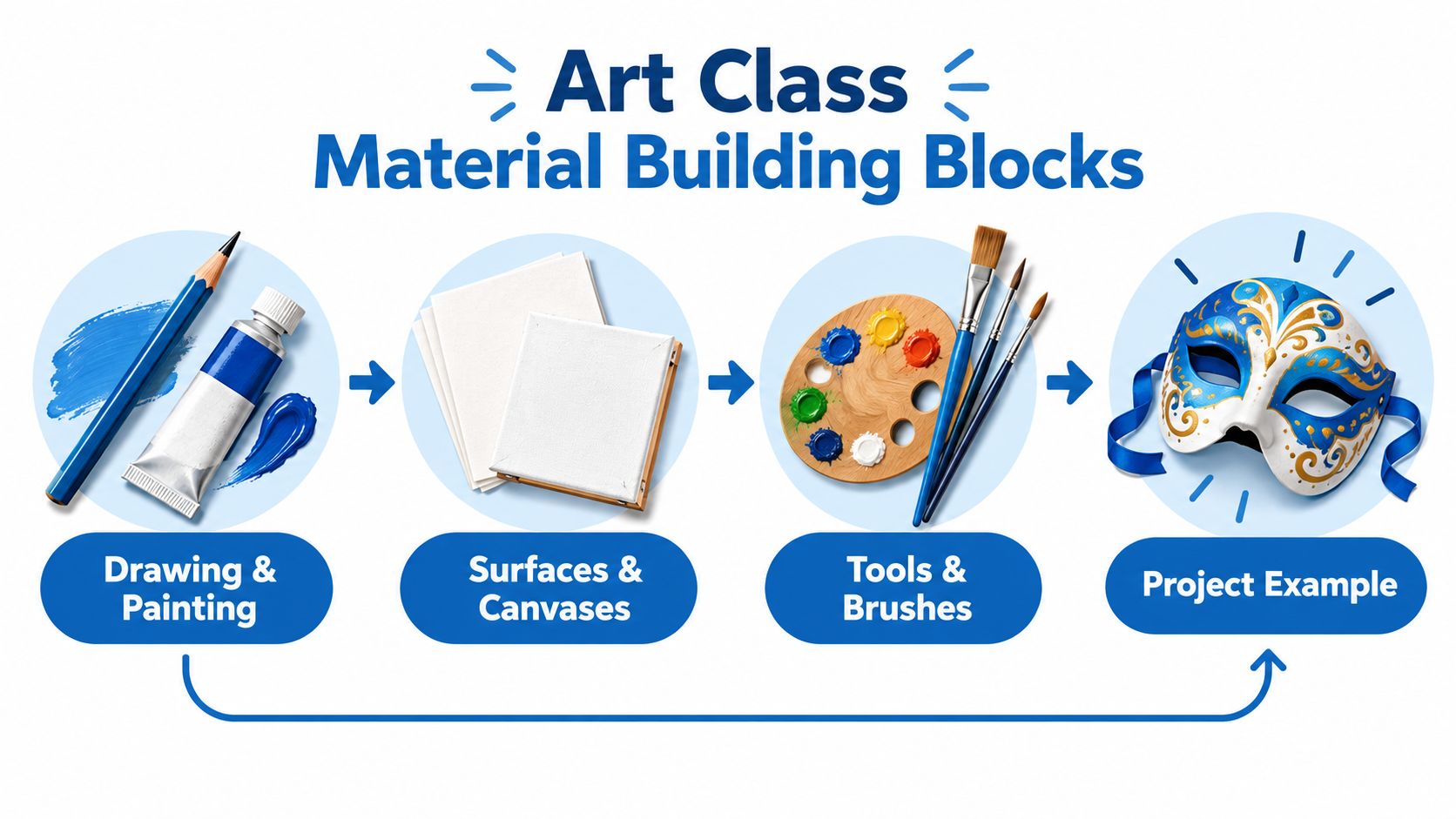
Every art project needs three things: something that makes a mark or changes shape, something to receive the work, and a tool that helps the child control the process. Think of the surface as the floor of a house. Paper, cardboard, canvas panels, and tag board give the project a place to stand. Paint, crayon, pencil, ink, clay, and collage pieces provide the color, texture, or structure.
Start with the material categories
Drawing materials include pencils, crayons, colored pencils, charcoal, oil pastels, chalk pastels, and markers. They vary in hardness, softness, opacity, and grip. A chunky crayon invites broad movement, while a sharpened colored pencil supports small details. A washable marker creates a strong, immediate line, but it may bleed through lightweight paper.
Painting materials include tempera, watercolor, acrylic products for suitable settings, palettes, water cups, paint trays, and brushes. Paint behaves like a language of color. Water changes its movement, paper changes its absorption, and the brush shape changes the mark. A round brush can make a line or dot, while a flat brush covers a wider area.
Sculpture and construction materials let children work in three dimensions. Modeling dough, clay, cardboard, wire, recycled packaging, craft sticks, and masking tape can become figures, structures, or invented machines. These materials connect naturally with building, design, and STEAM activities because children must plan, join, balance, and revise.
Collage materials bring together paper scraps, fabric, yarn, natural objects, foil, cardboard, glue, and scissors. Collage is forgiving because a child can layer, cover, tear, and rearrange. It's often a useful entry point for children who feel unsure about drawing.
Match the tool to the task
School-grade materials usually prioritize durability, easy sharing, simple cleanup, and manageable cost. Professional materials may offer richer pigment or finer control, but that doesn't automatically make them suitable for a group of young children. A classroom needs supplies that several hands can use without turning every lesson into a maintenance project.
For example, watercolor pencils might be appropriate for an elementary lesson about line and blending, while finger paint and thick paper better support a preschool sensory activity. If a child is practicing cutting, ordinary paper and blunt scissors are more useful than specialty cardstock and precision blades.
Teachers who want to introduce a more advanced drawing medium can use a carefully supervised pastel lesson and strengthen your art portfolio with pastels through OCAD's resource. At any age, the key question is simple: What action should the child practice, and which material makes that action possible?
Store supplies by the activity they support, such as drawing, painting, collage, or construction. A practical art supply organization system helps children find the right tool without opening every container.
Core Essentials Versus Optional Extras for Every Art Class
A useful supply list starts with a filter, not a shopping cart. A core essential should work across several activities, get used regularly, suit the children's age, and be easy to replace or clean. An optional extra earns its place when it supports a specific curriculum goal or adds a meaningful new way to create.
For most preschool and elementary settings, the core begins with thick drawing paper, crayons, washable markers, washable paint, glue sticks, child-safe scissors, and a small range of brushes. Add cardboard, recycled packaging, and fabric scraps when available. These materials can support drawing, painting, collage, cutting, pattern-making, and simple construction without requiring a separate kit for every lesson.
Use a practical decision test
Before buying an unusual supply, ask:
- How often will we use it? A specialty tool used once may be better borrowed or purchased for a short project.
- How many activities can it support? A good brush can serve painting, printmaking experiments, and texture studies.
- Who can safely use it? A material that requires close adult handling may not belong in an open-access station.
- What happens after use? Consider washing, drying, sharpening, recycling, and storage.
- Does it reduce waste? Refillable, durable, reusable, or recycled options may fit the classroom better.
Sustainability deserves a place beside price and durability. One market report states that 76% of surveyed consumers preferred eco-friendly materials, while 43% were willing to pay more for them. It also reports sustainable art products growing at an 8.2% CAGR and often carrying a 15% to 25% premium. Those figures come from Dataintelo's art learning supplies market report, and they point to a real purchasing question: does the greener option reduce waste enough to justify its higher upfront cost?
Core supplies and useful upgrades
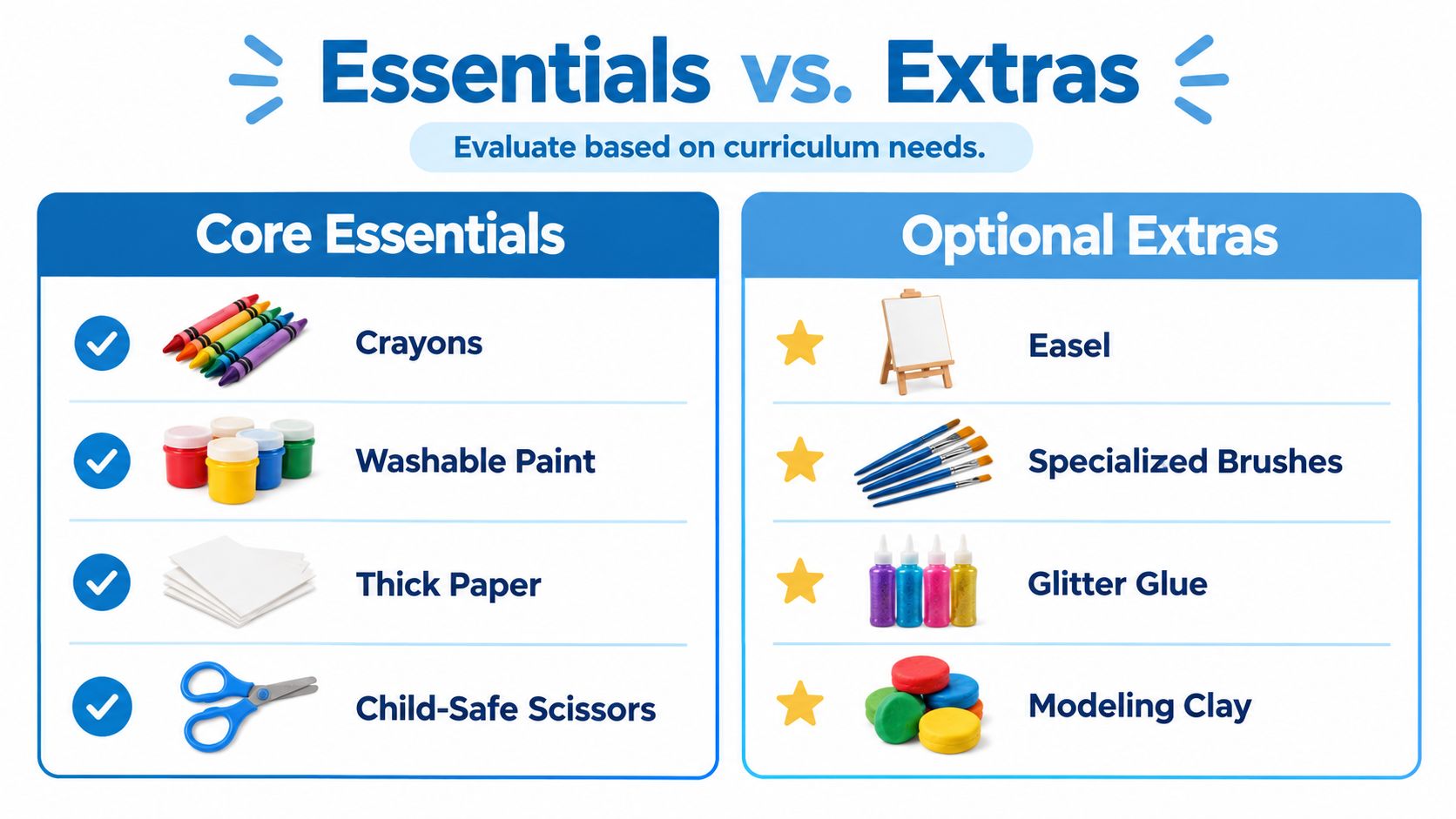
| Material Category | Core Essential | Optional Upgrade | Best For |
|---|---|---|---|
| Drawing | Crayons and washable markers | Colored pencils or brush markers | Lines, shapes, stories, and pattern work |
| Painting | Washable paint and basic brushes | Specialized brushes or watercolor pencils | Color mixing and brush control |
| Surfaces | Thick drawing paper and recycled cardboard | Watercolor paper or canvas panels | Everyday work and focused studies |
| Joining | Glue sticks, tape, and child-safe scissors | Fabric adhesive or hole punches | Collage and construction |
| Three-dimensional work | Modeling dough or recycled materials | Modeling clay, wire, or sculpting tools | Forms, structures, and STEAM projects |
| Classroom identification | Simple name labels | Activity-specific pouches or kits | Shared supplies and take-home work |
An easel, glitter glue, fabric markers, modeling clay, or specialty paper can be worthwhile, but only when the project needs it. Labeling is another small upgrade with a large practical purpose. A clear labeling system for crayons helps children return shared sets to the correct place and makes it easier to notice what needs replenishing.
Choosing Safe and Washable Art Class Materials With Confidence
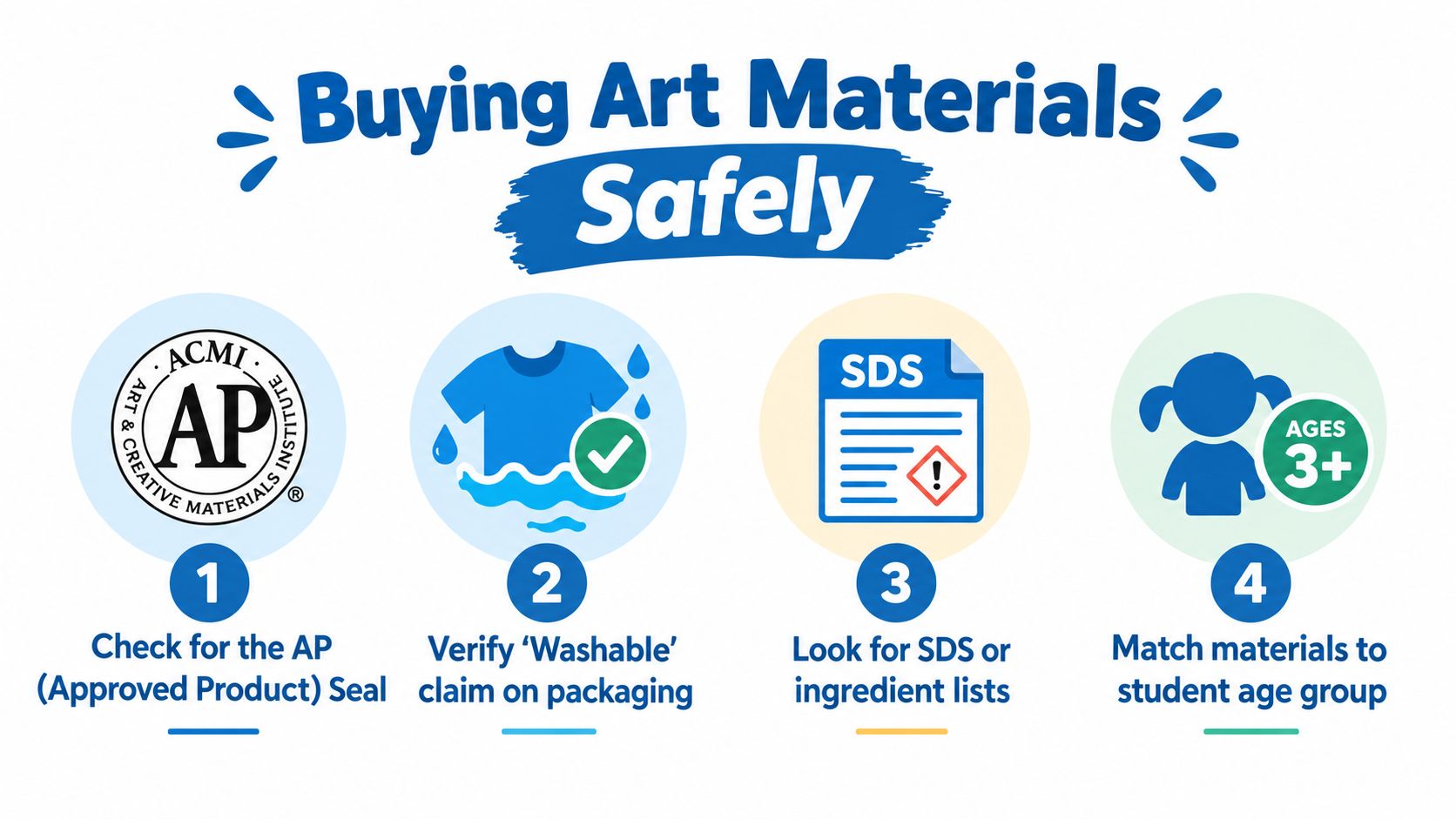
“Washable” is helpful, but it isn't a complete safety plan. A washable marker may clean more easily from clothing, while the classroom still needs safe handling, age-appropriate use, and clear storage. Treat the word as one feature to verify, not as a substitute for reading the full label.
Read the package in a consistent order
For art materials sold in the United States, OSHA hazard communication rules and the Labeling of Hazardous Art Materials Act shape what schools should look for. Covered products need a conformity statement to ASTM D-4236, ingredient disclosure, chronic hazard statements where applicable, precautionary guidance, a manufacturer phone number, and a notice if the product isn't appropriate for children. The Monmouth University art studio safety guide summarizes these requirements.
Use this label check:
- Find the age guidance. Don't give a preschooler a tool intended for older students just because the package is colorful.
- Look for the ASTM D-4236 conformity statement. This signals that the material has gone through the required toxicological review process.
- Read warnings and precautions. “Non-toxic” alone doesn't tell you every condition of safe use.
- Check ingredients or the safety documentation. Keep the relevant product information available for staff.
- Confirm the review status. The toxicological review may need to be completed again at least every 5 years, as described in the safety guide.
Control the room, not just the product
Some materials create more exposure risk when they're sprayed, powdered, heated, poured into new containers, or used in a poorly ventilated room. Teachers should keep food and drinks away from art areas, clean spills promptly, and store materials in their original labeled containers. For powders, sprays, adhesives, or solvents, use strong ventilation or local exhaust when available, and add gloves, smocks, and eye protection when the product guidance calls for them. The Cornell K-6 art guidelines provides practical exposure-control guidance.
Practical rule: Choose a complete label first, then build the activity around the product's instructions.
For young children, prioritize washable tempera, washable markers, large crayons, glue sticks, and tools with rounded or blunt ends. Keep stronger adhesives, craft knives, spray products, plaster, and solvent-based materials for controlled adult-led activities, if they're appropriate for your setting at all. Families looking for a plain-language overview can also review non-toxic materials for children, then confirm the package information for the specific product they plan to use.
Age by Age Checklists for Preschool and Elementary Art Class Materials
A preschool art station should feel generous without becoming difficult to control. Young children are still developing hand strength, visual planning, and the ability to manage several steps at once. Larger tools, sturdy surfaces, and washable formulas give them room to experiment without making every mistake feel like a crisis.
A 2023 peer-reviewed study found that preschool and elementary school children used markers for an average of 27 minutes per day, more than twice their daily home use, according to the Journal of Exposure Science & Environmental Epidemiology. That daily-use pattern makes markers a high-priority classroom supply, especially when children share materials or take work home.
| Item | Preschool Checklist | Elementary Checklist |
|---|---|---|
| Drawing tools | Chunky crayons, large washable markers, thick pencils | Standard crayons, fine and broad washable markers, colored pencils |
| Paint | Washable finger paint and tempera | Washable tempera, pan watercolor, and selected watercolor pencils |
| Paper | Thick drawing paper, cardstock, and cardboard | Drawing paper, mixed-media paper, watercolor paper, and cardstock |
| Brushes | Large round and flat brushes with sturdy handles | Round, flat, and detail brushes matched to the lesson |
| Cutting | Blunt child-safe scissors with close supervision | Child-safe scissors, with more precise cutting tasks as ready |
| Adhesive | Glue sticks and small amounts of washable liquid glue | Glue sticks, liquid glue for planned construction, and tape |
| Three-dimensional materials | Modeling dough, paper tubes, boxes, and fabric scraps | Modeling materials, cardboard engineering pieces, and simple sculpting tools |
| Organization | Shared trays or labeled classroom bins | Individual folders, labeled supply pouches, and project boxes |
For preschool, put out only the tools needed for the invitation. A tray with thick paper, large markers, glue sticks, and pre-cut collage pieces is more usable than a crowded table. Finger paint can support sensory exploration, while blunt scissors and strips of paper build control through a concrete task.
Elementary students can handle more variety because they're ready to compare tools and make intentional choices. Offer finer markers, colored pencils, watercolors, detail brushes, and simple sculpting materials as skills develop. A take-home kit might include a small paper pad, a few drawing tools, glue, and scissors, while shared classroom bins hold paint and specialty materials. That split prevents every family from repurchasing the full classroom collection.
Smart Storage Transport and Labeling Systems for Art Supplies
A supply system succeeds when a child can answer three questions without asking an adult: What is this, where does it belong, and what should I do when I'm finished? Organization should support independence, not create another set of rules children can't remember.
Build zones around real use
Sort materials by activity first, then by frequency. Keep everyday drawing tools in open caddies, painting supplies together near a washable surface, collage pieces in shallow trays, and construction materials in larger bins. Store infrequent specialty items separately so children don't empty the entire cupboard while looking for one punch or stencil.
Clear containers make inventory visible. Use small pouches for pencils and markers, lidded trays for collage pieces, and sturdy caddies for brushes and scissors. A grab-and-go kit for home learning might contain paper, crayons, washable markers, glue, and scissors. A classroom project box can hold the lesson-specific extras, such as watercolor paper, masking tape, or modeling materials.
Put the supplies children use every day at child height. Put the supplies that require an adult nearby, not merely out of sight.
Label the item and the home
Label bins with both words and simple pictures. “PAINT,” paired with a brush icon, helps emerging readers return materials correctly. For shared sets, label the container and the individual tools when mix-ups are likely. A child's name on a pencil pouch, brush roll, smock, or project folder makes ownership clear without turning the room into a guessing game.
For classroom-specific ideas, use this guide to label supplies for the classroom. InchBug also offers personalized labels for small school supplies such as pencils, pens, and highlighters, which can fit individual take-home kits or shared classroom systems.
Store paint, glue, and other liquid products in their original labeled containers whenever possible. Keep lids closed, wipe spills immediately, and avoid placing food or drinks in the art area. Ventilation matters for any activity involving vapors, sprays, powders, or strong adhesives, even when the rest of the room feels comfortable.
Make cleanup part of the lesson. Assign one child to count brushes, another to check caps, and another to match bins to shelf labels. A short closing routine protects the materials, teaches responsibility, and gives the next group a ready workspace.
Bringing Your Art Class Materials Plan Together
A strong art class materials plan doesn't require an overflowing cupboard. Start with a reliable core: thick paper, crayons, washable markers, paint, brushes, glue, scissors, and surfaces that match the activity. Add optional tools only when they support a clear learning purpose, such as precision drawing, construction, printmaking, or a STEAM challenge.
Next, audit what you already have. Remove dried markers, cracked containers, unsafe tools, and unlabeled materials. Group the rest by age and activity, then create one preschool-friendly station and one elementary-ready station. Keep the safety information with products that need special handling, and use original containers so labels and instructions remain available.
The most effective system combines selection, supervision, and identification. A suitable tool helps a child succeed. A clear routine keeps the room safe. A label helps the tool return to its place, whether it belongs to a classroom, a family, or a take-home project kit.
Digital tools can extend an art lesson without replacing hands-on making. For families or older elementary students exploring tablet drawing, Tinymoose picks for iPad stylus apps can help adults choose an app that matches the child's interests and device setup. Keep the same decision rule: begin with the activity, then choose the material or tool that supports it.
Before your next purchase, select one upcoming project and list only the supplies it needs. Prepare the core materials, label the storage locations, check each product's safety information, and invite children to help maintain the system. Visit InchBug to explore personalized labels for art kits, pencils, folders, smocks, and other school supplies that need to stay identified through busy classroom and home-learning days. Choose the items that fit your routine, add each child's name, and set up the kit before the next art session begins.