

You're scrolling through personalized gifts for grandma, comparing mugs, blankets, jewelry, frames, and keepsakes that all claim to be meaningful. The problem is that grandma may already have a drawer full of objects she loves but rarely uses. You don't need another sentimental item that gets admired once and stored away. You need something that fits her routines closely enough to earn a place in them.
That's the standard I'd use for every purchase: Will she use this every week? Personalization matters because it makes an ordinary object emotionally specific, but it only works when the object itself is useful, comfortable, readable, and suited to her home. The personalized gifts for grandma that last are usually the ones she reaches for, wears, displays, or shares repeatedly.
What Makes a Personalized Gift Actually Work for Grandma
The best gift I've bought for an older woman in my family wasn't the most elaborate one. It was a simple daily-use item with a family detail added in the right place. She already had a morning routine, and the gift slipped into it without asking her to change anything. That made the personalization visible through repetition, not just through the reaction on opening day.
A custom mug can work because it meets an established coffee or tea habit. A photo frame can work because it gives a favorite image a permanent place on a nightstand or shelf. A recipe book can work when she already cooks and enjoys preserving family traditions. By contrast, a decorative object can miss the mark if she has limited display space or prefers a tidy home.
Practical rule: Personalize a product she already knows how to use, not a product you hope will create a new habit.
Personalization adds emotional value to a sound base product. It can't rescue a blanket that feels rough, a clasp she can't manage, a mug with a difficult handle, or a frame that produces a dark, blurry photo. Before choosing a name, date, or message, check the item's weight, care instructions, dimensions, finish, and placement in her home.
The weekly-use filter
Ask four questions before you order:
- Routine: Does this fit something she already does, such as reading, cooking, gardening, or having tea?
- Visibility: Will she see or handle it often, or will it compete with clutter?
- Comfort: Can she grip, open, wear, wash, or move it without frustration?
- Meaning: Does the personalization point to a real relationship, memory, or family role?
The wider market supports treating this category as established retail rather than a novelty. One 2026 industry estimate values the global personalized gifts market at USD 34.03 billion and projects USD 61.66 billion by 2035, with a 6.7% CAGR (Business Research Insights personalized gifts market analysis). That scale reflects more than impulse buying. It also shows why you should be selective. Grandma doesn't need proof that customization exists. She needs one customized item that belongs in her life.
For more ideas that keep sentiment tied to everyday use, this guide to monogrammed gift ideas is a useful starting point.
Read Grandma First
Don't open a marketplace before you profile the person receiving the gift. Start with observations, not categories such as “sentimental grandma” or “hard-to-buy-for grandma.” Those labels are too vague to guide a good purchase.
Gather four real observations
- Watch her morning. What does she do between waking up and starting the day? Does she make tea, read the newspaper, feed pets, water plants, or sit in a favorite chair?
- Identify her main room. Where does she spend the most time? A kitchen gift makes more sense for someone who cooks there daily, while a reading pillow belongs near the chair she uses.
- Notice what she carries or wears. Look at her handbag, keys, glasses case, jewelry, scarf, phone, or notebook. Repeatedly used objects reveal more than a wish list.
- Account for physical limits. Arthritic hands, sensitive skin, reduced grip strength, and changing vision can determine whether a gift feels thoughtful or difficult.
Turn those observations into product filters. If reading small text is hard, avoid thin script and choose high-contrast lettering with generous spacing. If grip strength is reduced, favor a lightweight object with a rounded handle instead of a heavy container or tight lid. If she gardens, personalization should support that routine, perhaps through a weather-resistant marker, a useful tote, or a clearly labeled tool pouch.
Match the gift to her existing habits
A useful test is to finish this sentence: “She'll use it when she already…” If the answer is “drinks coffee,” “takes her knitting to the living room,” or “writes down recipes,” you have a credible use case. If the answer is “when she decorates the spare room,” the item may be a keepsake rather than a weekly gift.
Personalized gifts can command attention because the detail feels made for her, but customization becomes wasteful when the underlying product isn't something she'd select. A premium monogram on an uncomfortable robe is still an uncomfortable robe. A beautiful engraving on a box that doesn't fit her jewelry solves no practical problem.
Use this grandparent gift ideas guide to spark options, then return to your observations. The right choice should support her habits without forcing a new system, storage arrangement, or learning curve into her day.
Choosing the Right Type of Personalization
Personalization methods aren't interchangeable. Each creates a different balance between permanence, emotional intensity, and the chance of making an error. Choose the method after choosing the product, not before.
| Personalization Type | Best For | Meaning Score | Ease Score |
|---|---|---|---|
| Engraved name | Metal, wood, serving pieces | High | High |
| Embroidered monogram | Robes, aprons, scarves, pillows | Medium to high | High |
| Printed photo | Mugs, blankets, calendars, frames | Very high | Medium |
| Etched date | Milestone keepsakes and family objects | High | High |
| Short message | Journals, boxes, jewelry, plaques | High | Medium |
Engraved names are the safest choice for durability. A name on a metal pendant, wooden board, or keepsake box remains legible through ordinary handling, provided the lettering is large enough and the surface is suitable. Use the spelling grandma prefers, including a family title such as Nana, Grammy, or Grandma.
Embroidered monograms suit textiles because the thread becomes part of the object rather than a surface decoration. Placement matters. A monogram near the chest or corner of a pillow can look intentional, while one placed under a hand, along a seam, or where it rubs against a chair may be less successful.
Printed photos usually carry the strongest immediate emotion, but they also demand the most care. Select a clear image with grandma's face visible and enough contrast for the product surface. A photo can be meaningful and still print poorly if the original is dark, blurry, or crowded.
Dates work best when the date itself has a clear family meaning, such as an anniversary or a birth date. Don't add a date just to fill space. Months later, grandma should understand why it matters without needing an explanation.
Short messages can create intimacy, especially when they use a phrase your family says. Keep the wording brief enough to remain readable. A private joke is valuable only if grandma recognizes it and the type doesn't become cramped.
Research on customized gifting found higher appreciation for customized gifts in one experiment, with customized gifts receiving an appreciation mean of 4.86 compared with 1.67 for the reported standard deviation, and the study attributed the effect to “vicarious pride” rather than giver effort alone (Journal of Marketing Research paper on customized gifts). The practical lesson is simple: make the detail identity-linked, not decorative.
For a clearer distinction between adding personal details and building a product from scratch, see this explanation of personalization versus customization.
Materials and Usability That Hold Up
A personalized gift has to survive the way grandma handles it. The material, finish, closure, and lettering often matter more than the sentimental concept.
| Material or Method | Washability | Durability | Readability | Best For |
|---|---|---|---|---|
| Cotton | Usually straightforward, depending on care label | Good with proper washing | Embroidery reads clearly | Aprons, robes, pillow covers |
| Fleece | Generally easy to care for | Comfortable, but inspect for pilling | Printed designs can remain clear | Blankets and throws |
| Minky fabric | Requires careful care instructions | Soft, but texture can affect print clarity | Check a product preview closely | Comfort blankets |
| Laser engraving on metal | Not applicable to fabric washing | Strong for ordinary handling | High with simple, high-contrast layouts | Jewelry, tags, small keepsakes |
| Printed vinyl | Depends on product and finish | Can wear at high-contact points | Clear when lettering is large | Bags, cases, household items |
| Embroidered stitching | Washable when securely stitched | Usually strong on textiles | Excellent with uncomplicated fonts | Monograms, aprons, clothing |
Put readability before style
Thin cursive can look elegant on a product page and become frustrating in real life. Choose a simple sans-serif or classic serif font for small engraved surfaces. Strong contrast, generous spacing, and a clean background help older eyes identify names and messages without effort.
Photo products need a different check. Look for a preview that shows how the image will crop, and make sure faces aren't hidden by a handle, fold, border, or hardware. For blankets, assess whether the fabric texture will soften the image. For a frame or calendar, confirm that the main subject remains visible at the final size.
Test the physical experience
Before checkout, imagine grandma completing the basic action:
- Grip: Can she hold it without strain?
- Opening: Does it require a tight twist, small clasp, or awkward latch?
- Weight: Will she move it easily between rooms?
- Care: Can she clean it using her normal routine?
- Safety: Does the product use a non-toxic finish, skin-friendly metal, and rounded edges where hands make contact?
Research on customization anxiety supports keeping the design process constrained rather than forcing buyers to manage endless choices. A seller that offers one or two clear personalization fields, a live preview, and a straightforward confirmation process reduces the chance that emotional intent turns into decision fatigue (PubMed research on personalized product choice and returns).
For products intended to handle repeated use, consult the principles in this overview of product durability testing. You don't need laboratory language to make a good decision. You do need to know how the item will be washed, carried, opened, and displayed.
Budget, Timing, and Realistic Lead Times
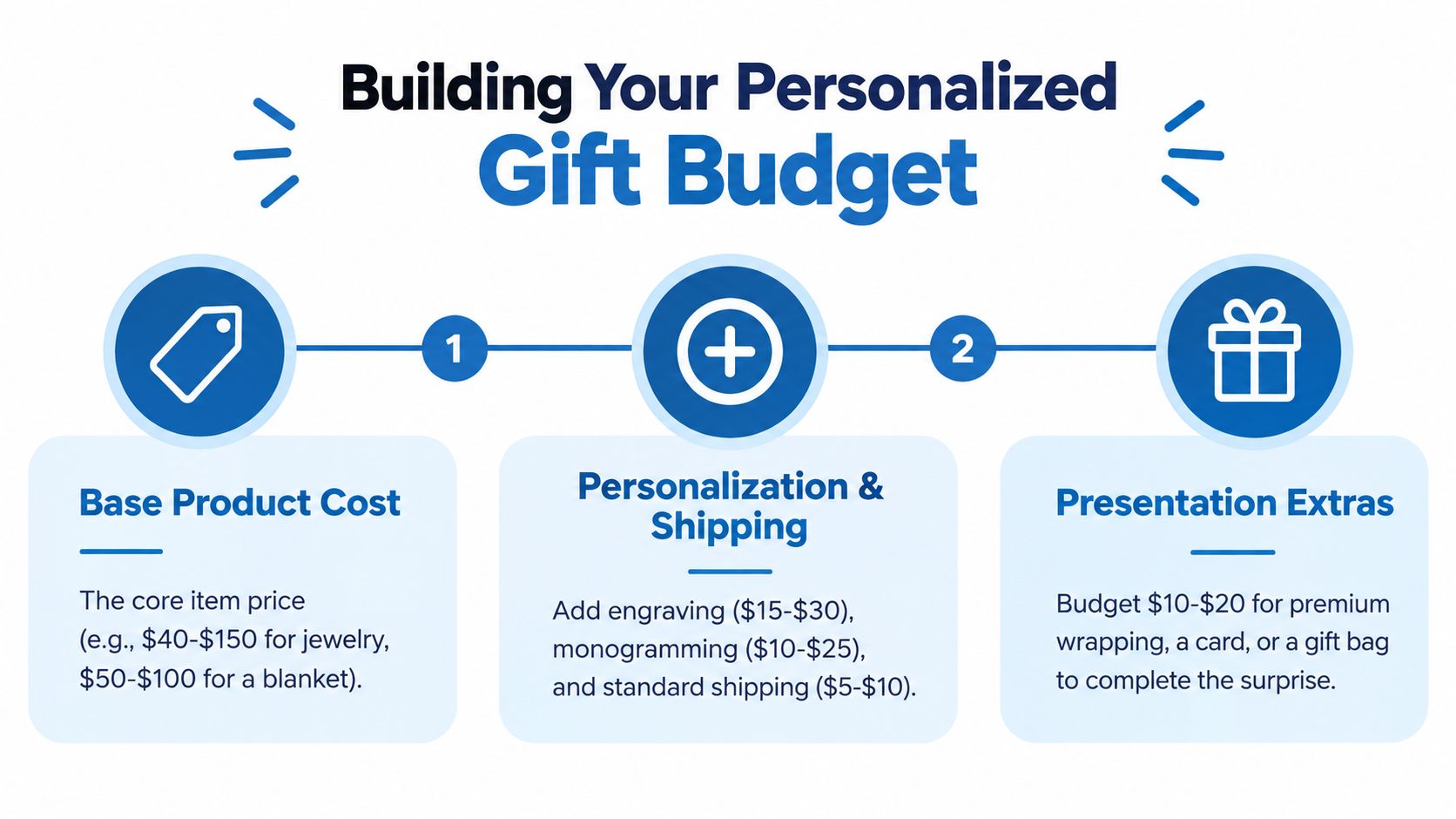
Set the budget before you fall in love with a design. Separate the base product, personalization fee, shipping, and presentation extras. A low advertised price can change once engraving, photo processing, upgraded packaging, or expedited delivery appears at checkout.
The supplied budget graphic includes example breakdowns such as $40 to $150 for jewelry, $50 to $100 for a blanket, $15 to $30 for engraving, $10 to $25 for monogramming, $5 to $10 for standard shipping, and $10 to $20 for presentation extras (personalized gift budget infographic).
Build the order in layers
- Choose the useful base. Decide whether the gift is a mug, textile, book, jewelry item, frame, or kitchen tool.
- Add one meaningful detail. A name, photo, date, or short message is usually enough. More fields don't automatically create more affection.
- Reserve money for delivery and presentation. A rushed shipping upgrade or missing card can undermine an otherwise careful gift.
Complexity affects timing. A ready-made blank with a simple name may move faster than a photo book, embroidered garment, or handcrafted wood item. Seasonal demand can extend production and shipping, especially around Mother's Day, Christmas, and birthdays.
Order at least three weeks before the occasion when the item is personalized. That lead time gives you room to inspect a digital proof, catch a spelling problem, deal with a delayed parcel, or reorder an item that arrives incorrectly. Don't assume an estimated dispatch date is the same as the arrival date.
A clear return policy also matters. Consumer research found that shoppers' preference for standardized gifts can reverse when returns are clearly allowed, because the return option reduces the fear of choosing incorrectly (consumer research on personalized gifts and returns). Check whether the seller accepts returns on custom products, what happens if the seller makes the mistake, and whether damaged goods follow a separate process.
For delivery planning, compare the seller's stated production process with its fast delivery services information. The cheapest option isn't useful if it arrives after the celebration.
Customization Tips Before You Hit Order
Most custom-order mistakes are preventable. Treat the preview like a proof, not a formality.
Start with the exact text. Ask grandma's children or another close relative whether she prefers Nana, Grammy, Grandma, Gran, or another family title. Verify names, middle initials, apostrophes, hyphens, and dates. Don't rely on memory when the item will be permanently engraved.
Use a simple proofing routine
- Read every character aloud. This catches missing letters and incorrect punctuation.
- Confirm the date format. Make sure the order uses the format your family recognizes.
- Check the photo crop. Grandma's face shouldn't disappear behind a border, fold, handle, or design element.
- Inspect the font at actual size. A script font may look attractive enlarged but lose clarity on a small pendant or tag.
- Review color contrast. Pale lettering on a pale background is a poor choice, even when it matches the product preview.
- Ask for a digital proof. Don't approve production until the layout, wording, image, and placement are correct.
For printed or engraved photo gifts, use the highest-quality original available. The customization notes recommend at least 300 dpi for printed or engraved photo gifts, but resolution alone doesn't fix a poorly lit image or a group shot where grandma's face is tiny. Choose a photo with a clear subject, good lighting, and enough empty space for the design.
Placement affects use. Keep lettering away from the part she grips, the section that rests against skin, or a seam that folds over the design. On a blanket, a corner can remain visible. On a mug, place the image where she'll see it without rotating the handle into an awkward position.
Keep messages within the seller's character limit and avoid copyrighted characters, logos, or images you don't have permission to use. A short family phrase usually beats a paragraph squeezed into unreadable type.
Review the finished item as soon as it arrives. Check the spelling, color, stitching, edges, clasp, and packaging before giving it to her.
Profile-Based Gift Ideas, Packaging, and Quick Answers
A profile is more useful than a generic “top gifts” list because it connects the item to a behavior. Start with what grandma already does, then choose personalization that makes that behavior feel remembered.
| Grandma Profile | Personalized Gift Idea | Packaging Suggestion |
|---|---|---|
| Home cook | Engraved cutting board, monogrammed apron, or recipe book using family handwriting | Tissue-lined gift box |
| Gardener | Personalized planter or weather-resistant garden plaque | Kraft wrap with a pressed-flower seal |
| Reader | Leather bookmark with initials or a reading pillow with a family phrase | Reusable linen pouch |
| Memory keeper | Photo blanket, family portrait illustration, or dated memory jar | Rigid box with a handwritten note |
| Traveler | Insulated tote with initials or a monogrammed passport holder | Reusable linen pouch |
| Minimalist | Simple engraved jewelry, subtle scarf monogram, or plain wood photo frame | Kraft wrap with restrained decoration |
The home cook should receive something that belongs in the kitchen, not another decorative sign. A family recipe in a book or on a board works because it honors something she already practices. The gardener needs weather resistance and readable text, while the reader benefits from a small item that stays beside the chair rather than taking over a room.
For the memory keeper, emotional density matters, but so does accessibility. A photo frame that can remain visible or update with new family images creates ongoing connection instead of a single viewing. Coverage of gifts for grandma has highlighted comfort, photos, and connection as useful categories, including a family-photo frame that keeps receiving new images rather than becoming static clutter (CNN Underscored guide to gifts for grandma).
The traveler and minimalist need restraint. Use initials, a location, or a small symbol instead of covering the whole item with names. If several relatives are contributing messages, a coordinated group card for grandma can carry the shared sentiment while the physical gift stays clean and practical.
Quick answers before buying
What if I don't know her size? Choose a non-wearable item, check an existing garment or bracelet discreetly, or select a product with an exchange policy. Don't guess just because the item is personalized.
How long will production take? It depends on the product, proofing process, and season. Order at least three weeks ahead and confirm both production and delivery windows with the seller.
Can custom orders be returned? Policies vary. Read the conditions before ordering, and confirm what happens if the seller makes a spelling, printing, or production error.
Will I see a preview? Many sellers provide previews, but don't assume every product includes one. Look for a live mockup or request a digital proof before production.
What should I give if grandma has everything? Choose a familiar object she uses weekly, then personalize it lightly. A useful item with the right family detail beats an unusual object that creates storage work.
The strongest choice should pass one final test: grandma can use it without instruction, see the personal detail without effort, and place it naturally into her home. InchBug offers customizable essentials such as personalized pouches and handwriting boards, along with labels and tags designed for practical everyday organization, which can also suit a grandmother who values useful, clearly identified household items.
If you're choosing a practical personalized gift that can carry family handwriting or a familiar name, visit InchBug and explore its customizable essentials. Pick the item first, confirm how grandma will use it, then keep the personalization clear, durable, and easy to live with.