

You're tired, it's late, and the school form said labels were “required,” which sounded simple until you opened the product page. Now you're choosing between fonts, icons, colors, shapes, layouts, and maybe a tiny dinosaur that your child will either adore forever or reject by breakfast.
Many parents often get stuck. Not because labels are complicated, but because the buying experience turns a practical task into a mini design project. When you need bottle bands, clothing labels, or allergy alerts, too many choices can feel like one more thing competing for your attention.
The useful question isn't “Which option is cutest?” It's personalization vs customization. Once you know the difference, ordering gets much easier. You can save the creative energy for the items that deserve it and choose the faster route for the items that just need to work.
The Late Night Labeling Dilemma
A common parent routine goes like this. You finally sit down after bedtime, open a few tabs, and start ordering labels for daycare or school. You think you'll be done in five minutes.
Then the options keep coming.
Do you want script or block letters? Pastel or bright? Full name or first name only? Add an icon? Change the border? Match siblings? Coordinate lunch gear? Suddenly a basic purchase starts to feel like you're designing a brand package for a very small client who prefers sharks this week and astronauts next week.
That overload is real. It's one reason practical systems matter so much for family life. If you need a quick reset before you buy, this post on how busy moms stay organized with personalized adhesive labels captures the everyday problem well.
Here's the part many stores don't explain clearly. Some products ask you to customize every detail. Others are personalized for you with a simpler process. Those are not the same thing, and they solve different problems.
Early in the decision, this comparison helps:
| Question | Personalization | Customization |
|---|---|---|
| Who does the work? | The system or brand does most of it | You do most of it |
| What do you enter? | Core details like name or allergy | Core details plus design choices |
| Best for | Fast, functional labeling | Special items and creative expression |
| Effort level | Lower | Higher |
| Parent mood it fits | Busy, distracted, rushing | Relaxed, intentional, browsing |
If you've ever abandoned a cart because you couldn't decide between twelve cute options, you've already felt the trade-off. More choice can be fun. It can also be one choice too many.
What Are Personalization and Customization Anyway
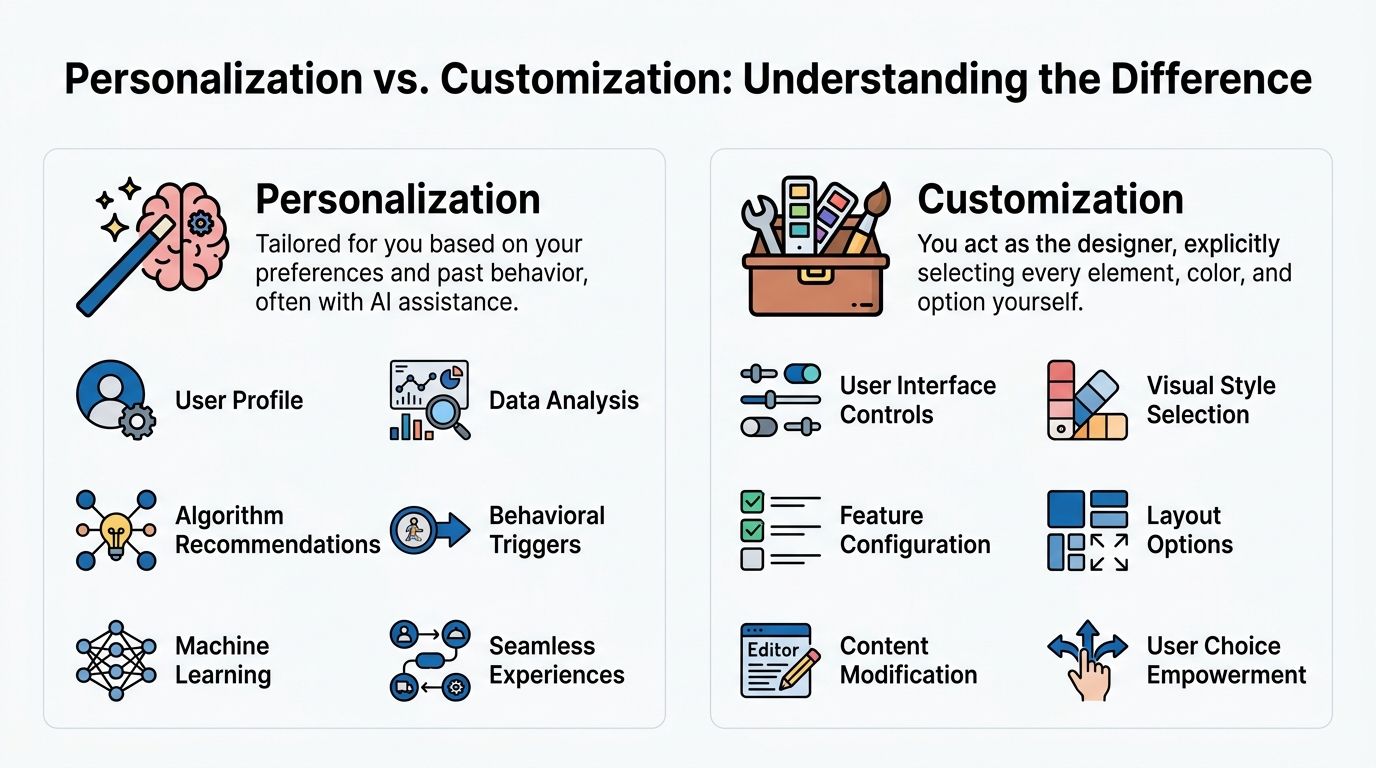
The cleanest way to think about it is this. Customization is user-driven. Personalization is system-driven.
Research describes customization as an explicit process where people manually modify the product themselves, while personalization is an implicit process where the company uses information to tailor the experience without requiring active user control, as noted in this consumer behavior research on customization and personalization.
A simple parent analogy
Think about ordering coffee.
Customization is when you choose every part of the drink yourself. Size, milk, syrup, temperature, number of espresso shots, foam level. You're in charge, which is great when you care about the details.
Personalization is when the barista already knows your usual and hands it to you with minimal effort from you. You still get something made for you, but you didn't have to build it step by step.
That same difference shows up in labels.
- Customized labels let you act like the designer. You pick the theme, palette, type style, icon, and layout.
- Personalized labels usually ask for the essential information, then apply it to a format that's already designed to be readable and practical.
The key difference is control. With customization, you create it. With personalization, the system prepares it for you.
What this looks like on a label order
For a child's bottle band, personalization might mean you enter the child's name and select a straightforward, proven format. You're done.
For a sticker label sheet, customization might mean you browse theme sets, choose a favorite design direction, test different looks, and fine-tune the result. If you want to see that more hands-on route, these customized name tag stickers show the kind of product where user choice plays a much bigger role.
There is no inherent superiority in one approach. They serve different moments.
One practical rule
Practical rule: If the item's main job is identification, readability usually matters more than creative freedom.
That rule doesn't make customization less valuable. It just puts it in the right place. If you're labeling ten bottles, six food containers, a jacket, nap mat, shoes, and extra clothes, your real goal is probably speed and clarity, not artistic exploration.
When to Choose Customization For Fun and Flair
Customization shines when the item is supposed to feel special. If the point is delight, self-expression, or ownership, the extra effort makes sense.
That's especially true for one-off items. A first-day water bottle. A backpack tag that matches a child's current obsession. Party favors. Team gifts. Anything where the design itself carries part of the emotional value.
Research on mass customization makes the trade-off plain. Customers select from predefined options and build a unique combination themselves, which requires more effort than mass personalization, where a system handles more of the tailoring through lower-effort inputs, as explained in this overview of mass personalization and mass customization.
Good uses for customization
Some label jobs are worth slowing down for:
- A milestone item: A kindergarten lunch box or “big kid” water bottle often feels more meaningful when your child helps choose the design.
- A gift: Grandparents, aunts, and family friends often want the item to feel one-of-a-kind.
- A hobby or sport: Gear tied to a strong interest often benefits from more personality.
For sports families, that logic carries beyond labels. This guide to personalized lacrosse balls is a useful example of how personalization and design choice can matter more when the item is tied to team identity or gifting, not just basic function.
Why kids respond to it
Children care about ownership more than adults sometimes realize. A label they helped design can make them more likely to recognize their things, keep track of them, and feel attached to them.
That doesn't mean every sock label needs a design session.
It means customization earns its keep when the process itself is part of the value.
Where parents get into trouble
The friction starts when customization is used for bulk, repetitive, essential tasks. If you're trying to label everything on a school supply list, too many design decisions can slow you down and lead to second-guessing.
A better approach is to reserve customization for lower-stakes moments, then use it intentionally. If you want ideas without starting from a blank screen, these label design ideas can help narrow the options before you order.
Customization is worth the time when the item is meant to feel memorable, not merely managed.
Why Personalization Is a Parent's Best Friend
At 10:45 p.m., more options do not feel helpful. They feel like one more job between packing lunches, answering the school email you forgot about, and getting everyone out the door in the morning.
That is the parental friction paradox. Parents often assume more control will produce a better result, but for functional gear, extra choices can create delay, second-guessing, and abandoned carts. A shorter path often serves families better because the primary goal is not creative expression. The goal is to get clear, usable labels on the right items and move on.
The parental friction paradox
Analysts at Nielsen Norman Group note in this analysis of customization and personalization in UX that customization asks the user to do more work, while personalization reduces effort by shaping the result around the user with fewer decisions.
Parents feel that trade-off fast.
A design-heavy flow can be enjoyable for a keepsake water bottle or birthday gift. It is much less appealing when you are ordering school labels, daycare name tags, or allergy alerts in bulk. In those moments, every extra choice carries a cost. You spend more time, make more tiny decisions, and are more likely to postpone the task.
For routine items, parents usually need three things:
- Clarity: Names and safety details should be easy for teachers, caregivers, and substitutes to spot and read.
- Speed: The order process should be quick enough to finish in one sitting.
- Consistency: Labels should look coordinated across clothes, bottles, lunch gear, and backup items.
Functional labels work better with fewer decisions
This matters most for labels tied to routine, handoff, and safety. Clothing labels need to survive busy mornings and laundry. Bottle labels need to be easy to identify in a group setting. Allergy alerts need to communicate fast, without decorative clutter getting in the way.
That is why a simple personalized format often outperforms full customization for family logistics. You add the child's name and the information that matters, then you are done. For families labeling lots of daily-use items, personalized labels for daycare are a good example of this approach because they solve a practical coverage problem instead of turning the order into a design project.
I see the same pattern every school season. Parents rarely regret having fewer font and icon decisions on a routine order. They regret realizing too late that they spent half an hour tweaking labels for socks, cups, and jackets that just needed to be readable.
What works and what tends to create more work
| Helps stressed parents | Adds friction |
|---|---|
| Pre-set formats for names and allergy info | Long chains of visual choices for routine items |
| Easy reordering of the same label style | Rebuilding the design from scratch every time |
| Readable fonts and consistent layouts | Decorative type that slows recognition |
| Fast selection for large school or daycare orders | Treating every label like a one-off craft project |
One product path that matches this functional-first approach is InchBug's personalized labeling system for kid gear, including bottle bands, clothing labels, and allergy-focused items. The practical value is straightforward. Parents can label a lot of things quickly without getting pulled into unnecessary design decisions.
For repetitive, important jobs, less choice often helps parents more.
Choosing Your Approach A Scenario-Based Guide
It is 10:30 p.m., the permission slip is signed, the lunchbox is drying, and you still have a pile of things to label. In that moment, the right question is not which option gives you the most creative control. It is which option gets the job done correctly before you run out of patience.
Five common scenarios
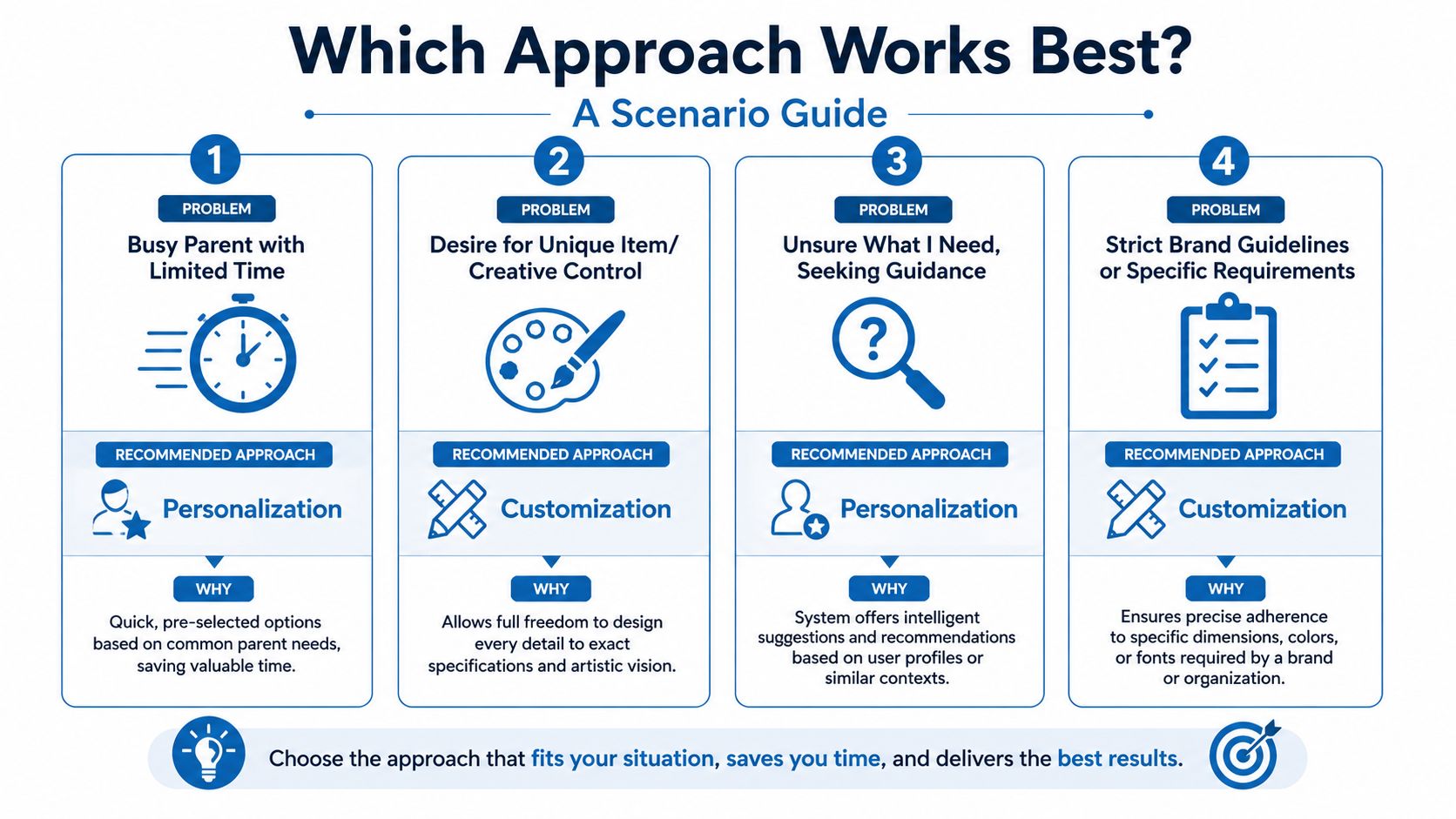
Labeling the entire daycare supply list
Choose personalization. You are usually working through cups, spare clothes, shoes, blankets, and bottles in one sitting. Fewer decisions help you finish faster and make fewer mistakes.
Creating a special first-day-of-school water bottle
Choose customization. This is one of the few cases where extra choice can feel fun instead of draining. If your child cares about the look and you are ordering one or two items, the added effort may be worth it.
Ordering urgent allergy alert tags
Choose personalization. Clear wording and fast recognition matter more than decorative choices. For safety-related items, I would rather have a proven format than twenty design decisions.
Designing matching labels for siblings
Use both, if needed. Personalization works well when you want clear names and quick ordering. Customization makes sense if each child wants their own color or theme and the order is small enough that the extra setup will not slow you down.
Equipping a classroom or daycare room
Choose personalization for the core items. Repeating the same format across bins, bottles, and supplies keeps things readable for adults who are moving fast. If you want a themed label for a special station or celebration, customize only that small piece.
The pattern behind the choice
The trade-off is simple. More choice can feel better at the start, but it often creates more parent friction by the fifth item.
Use personalization when the job is routine, high-volume, time-sensitive, or tied to safety. Use customization when the item is visible, sentimental, or limited in number. That is usually the dividing line between a quick order and a bedtime project you did not mean to start.
I have found that stressed parents do better with a shorter path for practical gear. Reordering is easier, labels stay consistent, and no one has to reconsider fonts for a backup sweatshirt. That is why personalized options tend to work so well for school labels, daycare gear, and allergy alerts. They remove decisions that do not improve the outcome.
If you are sorting this out by age and stage, this guide on which custom name labels are right for your child's age can help you match the label type to what your child uses now.
Your 3-Step Plan for Ordering the Right Labels
You don't need a long checklist when you're already busy. You need a filter that works fast.
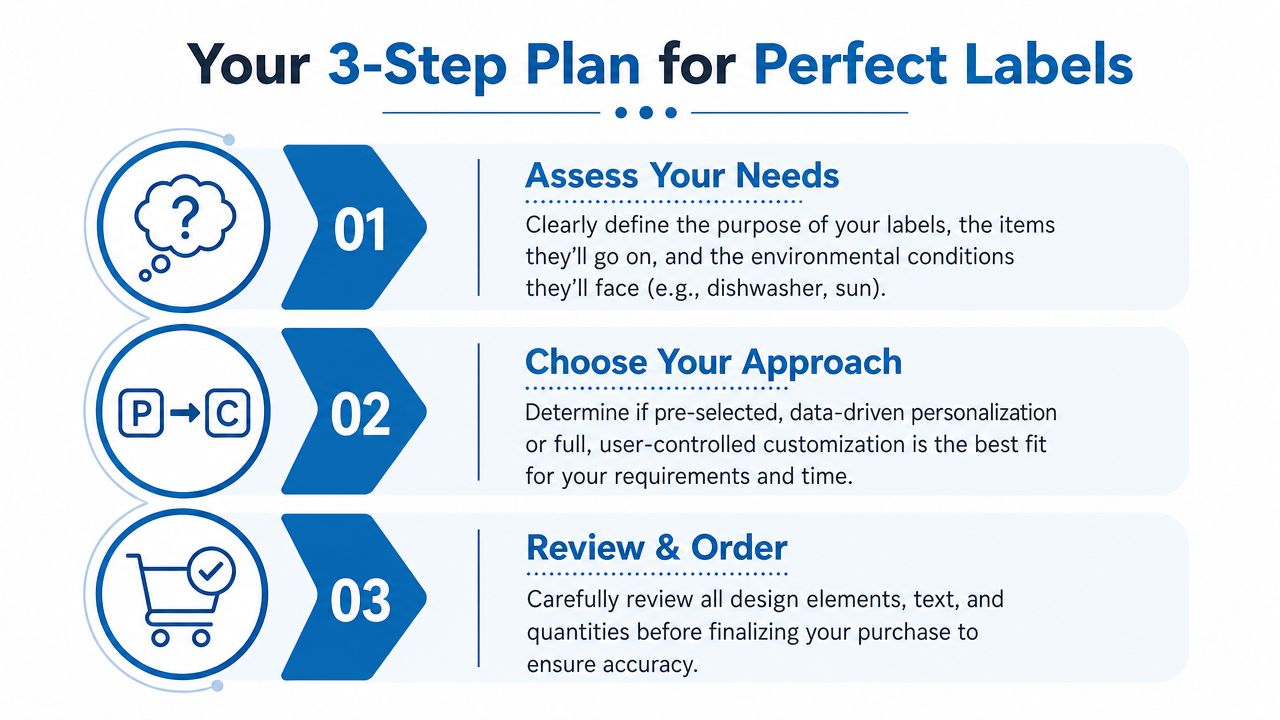
Step 1 Assess the job
Start with the item's real purpose.
Is this label meant to prevent mix-ups, support allergy awareness, survive the wash, or help a teacher identify belongings quickly? If yes, treat it as a functional tool. If it's for a gift, milestone, or visible keepsake item, you have more room to play.
Ask yourself:
- Is this about safety or speed? If yes, keep the format simple.
- Is this about personality? If yes, a custom route may be worth it.
Step 2 Count the items and your patience
The number of items changes the right answer. One custom water bottle is manageable. A full daycare setup is a different task entirely.
Use this rough filter:
- A handful of visible items: Customization can be enjoyable.
- A pile of essentials: Personalization is usually the saner choice.
- A reorder of something that already worked: Don't reinvent it.
Step 3 Pick the lowest-friction path that still fits
Most parents don't need the maximum number of choices. They need the right amount.
If the item is routine, choose the option that gets you to a readable, durable result quickly. If the item is sentimental or expressive, give yourself permission to browse and build.
This isn't just good for parents. It's why strong personalization matters in business. Companies that excel at personalization generate 40% more revenue from those activities than average players, according to McKinsey's research on the value of personalization. The practical takeaway is that people stay loyal to systems that correctly identify what they need. In family life, that often means reducing effort in high-stress moments.
A label order should solve a problem, not become one.
When you use that three-step filter, the decision gets easier. Functional need means simple personalization. Creative moment means customization. You stop treating every product page like a referendum on your taste level and start buying based on what your week looks like.
If you need labels that keep the order process straightforward for daycare, school, bottles, clothing, and allergy alerts, take a look at InchBug. The product range is built around personalized kid gear for everyday organization, which makes it a practical option when you want less friction and more done.