

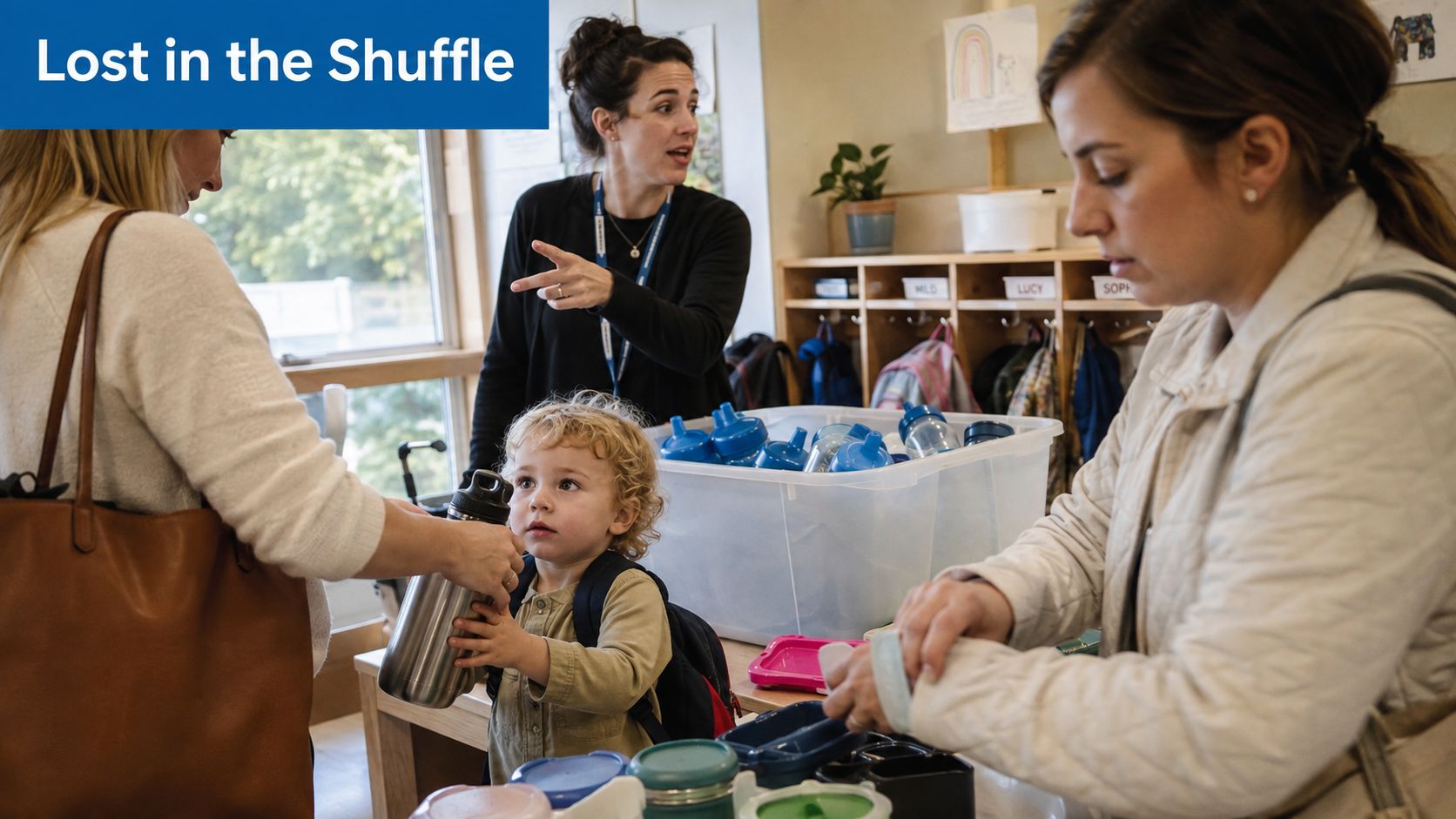
You're halfway out the door when your toddler hands you a stainless-steel bottle, the lunchbox has a lid that belongs to another container, and the daycare teacher is sorting a bin of identical sippy cups. You know the items are yours, but recognizing them quickly is harder once names written with marker have faded or paper stickers have softened.
That's the everyday problem waterproof dishwasher safe labels are designed to solve. Daycare rooms manage many similar bottles, lunch containers, shoes, and comfort items, often alongside cleaning routines that expose belongings to water, heat, detergent, and friction. A clear label helps staff return the right item to the right child, while the right material keeps that identification visible after repeated washing. For broader hygiene routines, parents and staff may also find this guide to child safety in daycares useful.
The important questions aren't just whether a label says “waterproof.” What is it made from? Will it grip a curved bottle? Does it tolerate commercial washing? How should you apply it, and how long should you wait before the first wash? This guide answers those questions in plain language, using the same practical concerns parents and daycare teams face when choosing labels for bottles used at daycare.
Why Daycare Mornings End in Lost Bottles
A daycare morning can turn identification into a small logistics exercise. One parent is counting mismatched lunchbox lids, another is checking the name on a pacifier case, and a teacher is pointing toward a shelf filled with nearly identical cups. A stainless-steel bottle may look distinctive at home, but it becomes one of many once it joins a classroom routine.
The issue isn't carelessness. Daycare staff handle many children's belongings at once, and items move between cubbies, tables, drying racks, bags, and cleaning areas. Without a durable name mark, a bottle can lose its identity when a handwritten label fades, a paper sticker absorbs moisture, or a small tag detaches.
Practical rule: Label the item where staff naturally look for identification, not only where you notice it at home.
A waterproof dishwasher safe label turns recognition into a quick visual check. A teacher can match a child's name, color, or familiar symbol before placing the item in a cubby or returning it to a lunch bag. That simple step can reduce mix-ups involving bottles, food containers, lids, and other frequently handled gear.
The phrase “dishwasher safe” also carries more meaning than “this label can get wet.” A label intended for repeated washing needs a water-repelling face material, a durable bond, and protection for the printed name. Heat and detergent test those parts together, especially when a container goes through a strong cycle rather than a gentle rinse.
This is why material choice matters more than appearance alone. A bright sticker may look excellent on the first day, yet fail if its adhesive softens or its ink sits unprotected against detergent. Parents should ask where the label can be used, whether it has a stated dishwasher rating, and how it should be applied before the first wash.
How Waterproof Dishwasher Safe Labels Are Built
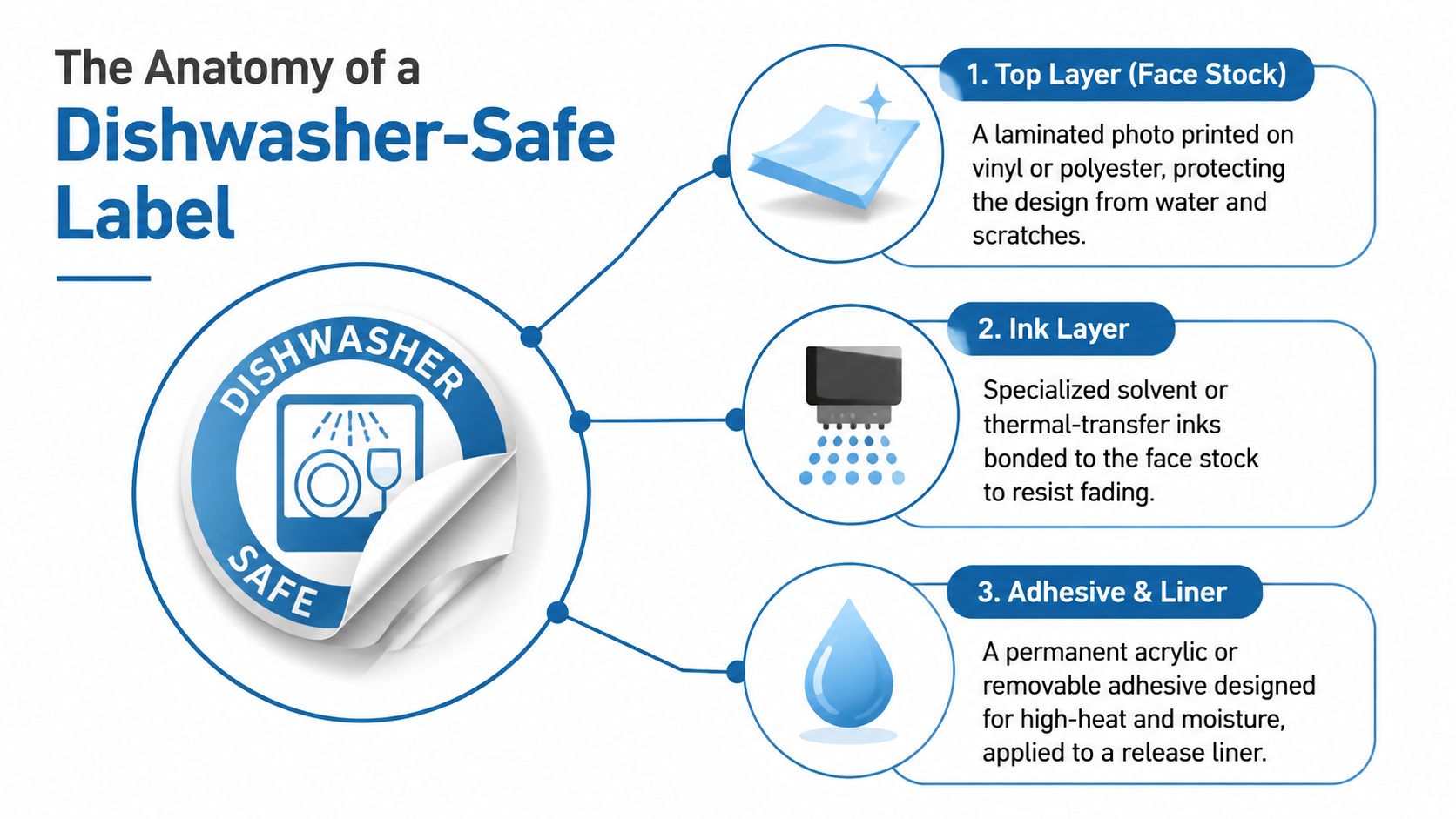
A reliable label works like a small protective system rather than a single sticker. The usual construction has three connected parts, a non-porous face stock, a pressure-sensitive adhesive, and a protective print layer or overlaminate. Guidance on label durability testing highlights why the complete construction matters more than one impressive-sounding material claim.
The face stock forms the outer surface
The face stock is the material you can see and touch. Common choices include vinyl, BOPP, and polyester, all of which are plastic films that resist water more effectively than paper. You can think of this layer as the cover of a laminated photograph. It gives the printed design a surface that doesn't readily absorb water, swell, or disintegrate.
Vinyl is flexible and can conform well to gently curved bottles. BOPP, or polypropylene film, is also non-porous and widely used for labels. Polyester, often called PET, offers a firm film structure and is frequently selected for demanding applications. The best option depends on the bottle shape, expected heat, detergent exposure, and the manufacturer's testing.
The ink carries the identity
The name, icon, or allergy message must remain readable. Waterproofing the film doesn't automatically protect the print, so manufacturers may use specialized solvent, pigment-based, UV-stable, or thermal-transfer printing methods, depending on the label construction.
Ink can fade, smear, or lose contrast when hot water, detergent, sunlight, and abrasion reach it directly. A label designed for washing therefore needs print protection that matches its face stock. Strong color contrast also helps teachers identify an item quickly, particularly in a busy room or on a crowded drying rack.
The adhesive holds everything in place
The adhesive bonds the label to plastic, glass, coated metal, or another surface. Permanent acrylic adhesives are common in high-durability constructions because they can maintain contact through moisture and temperature changes. Some rubber-based adhesives offer strong initial tack, especially on certain curved or textured surfaces, but the product must still be rated for the intended environment.
Adhesive is often the first part to fail. Hot water and alkaline detergent can soften or chemically stress the bond, allowing water to enter at an edge. That can cause curling, bubbling, haze, or complete peeling even when the film itself remains intact.
The overlaminate closes the protective system
A clear overlaminate or coating covers the printed surface and helps shield it from detergent, scratches, and water jets. It also reduces the chance that cleaning tools or neighboring dishes will abrade the name.
A genuine dishwasher rating depends on all three elements working together. A plastic film with weak adhesive isn't dependable, and strong adhesive cannot rescue exposed ink that fades during washing.
Waterproof vs Water Resistant vs Dishwasher Safe
These claims describe different levels of protection. Water resistant usually suits brief contact, such as a splash or damp hand. Waterproof suggests stronger protection against immersion, yet it does not explain how the label handles heat, detergent, or drying.
“Dishwasher safe” is the more specific claim for items entering a wash cycle. It indicates that the label construction is intended to withstand hot water, detergent, mechanical contact, and drying heat together. Guidance on safe bottle washing for parents covers the container itself, while the label still needs its own suitability information.
| Attribute | Waterproof | Water Resistant | Dishwasher Safe |
|---|---|---|---|
| Wet holding power | Handles substantial water exposure or submersion when properly made | Handles splashes and brief contact | Handles repeated wet exposure as part of a tested wash environment |
| Heat tolerance | Not necessarily specified | Usually limited or unspecified | Designed for hot water and drying heat within the stated rating |
| Detergent resistance | May be limited | Usually not the main design goal | Formulated to resist detergent exposure more effectively |
| Typical lifespan | Depends on film, ink, adhesive, and use | Often intended for shorter or lighter use | Depends on construction, application, and cycle intensity |
| Best-fit items | Bottles, outdoor gear, wet-use containers | Notebooks, light-use accessories, occasional splash zones | Daily-use bottles, lunch containers, lids, and hard children's gear |
A waterproof label can still fail in a dishwasher when its adhesive softens or its ink lacks a protective layer. A dishwasher-rated label can also perform poorly on a dirty, damp, textured, rubber, or silicone surface. The label's construction and application both affect the result.
Cure time matters too. After application, the adhesive needs time to build a stronger bond before the first wash. Heat can soften some adhesives, while alkaline detergent can stress the bond. Repeated spray and drying then test the exposed edges, so a label that survives a splash may still lift during daily washing.
Choose by the hardest condition the item will face. If a bottle enters a dishwasher every day, select a label explicitly rated for dishwasher exposure, not one described only as splash-proof.
For a closer look at labels suited to daycare equipment, see this guide to waterproof name labels for daycare. Match the claim to the routine. A label described only as splash-proof is insufficient if the bottle enters a dishwasher every day.
Where These Labels Get Used
A daycare morning can test several label materials before breakfast. A bottle meets hot water and curved plastic, a shoe bends and rubs against the floor, and clothing stretches through washing and play. Lunchboxes add seams, hinges, gaskets, and textured grips that can catch an exposed label edge.
Bottles and sippy cups
Choose a flexible vinyl, BOPP, or polyester label for the smooth body of a bottle or sippy cup. Keep it clear of ridges, seams, and lips. A wrap-around format suits a gently curved surface, provided its edges press firmly against the container. Water that reaches a loose edge can work underneath it, especially after heat and detergent have weakened the bond.
The bottle body and lid may travel or wash as separate pieces. Label both if staff or family members handle them independently. Silicone grips, rubber sections, and soft gaskets are poor placement areas because pressure-sensitive adhesives often struggle to bond reliably to those materials.
Lunchboxes and bento containers
Lunchboxes and bento containers commonly provide smooth plastic or stainless-steel areas for adhesive labels. Place the label on a flat section of the lid or body, away from rubber gaskets, hinges, and textured grips. A gasket must flex to maintain a seal, whereas the label needs a surface that stays stable during washing.
Small containers inside a lunchbox also benefit from individual identification. Staff may move food pieces to a table, drying rack, or shared storage area, where a name that can be read at a glance is more useful than one squeezed into a narrow corner.
Clothing and school uniforms
Hard-surface dishwasher labels are not designed for fabric. Clothing stretches, folds, tumbles, and rubs against other garments, so use iron-on name tapes for a lasting fabric bond. Stick-on clothing labels can work as a no-iron option when applied to a smooth care tag.
A care tag moves less than the surrounding fabric and gives the adhesive a more consistent surface. Follow the label maker's laundry instructions. A construction that tolerates bottle washing may not withstand a washing machine or tumble dryer.
Shoes and flexible gear
Shoes place repeated stress on a label. The inside bends, the material may have texture, and constant rubbing can wear down both the label and its print. Shoe-specific curved labels or shoe-pouch tags are generally more suitable than a flat bottle label stuck inside the heel.
A 30-piece preserving jar kit shows how label formats can be designed for smooth containers. Children's shoes and clothing need different constructions, matched to flexing, abrasion, and fabric movement.
| Item Category | Recommended Label Type | Key Feature Needed |
|---|---|---|
| Water bottles and sippy cups | Flexible dishwasher-rated vinyl, BOPP, or polyester | Curved-surface grip and protected print |
| Lunchboxes and bento boxes | Laminated hard-surface label | Detergent resistance and placement away from gaskets |
| Clothing | Iron-on tape or care-tag clothing label | Bond designed for fabric and laundry movement |
| Shoes | Curved shoe label or shoe-pouch tag | Flex resistance and abrasion tolerance |
How to Choose the Right Label for Each Need
Buying decisions become easier when you start with the item rather than the artwork. A cute icon can't compensate for an adhesive that doesn't suit stainless steel, or a label that is too large for a narrow bottle lid.
Start with the surface
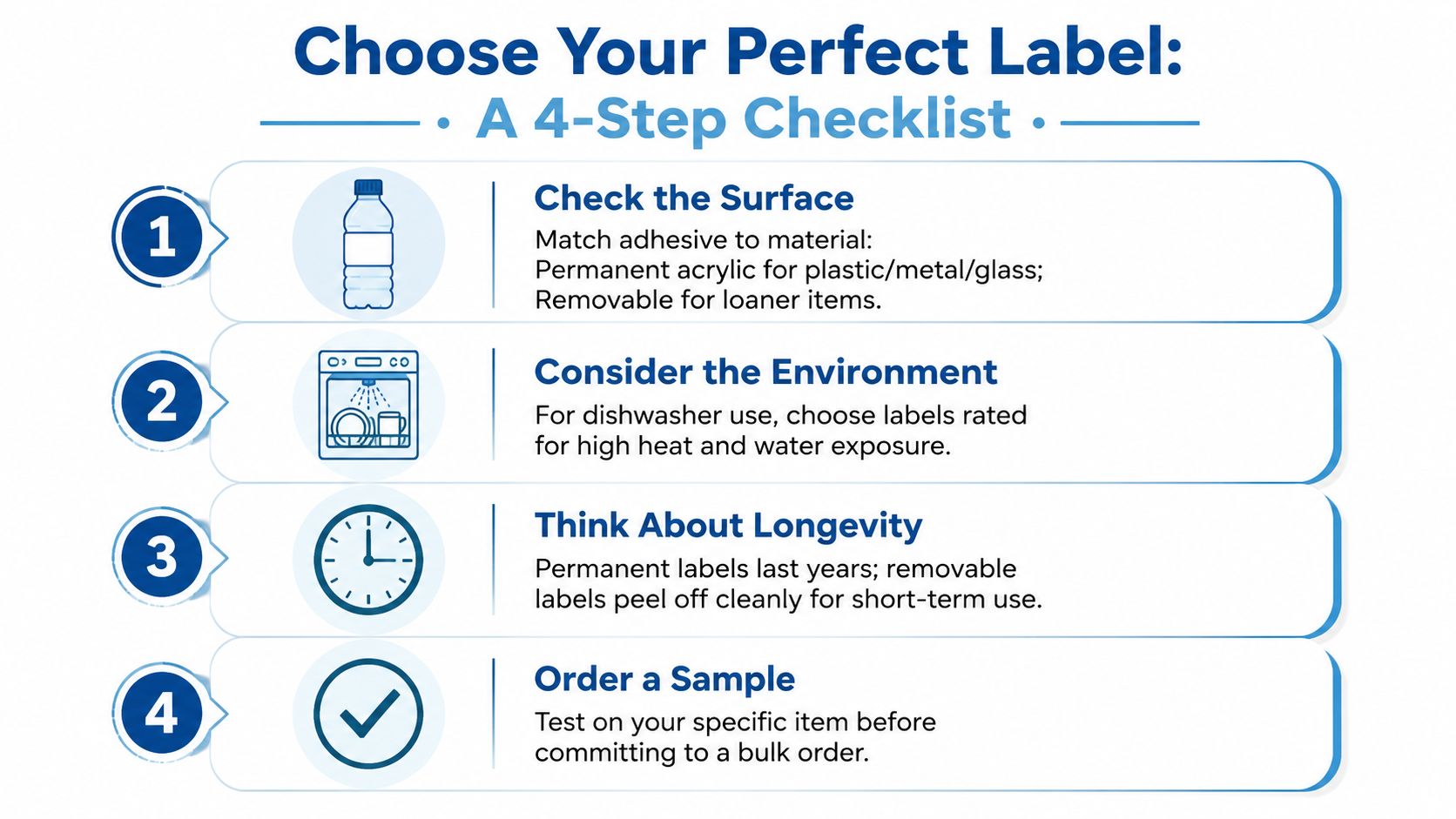
Smooth plastic, glass, and metal generally suit permanent acrylic adhesives. A removable adhesive may be more appropriate for loaner equipment, classroom supplies, or items that will change owners. Textured or gently curved surfaces may need a higher-tack construction, but silicone, rubber, fabric, and porous materials remain difficult regardless of adhesive strength.
Check the manufacturer's surface list before ordering. If you're labeling a bottle with a silicone boot, place the label on the smooth bottle body instead of the boot.
Size the label for recognition
The label should be large enough for an adult to read quickly and small enough to fit a stable surface. A name printed in at least 8-point type can support basic legibility, but the actual result depends on the font, contrast, viewing distance, and amount of text.
Rectangles suit bottle bodies and lunchbox lids. Circles work well on small lids or compact accessories. Pre-cut labels simplify application, while sheets may offer more flexibility if you're marking unusual shapes.
Decide what information matters
A simple first name may be enough for a family with one child in a small classroom. An icon, color code, or allergy alert can help when several belongings look alike. Bilingual households may need names or instructions in more than one language, but adding text reduces the space available for large, readable lettering.
Check child-safety information
Ask whether the materials are BPA-free, whether the inks are described as non-toxic, and whether the label is intended for direct food contact. Rounded corners can make edge lifting less tempting for children who chew on objects, but labels still shouldn't be placed where a child can easily pick at them.
ASTM F963 is a toy-safety standard, not a universal certification for every label used on bottles or lunchboxes. Treat compliance language carefully, and distinguish waterproof, dishwasher-safe, indirect food-contact-adjacent, and microwave-safe claims.
Prioritize the failure you most need to prevent. For a daycare bottle, surface compatibility and dishwasher performance come first. For a shared classroom bin, clean removal may matter more than permanent adhesion.
Getting the Longest Life Out of Every Wash
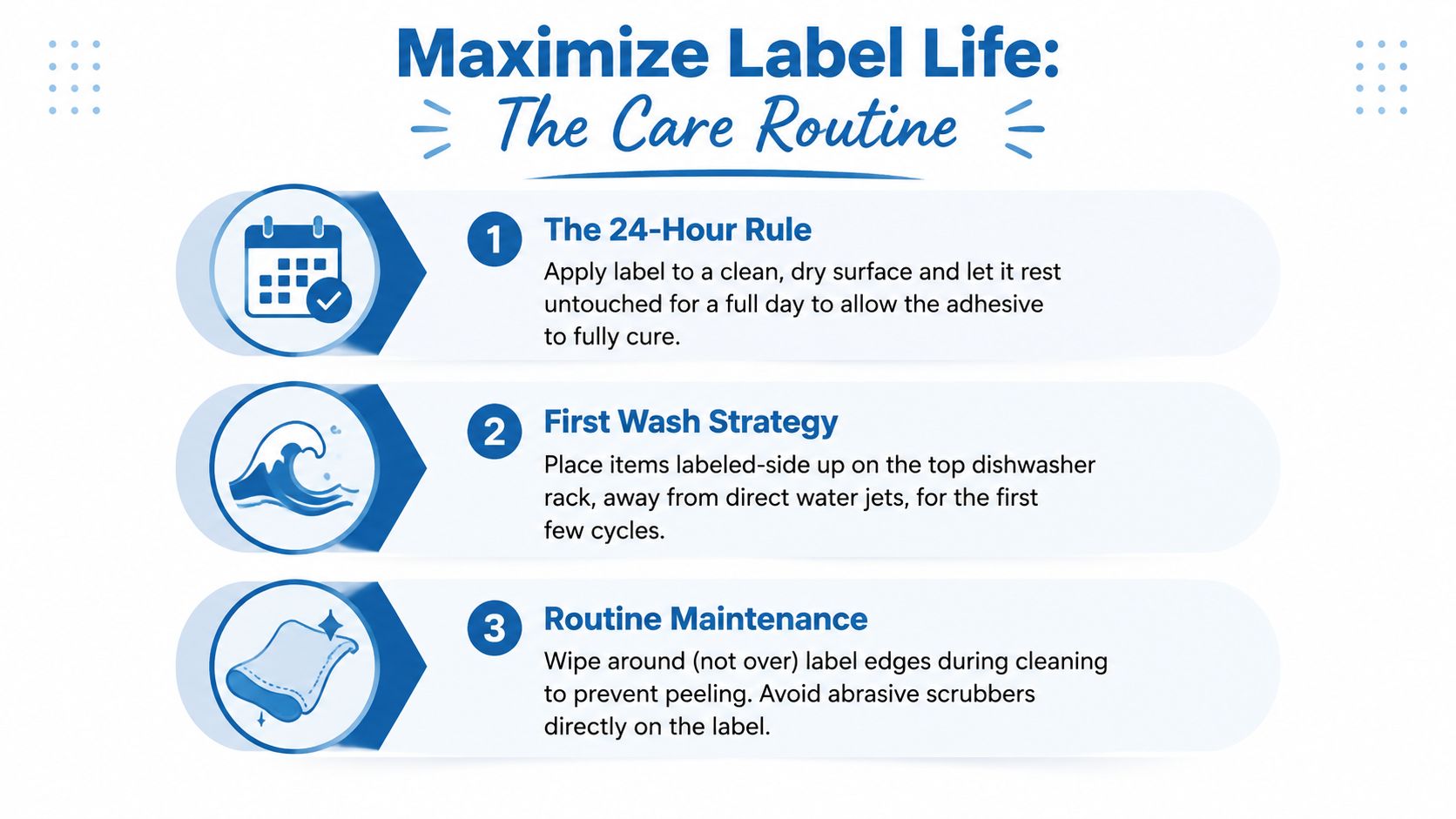
Application determines whether the adhesive bonds to the item or merely sits on top of residue. Start with a clean, dry, non-porous surface, press from the center outward, and smooth every edge. Then leave the item untouched for about 24 hours before its first wash, allowing the adhesive to build bond strength, as explained in this label care instructions guide.
Use a gentler first wash
Place a newly labeled item on the top rack, with the label facing away from direct jets when possible. Keep it away from heating elements and avoid the most aggressive settings during the initial washes. Standard dishwasher guidance commonly places cycles around 55–65°C, while some sanitize cycles can reach approximately 82°C, according to material guidance from dishwasher-safe label specialists.
That heat combines with detergent chemistry. Strong alkaline formulas and bleach accelerators can stress an adhesive interface faster than a milder cycle. If the item doesn't require sanitizing, a gentler program may help preserve the label.
Watch the edges, not just the center
A label often gives warning before it falls off. Edge lift suggests the adhesive is losing its bond or the label crossed a curve that was too sharp. Bubbling can indicate trapped air or moisture infiltration. Fading points toward insufficient print protection, while a gummy surface may signal adhesive softening.
Use this quick staff-room checklist:
- Before washing: Confirm the label is fully bonded and the item has completed its cure time.
- During loading: Use the top rack and keep labels away from heating elements.
- After washing: Check for curling, haze, fading, or softened adhesive.
- When cleaning by hand: Avoid abrasive scrubbers directly over the printed area.
- For clothing: Wash garments inside out when practical and avoid unnecessary high-heat drying.
A label that survives one wash hasn't proved long-term performance. Repeated thermal cycling is the stress that reveals whether the film, ink, adhesive, and edge seal work as a complete system.
What Parents and Staff Ask Most
How long should a dishwasher label last?
There isn't one universal lifespan. Premium laminated vinyl or polyester constructions may last through multiple dishwasher cycles, while lower-grade BOPP or unlaminated print can begin peeling or showing color change much sooner, particularly under hotter conditions. Some supplier guidance describes premium laminated vinyl lasting 3–5 years outdoors, while dishwasher-safe BOPP may begin peeling after roughly 5–10 cycles in harsher conditions. Those figures come from independent material guidance, not a promise for every product or household.
Will it survive a sterilizer or sanitize cycle?
Only if the manufacturer explicitly rates it for that environment. Sanitize cycles can reach approximately 82°C, so a label suitable for ordinary washing may still haze, fade, or peel under more intense heat and chemistry. Don't assume a dishwasher rating covers steam sterilizers, boiling water, or commercial equipment.
Can it go in the microwave?
Not automatically. Food-contact-adjacent suitability and microwave safety are separate claims. Labels used on lunchboxes and bottles should not be treated as suitable for direct food contact, microwave, or oven use unless the maker clearly says so.
What happens if I wash it too soon?
The adhesive may not have developed its full bond. Applying a label to a surface that was just washed, or washing the newly labeled item before the recommended cure period, can leave moisture between the adhesive and the item and make early edge lifting more likely.
Why does the print fade?
The film may be waterproof while the ink remains exposed. Detergent, heat, scratching, and repeated water jets can degrade unprotected print. A clear overlaminate or suitable protective print layer helps separate the ink from those forces.
Is it food safe?
“Food safe” requires careful interpretation. A label may be suitable for indirect food-contact-adjacent use on a bottle or lunch container while not being intended to touch food directly. Check the product's exact safety language rather than relying on the word waterproof.
Will it stick to silicone?
Usually, silicone is a poor surface for pressure-sensitive labels. Choose a smooth plastic or metal area instead, and avoid rubber gaskets and flexible grips.
Is a waterproof label suitable for clothing?
Not usually. Fabric flexes and tumbles differently from hard plastic or metal. Use an iron-on label or a laundry-specific stick-on label for clothing, preferably on the care tag when the product instructions allow it.
Ordering and Personalization Made Simple
Start by measuring the usable surface, not the entire item. A bottle may have a broad center panel but a narrow lid, while a lunchbox may offer room for a large name on the outside and only a small area on each internal container. Keep labels away from seams, hinges, gaskets, screw threads, and textured grips.
Choose the information staff need to recognize first. A child's name should remain prominent, with an icon or color supporting quick identification rather than competing with it. For early readers, select a clear font with strong contrast and request a proof if the name is long or includes multiple languages.
Before checkout, verify four details:
- Material rating: Confirm whether the label is dishwasher safe, laundry safe, microwave safe, or only waterproof.
- Application surface: Check whether it suits plastic, stainless steel, glass, care tags, shoes, or another specific material.
- Proof details: Review spelling, font size, icon choice, and color contrast before personalization begins.
- Order fit: For daycare bundles, coordinate the name list first so duplicate spellings and missing items don't create a second order.
Gift shoppers can pair labels with a new bottle, lunchbox, or shoe set and choose a design that reflects the child without reducing readability. Administrators ordering for a daycare should ask about sample packs, gather names in a consistent format, and separate classroom sets by room or age group. A practical personalized labels for daycare guide can help staff organize that process before placing a larger order.
For one parent-focused option, InchBug offers customizable waterproof and dishwasher-safe name labels for children's hard gear, along with product formats for bottles, clothing, shoes, and bags. Review the material rating and application instructions for the specific label type you choose.
Choose the label format that matches each child's actual routine, prepare every surface carefully, and allow the adhesive to cure before washing. Visit InchBug to compare personalized labels for bottles, lunch containers, clothing, shoes, and daycare gear, then build a set that helps your family send home the right belongings every day.