

Aries is traditionally the first of the 12 zodiac signs, associated with initiative, identity, and independence. Aries babies are commonly described as energetic, direct, strong-willed little starters, while the overlooked truth is that their bold exterior can hide a child who needs reassurance and gentle emotional support.
You may already know the scene. The day has barely started, yet your baby is wide awake, vocal, reaching for the next toy, and determined to move before you've finished your coffee. A change of clothes becomes a negotiation because your little one wants to do it independently, and a short delay can produce a surprisingly large reaction.
Astrology gives parents a language for describing that intensity, but it shouldn't replace attention to a child's individual temperament or developmental needs. Used thoughtfully, Aries symbolism can help you notice patterns, especially the combination of high activation, independence, quick frustration, and emotional vulnerability.
The Fiery New Arrival - Meeting Your Aries Baby
An Aries baby often seems to arrive with a strong point of view. They may communicate loudly, reach decisively, and throw their whole body into a new movement. If they're trying to roll, crawl, stand, or grab something interesting, a small obstacle can feel less like a minor inconvenience and more like a problem that must be solved immediately.
That determination is why Aries has such a recognizable place in astrology. It's traditionally the first of the zodiac signs and is associated with the First House of Self, a symbolic placement connected with identity, initiative, and independence. The sign's association with the ram also reinforces the familiar image of a child who moves forward rather than waiting for someone else to lead.

The history behind Aries is long. The sign is linked with Babylonian zodiac development from about 2,500 years ago, and its traditional symbolism has continued through Western astrology. Modern parenting descriptions still portray Aries children as self-starting, energetic, and inclined to take the initiative, as outlined in this guide to baby zodiac signs and Aries traits.
What the first weeks can feel like
Parents often notice the contrast between an Aries baby's apparent confidence and their need for closeness. Your child may insist on reaching toward an object, then become upset when they can't get it. They may resist being held back from an activity, yet become distressed if they feel ignored or disconnected.
That contradiction isn't a parenting failure. It's a useful clue. The same child who wants freedom may also need a calm hand on their back, a familiar voice, and reassurance that frustration hasn't changed your love for them. Even a tiny ritual, such as a consistent good-morning phrase or a personalized newborn announcement idea, can help you mark the individuality you're beginning to see.
Try to treat the energy as information rather than misbehavior. An alert, active baby may need movement, novelty, or a faster transition, while a suddenly explosive reaction may signal tiredness, hunger, overstimulation, or hurt feelings. The Aries label is most useful when it makes you more observant, not when it makes you expect every reaction to fit a stereotype.
Understanding Core Aries Baby Traits
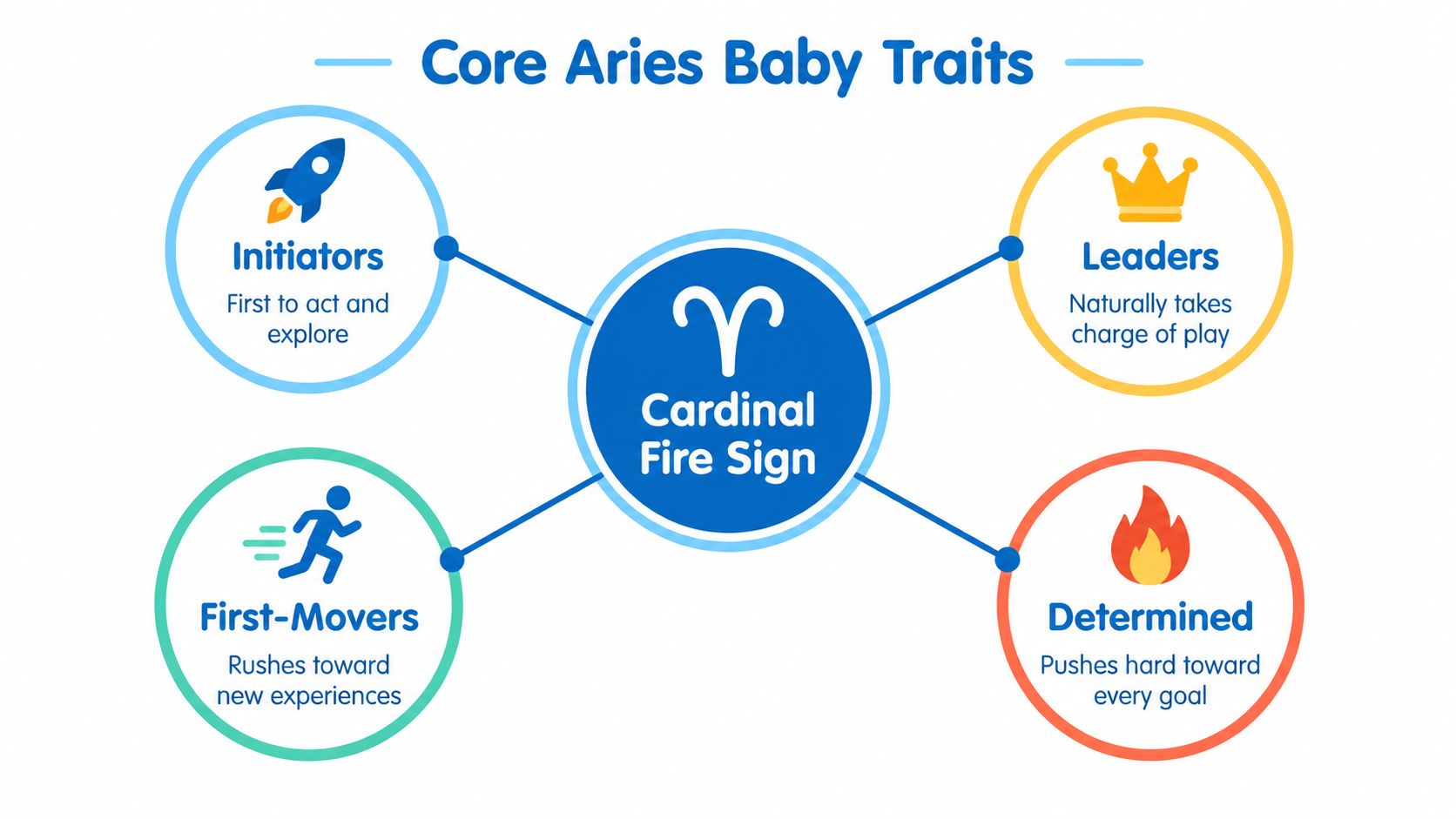
Aries is traditionally classified as a cardinal fire sign. In astrological language, cardinal signs initiate, while fire is associated with vitality, expression, and action. That combination creates the familiar Aries profile: a child who wants to begin, explore, test, and move toward the next experience.
The most helpful way to interpret these traits is to separate the strength from the challenge. A child's eagerness can support exploration, but it can also create safety risks. Assertiveness can become leadership, but it can also look like grabbing, interrupting, or insisting that play happen one way.
The main personality pillars
- Initiation: Aries babies are often described as first movers. They may reach for the unfamiliar object, attempt a new movement, or show interest in an activity before a caregiver expects it. Astrological descriptions connect this tendency with Mars, traditionally associated with drive, speed, and direct action. The Aries profile from Astrology.com presents this sign through that action-oriented symbolism.
- Independence: An Aries child may prefer trying something personally instead of watching a long demonstration. With an infant, that can appear as repeated attempts to reach, turn, pull, or reposition. With a toddler, it may become a determined “I do it” attitude. Offer safe choices, but don't confuse independence with readiness for every task.
- Leadership: Aries children are frequently portrayed as natural leaders who organize games and draw other children into activity. The constructive version is initiative and confidence. The difficult version is bossiness. A young leader needs practice with taking turns, listening, and noticing when another child wants a different role.
- Intensity: Energetic children often move quickly from interest to frustration. Their attention may be strongest when an activity feels active, immediate, or purposeful. Long explanations usually work less well than a short instruction followed by a chance to act.
A useful parenting question is, “What is my child trying to start?” The answer might be movement, contact, exploration, or a bid for your attention. Responding to that underlying need gives the behavior a direction instead of turning every moment into a contest.
Astrological tradition has described Aries-born people as determined and executive for centuries, so the leadership narrative didn't begin with modern parenting blogs. Still, symbolism isn't a diagnosis. Your baby may fit some descriptions, many of them, or none of them, and their actual needs should guide your response.
Beyond the Tantrum - The Sensitive Side of Aries
The most limiting description of an Aries baby is the fearless little warrior who only needs stronger discipline. That image misses an important emotional reality. Some Aries children may look tough, direct, or relatively unemotional while still being strongly affected by criticism, rejection, or the feeling that they aren't loved.
This sensitive side changes how a parent should respond to a difficult moment. A loud protest may not mean your child is trying to control the room. It may mean the child feels blocked, overlooked, embarrassed, tired, or suddenly unsure of their connection with you.
Why reassurance matters
Aries descriptions often emphasize quick tempers, but they also suggest that the emotional flare may pass quickly. The child who was furious about leaving the playground may recover and seek a cuddle soon afterward. That rapid reset can tempt adults to dismiss the earlier distress, especially when the child appears cheerful again.
Don't use the recovery as proof that the feeling was insignificant. A baby or toddler can move on quickly and still need you to help them feel secure. Calmly name what happened, restore connection, and hold the boundary without shaming the reaction.
Practical rule: Correct the behavior without attacking the child's character.
Try language such as, “You wanted that toy, and you were angry when I moved it. I won't let you hit. I'm here, and we can try again.” The words are short, emotionally accurate, and firm. They don't reward hitting, but they also don't turn frustration into a verdict about who your child is.
The criticism trap
A high-drive child may invite strong correction because they move quickly and create more visible mess or risk. Repeated labels such as “difficult,” “bossy,” or “too much” can land harder than adults realize, particularly for a child who is sensitive to feeling unwanted. The Aries guidance from Bounty highlights this less visible need for reassurance alongside the sign's quick-tempered reputation.
Use specific feedback instead. Say, “You waited while I opened the gate,” or, “You touched gently when the baby was sleeping.” This teaches the behavior you want while preserving the child's sense of capability. Confidence and sensitivity can exist together, and a child doesn't need humiliation to learn self-control.
Practical Parenting Tips for High-Energy Babies
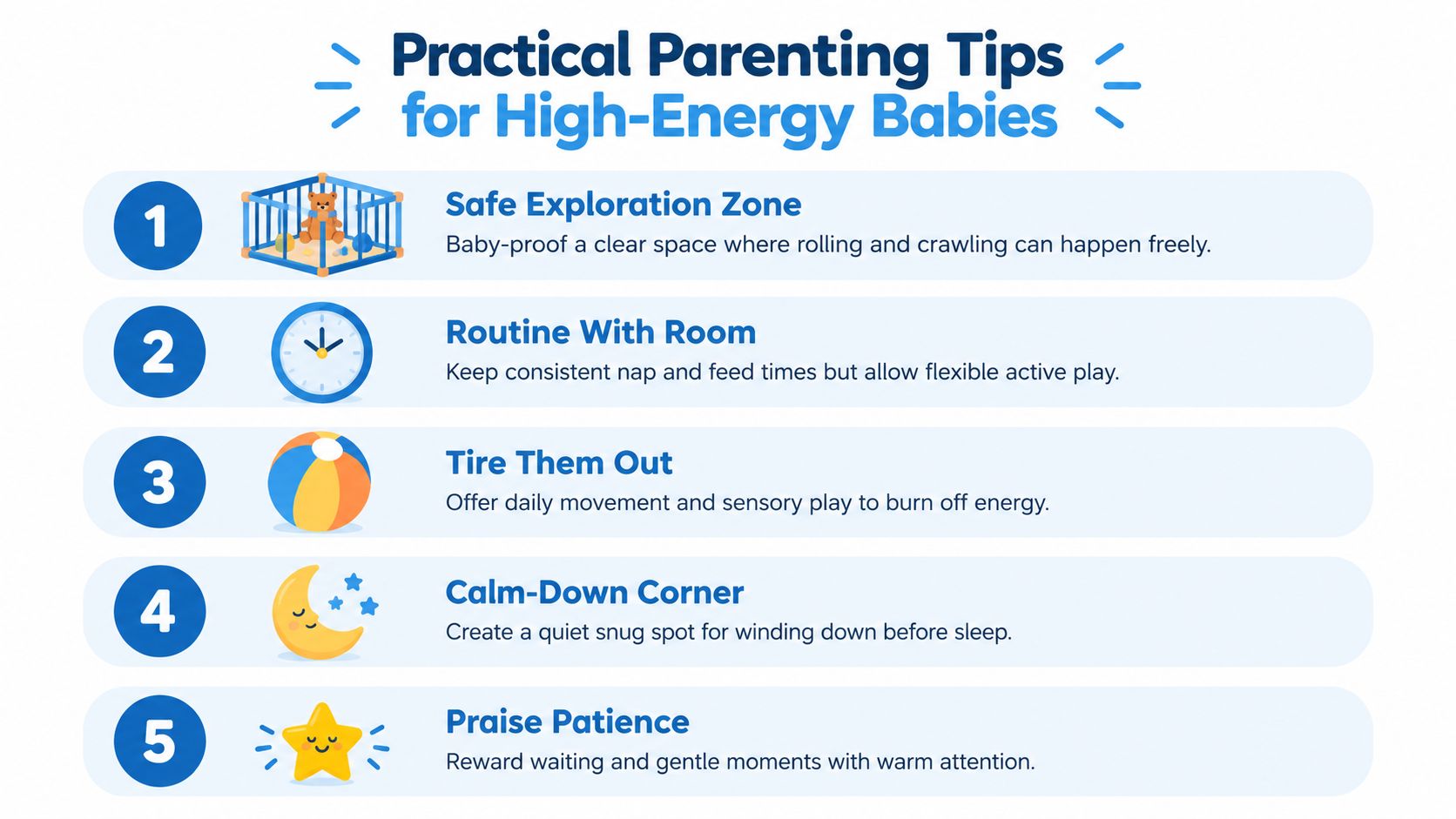
High energy responds better to structure and purposeful movement than to constant restriction. The aim isn't to suppress an Aries child's drive. It's to create safe ways to use it, while making the limits predictable enough that every transition doesn't become a fresh argument.
Build a home that supports movement
Start with a clear, baby-proofed exploration area. Remove hazards, secure furniture, and place approved objects within reach. A safe space gives your child room to roll, crawl, pull up, and investigate without requiring you to say “no” every few seconds.
Keep routines consistent, but don't make them rigid. Familiar feed, rest, and wind-down patterns can help an active baby anticipate what happens next. Within that framework, leave room for energetic play and changes in interest.
These strategies work because they reduce unnecessary battles. They don't work if they become another way to demand adult-level self-control from an infant. Babies still need co-regulation, supervision, and help stopping when their bodies are tired.
Give directions that match the moment
Use one clear instruction at a time. “Hands down,” “Come here,” and “Toy stays on the floor” are easier to process than a long explanation during an active moment. Once your child is calm, you can add the reason.
Offer controlled choices when both options are acceptable:
- “Do you want the blue cup or the green cup?”
- “Will you crawl to me or should I pick you up?”
- “Are we putting on the left sock or the right sock first?”
Choices give an independent child a sense of participation without handing over decisions that belong to the adult. If neither option is safe, don't offer a choice. State the boundary and help your child through the disappointment.
Movement can also become a cooperative task. Invite your baby to push a soft ball, carry a small safe object, find a hidden toy, or help place clothes in a basket. For families preparing for daycare, a practical daycare essentials guide can help turn daily preparation into a predictable sequence rather than a last-minute scramble.
Make calm a physical experience
A tired Aries baby may not respond to more stimulation, even when they appear determined to continue. Lower the lights, reduce noise, slow your voice, and use the same short wind-down cues each time. A quiet corner isn't a punishment space. It's a place where the nervous system can settle with an adult nearby.
Praise the pause, not only the achievement. “You waited,” “You stopped when I asked,” and “You used gentle hands” reinforce the patience that energetic children are still learning. Warm attention makes cooperation worth repeating.
Developmental Milestones and Aries Behavior
Astrological descriptions often connect Aries with early movement and a strong appetite for new experiences. Some baby-sign guides portray Aries children as eager to crawl, walk, talk, grab, or try an activity ahead of others. That language can feel familiar when your baby seems constantly driven toward the next physical challenge.
The important distinction is between astrological symbolism and developmental assessment. A birth sign can provide a playful lens for noticing your child's enthusiasm, but it can't predict when a baby will reach a milestone. Children develop at different rates, and a child who isn't an early mover is not failing to express their personality.
Support the attempt, not the comparison
When your baby reaches for a toy or tries to shift position, give them a safe opportunity to work. Place interesting objects within reasonable reach, vary supervised floor play, and allow time for effort before immediately stepping in. If your child becomes overwhelmed, offer assistance without taking over every attempt.
The Aries pattern is less about a specific age and more about the style of engagement described in astrology. Your child may approach new skills with urgency, repeat an action intensely, or show frustration when the body can't yet match the intention. Stay close, remove hazards, and celebrate persistence rather than treating development as a race.
A well-organized environment supports that curiosity. A nursery room essentials list can help you think through safe sleep, changing, storage, and play areas without turning the room into an obstacle course. The goal is a space where exploration can happen under supervision and rest remains protected.
If you have concerns about movement, communication, feeding, sleep, or emotional regulation, speak with your child's healthcare professional. Practical observation matters more than whether a horoscope seems to fit.
Aries Babies vs. Other Zodiac Signs
Aries is often described as more immediate and action-oriented than signs associated with steadier, more inward, or more emotionally reflective temperaments. A Taurus baby may be portrayed as slower to embrace change and comforted by familiar rhythms, while a Cancer baby is often described as especially responsive to closeness and atmosphere. These are symbolic comparisons, not reliable rules for predicting behavior.
The contrast can still help parents identify what they're seeing. An Aries-style pattern may look like reaching first, pushing toward movement, protesting delays, and recovering quickly after frustration. A child with a quieter temperament may watch longer before joining in, while another may prioritize physical comfort or emotional connection before exploration.
| Aries-style tendency | A different temperament may prefer | Helpful parent response |
|---|---|---|
| Immediate action | Observation before participation | Allow time without forcing engagement |
| Strong independence | More support during transitions | Offer closeness and simple choices |
| Fast frustration | Gradual adjustment | Preview changes and keep your voice calm |
| Leading play | Shared or parallel play | Teach turns without shaming initiative |
No sign is better than another. The energetic child brings enthusiasm and courage, while a more measured child may bring patience, sensitivity, or careful attention. Siblings can differ sharply even in the same home, so comparison should create understanding rather than competition.
Birth-season content can also be a lighthearted way to celebrate individuality, provided it doesn't replace what you observe. A keepsake or gift connected with a child's birth month, such as ideas found in this guide to babies born in October, can mark family memories without assigning a fixed personality to the child.
Embracing Your Little Warrior's Spirit
An Aries baby's independence is a strength when adults provide safe limits, clear routines, and room to try. Their intensity becomes easier to guide when parents remember that a bold exterior may conceal a child who needs reassurance after criticism or frustration.
Your job isn't to extinguish the fire. It's to teach your child how to use it with patience, empathy, and care for other people. Thoughtful gifts for new parents can celebrate that demanding, joyful beginning, but the most valuable support remains steady connection.
InchBug offers customizable labels and personalized essentials for bottles, clothing, shoes, bags, lunch boxes, and daycare gear, helping families keep busy children's belongings organized. Explore practical options for your active little one at InchBug, and make everyday routines a little easier to manage.