

By Friday afternoon, the name on your child's water bottle may be little more than a pale outline. It started the week bright and easy to read, then spent sunny hours on a cubby shelf, traveled through a backpack, met sticky hands, and went through another wash. At pickup, you're left wondering whether UV resistant labels are a real solution or just another cheerful phrase on a product page.
The useful answer begins with testing, not material names alone. A durable label needs to protect its printed name from sunlight while also holding its shape, resisting moisture, and staying attached through ordinary daycare handling. This guide translates the science into the question parents care about: will the name still be readable at the end of summer?
What UV Resistant Labels Really Mean for Busy Families
UV resistance means a label can maintain its color contrast, readability, and physical integrity after exposure to ultraviolet radiation. Sunlight is the obvious source, but reflected glare and some indoor lighting can also contribute to gradual fading. A bottle left in direct sun will face a much tougher test than one kept inside a shaded cubby.
That makes UV resistance a spectrum, not a yes-or-no switch. A basic printed sticker may look fine indoors but lose contrast outdoors. A label made with a stable synthetic face stock, protective ink system, and clear UV-blocking laminate has several layers working together to slow that change. The label's adhesive and backing must also remain stable, because a readable print is no help if the whole piece lifts from the bottle.
The history helps explain why today's options are more capable than older stickers. Commercial outdoor-grade vinyl, UV-resistant inks, and clear laminates became practical in the 1990s, allowing laminated labels with embedded UV inhibitors to survive roughly five years of direct sun instead of fading in months, as described in this history of outdoor label UV weatherability. The peel-and-stick backing itself has an earlier milestone, with a patent dating to 1935.
Parent-friendly translation: UV resistance protects the name from becoming hard to read. It doesn't automatically promise that the adhesive will survive every dishwasher, sanitizer, or scrape.
For daycare gear, the distinction matters. A name label on a lunchbox may spend most of its life indoors, while a bottle can move between a sunny playground, a hot car, a refrigerator, and a dishwasher. If you're comparing options, InchBug's weatherproof label guidance is useful because it keeps the conversation focused on the full label construction rather than a single marketing word.
How UV Protection Actually Works on a Label
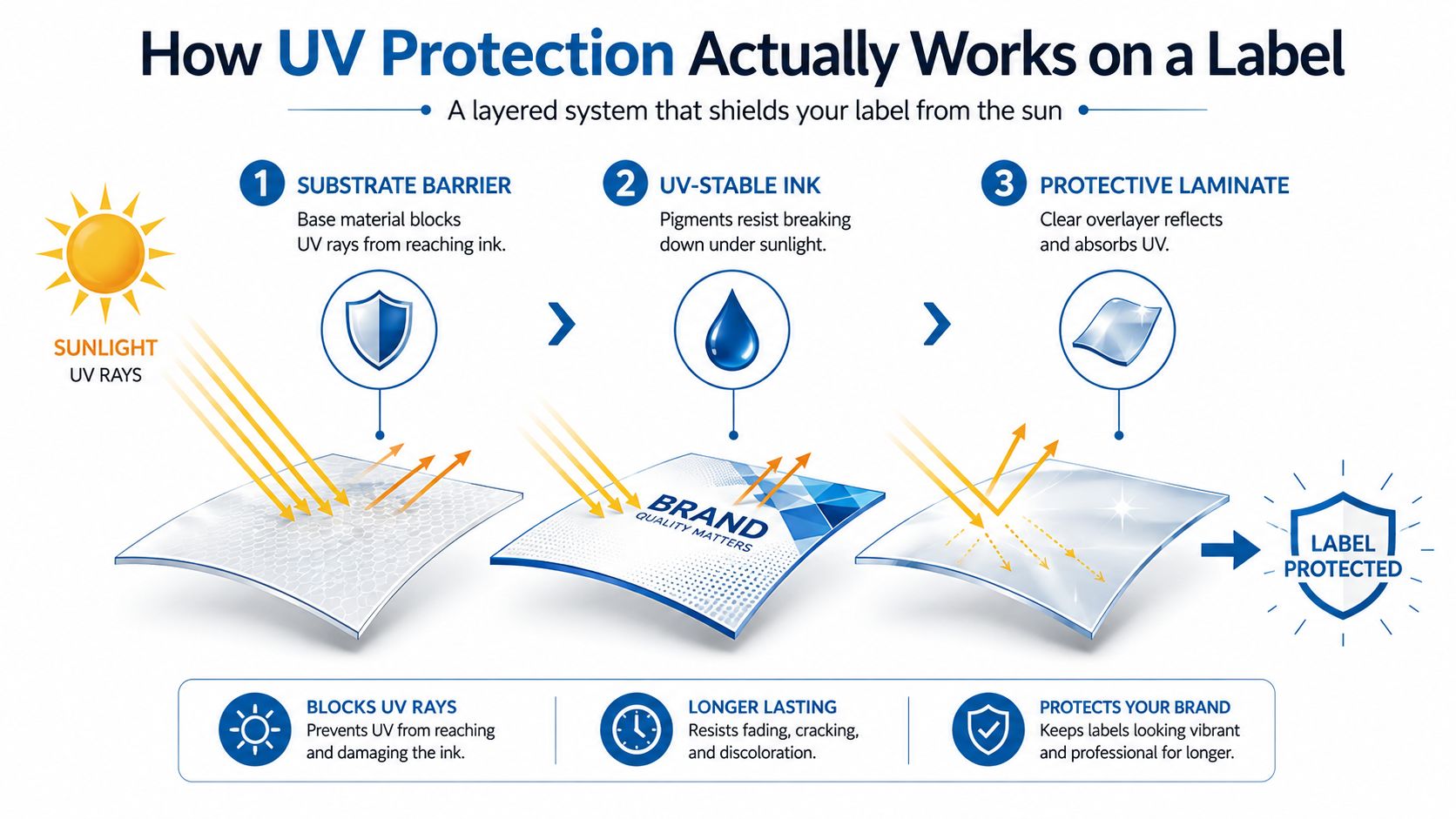
A label protects printed information much like sunscreen protects skin. One product may block some radiation, absorb another portion, and create a physical barrier against rubbing. UV protection works best as a layered system, not as a thick piece of one material.
The three layers that share the work
The substrate, or face stock, gives the label its physical body. PET, also called polyester, provides dimensional stability and forms a dependable base for outdoor applications. A UV-protective coating or overlaminate then helps limit the radiation reaching the print.
The ink layer carries the child's name, phone number, or symbol. Its pigments or dyes need to resist breaking down when light reaches them. Dark, high-contrast lettering can remain easier to read as subtle fading begins, but ink stability still matters.
Finally, the clear laminate or topcoat acts as a sacrificial shield. It reduces direct contact with water, detergent, fingernails, lunchbox friction, and continued sunlight. A thin PET label with stable ink and a suitable overlaminate can outperform a thicker sticker whose print system has poor light stability.
This is similar to tinted car windows, UV-blocking sunglasses, and a clear phone protector. The window doesn't need to be bulky to reduce glare, and the phone protector doesn't make the phone indestructible. Each layer prevents a different kind of damage from reaching the surface.
A label's surrounding environment also matters. Homeowners comparing ways to reduce sunlight through glass may find this explanation of Superior Home Improvement energy-efficient windows helpful, because the same basic idea applies: reducing UV exposure before it reaches a vulnerable surface slows degradation.
For parents, the practical lesson is straightforward. Ask whether the label includes a protective laminate, what face stock carries the print, and whether the maker has tested the complete construction. InchBug's label durability testing information offers useful context for thinking about labels as systems rather than isolated materials.
The video below provides another visual way to understand how protective layers work:
PET, Vinyl, and Paper Compared for Outdoor Durability
Material names can make shopping feel simpler than it is. PET, vinyl, and laminated paper each have a place, but they suit different levels of sunlight, washing, bending, and abrasion.
PET or polyester is generally the strongest choice for gear that sees repeated outdoor exposure. Independent guidance commonly rates polyester with UV acrylic and overlaminate for three to five years outdoors, while vinyl with comparable protection is also often rated for three to five years on conformable surfaces. Laminated paper usually falls into a shorter one-to-three-year range, according to this comparison of UV protection for outdoor labels.
| Material | UV Resistance | Typical Lifespan | Best Daycare Use |
|---|---|---|---|
| PET or polyester | Strong when paired with UV protection | 3–5 years outdoors with UV acrylic and overlaminate | Daily water bottles, lunchboxes, and gear exposed to sun |
| Vinyl | Flexible and suitable for curved surfaces | 3–5 years outdoors with UV acrylic and overlaminate | Squeeze bottles, shoes, helmets, and irregular surfaces |
| Laminated paper | More limited under moisture and direct sun | 1–3 years in suitable conditions | Indoor cubbies, folders, and short-term supplies |
These ranges describe material guidance, not a guarantee for every child's bottle. Adhesive choice, surface preparation, washing, temperature changes, and rubbing can shorten real-world life. A vinyl label may be the smarter fit for a flexible bottle because it conforms instead of resisting the curve, even if PET offers a more rigid and stable face.
Laminated paper can still be sensible for an item that stays indoors. If you're labeling a take-home art folder or a classroom bin, its lower exposure may make the entry option adequate. For a bottle that lives on a sunny playground shelf, a synthetic face stock provides more reassurance.
A simple match: Choose PET for stable, washable gear, vinyl for curved or squeezable items, and laminated paper for sheltered, temporary use.
Before ordering, check the shape of the item as carefully as its exposure. InchBug's waterproof vinyl label information can help when a flexible surface needs a label that follows its contours rather than pulling away at the edges.
The Testing Standards Behind Fade Resistance Claims
A claim such as “fade resistant” becomes more useful when it includes a test method, exposure duration, and pass condition. Without those details, shoppers can't tell whether the claim describes a complete label or only an attractive piece of film.
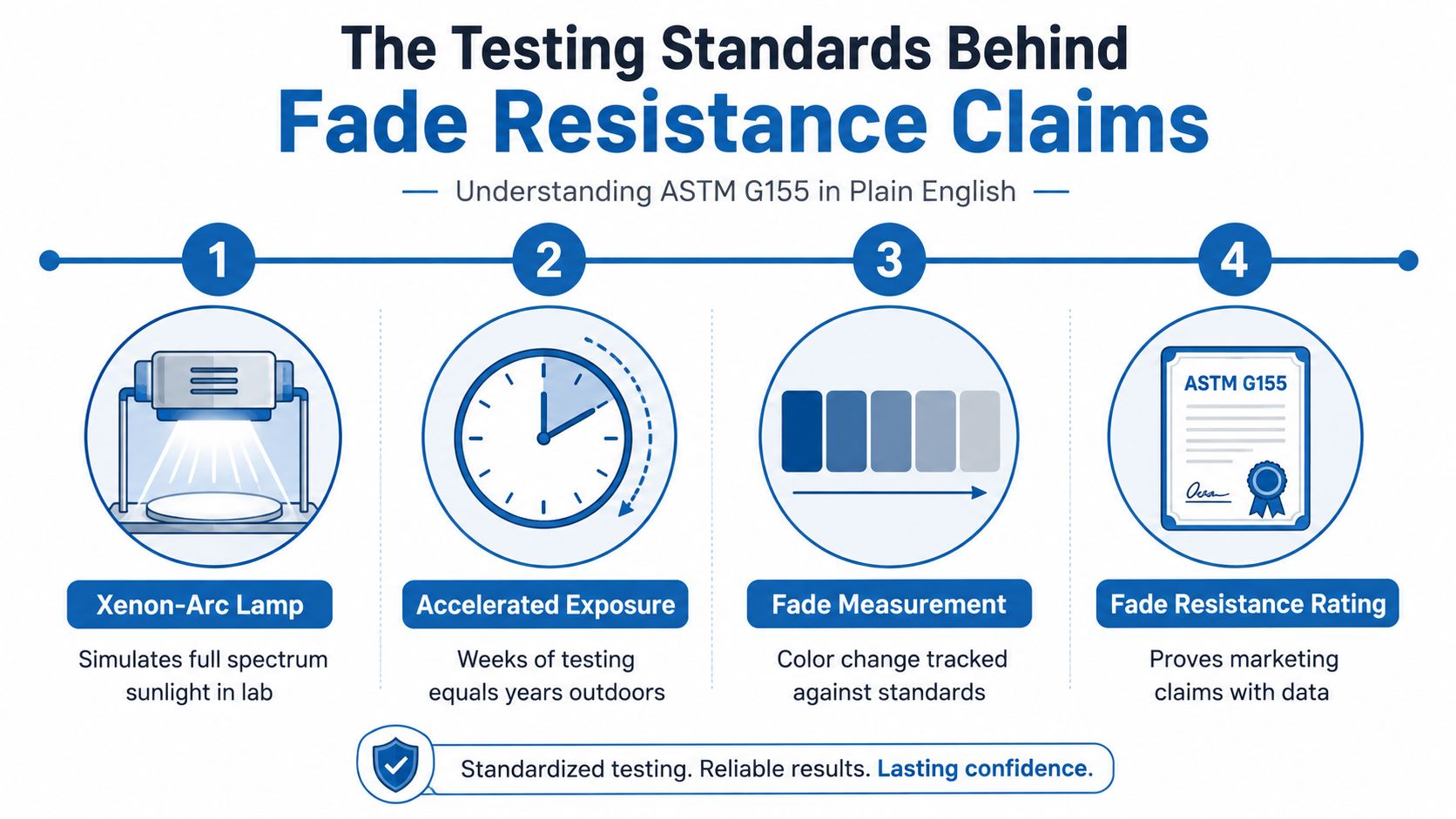
ASTM G155 is one important weathering method. It uses a xenon-arc lamp to expose materials to simulated sunlight, heat, and moisture under controlled laboratory conditions. The test doesn't recreate every daycare experience, but it gives product teams a repeatable way to compare constructions.
Some industry guidance uses 1,000 hours of UV exposure with no significant fade as a benchmark, while lower-grade labels may show noticeable fading after 200 to 400 hours, as explained in this technical overview of UV protection for outdoor labels. Those figures are laboratory exposure measures, not a universal promise of a particular number of school years. Climate, angle of sunlight, washing, and handling all change the result.
What to ask before trusting the number
A high-hour result is meaningful only when you know what was tested. A PET face stock alone may perform differently from the finished label with ink, laminate, adhesive, and printed color.
Look for these details:
- Test method: Is the result tied to ASTM G155 or another named weathering protocol?
- Complete construction: Did the test include the actual ink, laminate, and adhesive?
- Exposure duration: How many hours were recorded, and what happened afterward?
- Acceptance criteria: Did the maker define an allowable color change or a legibility requirement?
A technical datasheet for one weather-resistant label specifies 12,500 hours under ASTM G155 Cycle 1 xenon-arc testing, as shown in this Brady weather-resistant label datasheet. That figure illustrates why test method and exposure duration belong together. It doesn't mean every label with a similar material name will produce the same result.
Parents who want to explore the broader world of printed outdoor graphics can also review examples of fade proof outdoor signs. For a daycare purchase, though, you still need to ask how the label handles washing and rubbing, not only sunlight. InchBug's product durability testing guidance is another useful reference for reading performance claims with more care.
Why UV Resistance Is Not the Whole Story
A label can pass a sunlight test and still fail on Tuesday morning. In family life, the dishwasher, detergent, sanitizer, and backpack zipper may attack the label more often than the sun does.
Dishwasher heat can soften or weaken an adhesive. Detergent can work its way into small edge openings. Repeated rubbing against a lunchbox wall or zipper can scuff the laminate and eventually expose the print. A cold bottle can also create a problem called adhesive cold flow, where the adhesive shifts or loses edge control as temperatures change.
The useful mental test is simple. If sunlight were the only serious enemy, a patio chair would be the hardest object to label. A daycare bottle has a busier life. It gets handled, washed, chilled, squeezed, dropped, and packed tightly beside other gear.
| Stress Factor | How It Damages the Label | Typical Failure Sign |
|---|---|---|
| Sunlight | Breaks down vulnerable pigments and face-stock components | Faded name or reduced contrast |
| Dishwasher heat and detergent | Weakens the adhesive and attacks exposed edges | Curling, bubbling, or lifting |
| Sanitizer and cleaners | Can affect inks, coatings, or adhesive chemistry | Dull surface, smeared print, or loss of bond |
| Backpack and lunchbox abrasion | Scratches the laminate and print surface | Scuffs, missing corners, or unreadable characters |
| Temperature changes | Encourages adhesive movement and edge stress | Corners lifting from a cold or warm container |
The practical standard: A label should be judged by the complete routine, not by the sun exposure it can tolerate in isolation.
This is why a “waterproof” or “UV resistant” badge shouldn't end the conversation. Ask whether the construction was evaluated for the conditions your child creates every day. A label that stays colorful but peels away has still failed its job, and a label that remains attached but loses the child's name is equally unhelpful.
UV protection remains valuable, especially for bottles and outdoor equipment. It belongs beside adhesion, abrasion resistance, chemical tolerance, and wash performance on the shopping checklist.
Buying and Caring for Labels That Last
Start with the surface and routine, not the decoration. A bottle that spends time outdoors and in a dishwasher needs a different construction from a folder stored in an indoor cubby.
Use the buying checklist
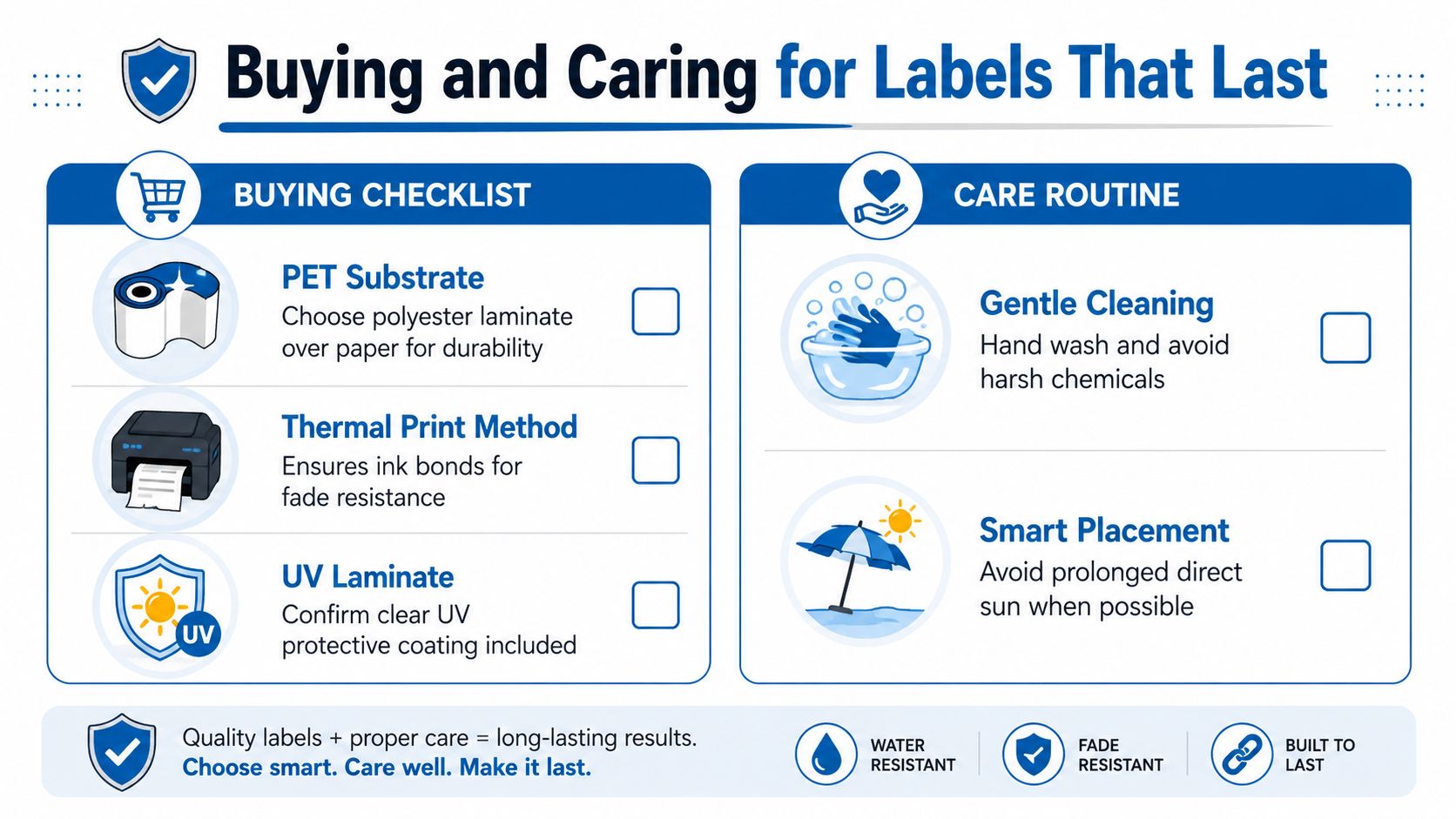
Choose PET or polyester laminate for demanding gear. Synthetic face stocks generally handle moisture and outdoor exposure more confidently than paper. Vinyl can make more sense when the surface bends or squeezes.
Confirm the print protection. Look for a UV-blocking laminate or topcoat and a stated print method. Thermal transfer, UV-cured ink, or another documented system is more informative than a bare promise that the label is “durable.”
Inspect the edges. Rounded corners and well-sealed edges give children fewer places to catch with a fingernail. Sharp corners can lift sooner when a bottle rubs against a lunchbox.
Ask about the adhesive. Acrylic-based adhesives are commonly selected for resistance to heat, moisture, cleaners, aging, and outdoor exposure. The adhesive still needs a clean, dry surface and enough time to bond.
Avoid glossy paper presented as a universal outdoor solution, and be cautious when a product uses “waterproof” without naming its test conditions. If the maker can't explain the substrate, protective layer, and intended washing routine, the claim leaves too much unanswered.
Give the label a fair chance
After application, press the label firmly onto a clean, dry surface and allow the adhesive to settle before washing. Hand-wash when you need maximum control, and follow the maker's instructions for dishwasher placement and cleaning products. Avoid assuming that a strong laminate makes harsh bleach or citrus-based cleaners harmless.
A simple do-this-not-that routine helps:
- Do wait before the first wash. Don't apply a label and place the item immediately into a hot cleaning cycle.
- Do use gentle cleaning when possible. Don't scrub the printed surface with an abrasive pad.
- Do protect the edges. Don't place a newly labeled bottle where zippers or rough seams will catch the corners.
- Do remove old labels from retired gear. Don't leave peeling material in place to collect dirt or interfere with a replacement.
For more detailed everyday guidance, see InchBug's label care instructions. When a child's bottle or lunchbox matters, careful placement and cleaning habits can preserve the label just as surely as choosing a stronger material.
Quick Takeaways Before You Order
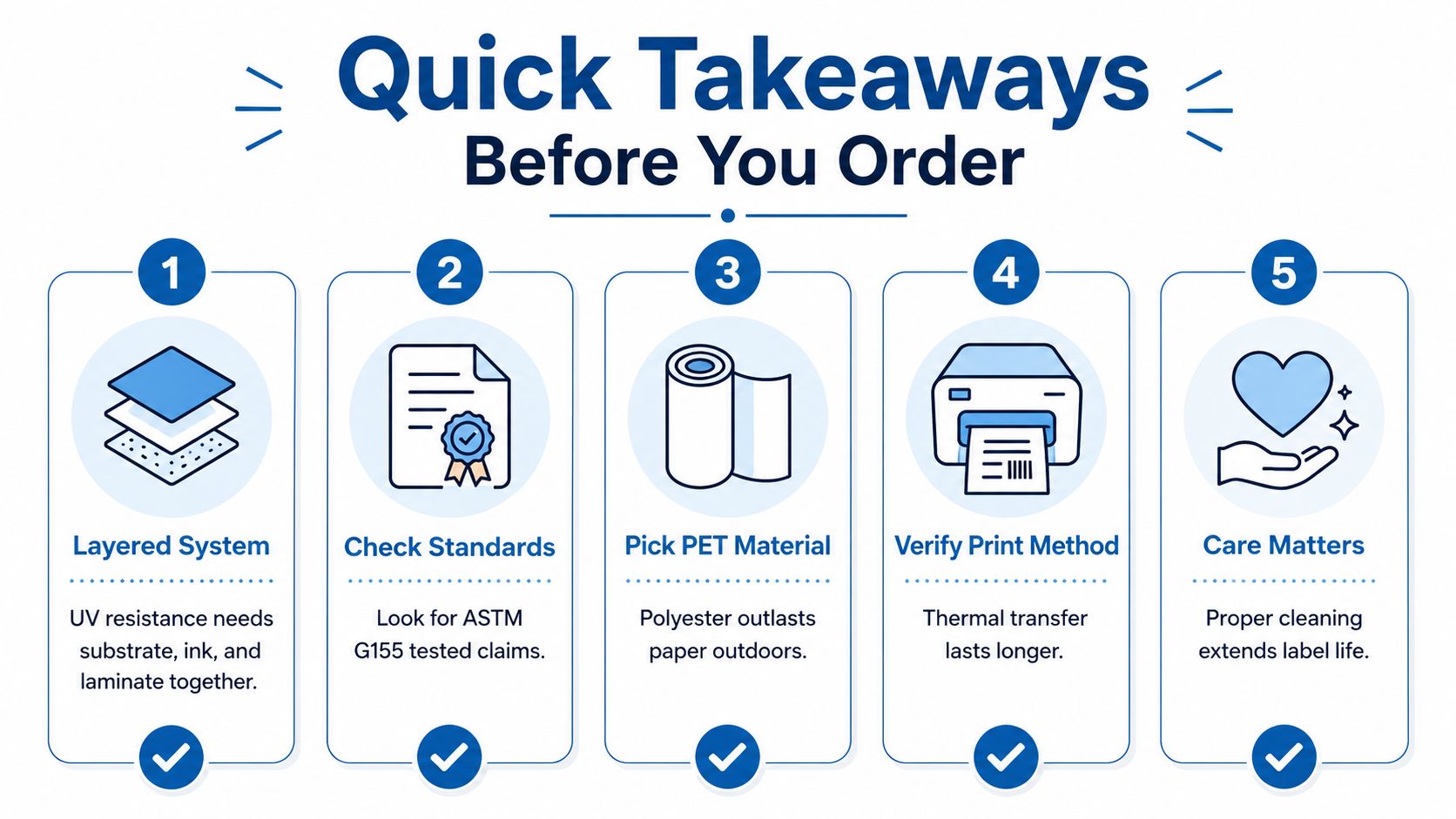
The shortest useful explanation is this: UV resistance is a team effort. The substrate provides stability, the ink supplies readable color, and the laminate shields the surface. A material name by itself can't tell you how the finished label will behave.
Keep these five points beside you while ordering:
- Think in layers. A synthetic face stock, stable ink, and protective laminate should work together.
- Look for a named standard. ASTM G155 and a stated exposure duration tell you more than “fade resistant” alone.
- Match the material to the object. PET or laminated polyester suits sun-exposed, stable gear. Vinyl fits flexible or squeezable bottles. Paper belongs on sheltered items.
- Check the whole routine. Dishwasher heat, cleaners, backpack friction, and temperature changes can defeat a label before fading becomes obvious.
- Treat care as part of durability. Apply to a clean surface, allow the adhesive to settle, and use gentle cleaning when the name needs to remain clear.
The mental model is easy to repeat to a partner or teacher: layers protect the print, testing explains the claim, and care protects the bond. Measure the containers before you order, choose the construction that fits each item, and reserve the most demanding labels for bottles, lunchboxes, shoes, bags, and gear that face sun and repeated handling.
If you're ready to organize your child's everyday gear, visit InchBug to explore customizable labels and personalized essentials for bottles, lunchboxes, clothing, shoes, bags, and sports equipment. Choose the material and format that match your child's routine, then apply the care habits that help the name stay readable through daycare days.