

By the time you notice the problem, it usually looks small. A hoodie in the wrong cubby. Spare leggings with no obvious owner. A daycare teacher holding up two nearly identical navy sweaters at pickup and asking, politely but with tired eyes, “Whose is this?”
For families, size labels for garments sound like a fit issue. In real life, they're also an ownership issue. If you've ever sorted a bag of damp daycare clothes while trying to figure out whether the 4T shirt is yours, whether it runs small, and whether your child can even wear it next week, you already know the label matters more than people admit.
The Chaos of Unlabeled Garments
Monday morning clothing chaos has a very specific look. Tiny socks that all seem to come from the same factory. Three blue hoodies from three different families. A backup outfit rolled into a gallon bag, then separated from that bag sometime between snack, art, and nap.
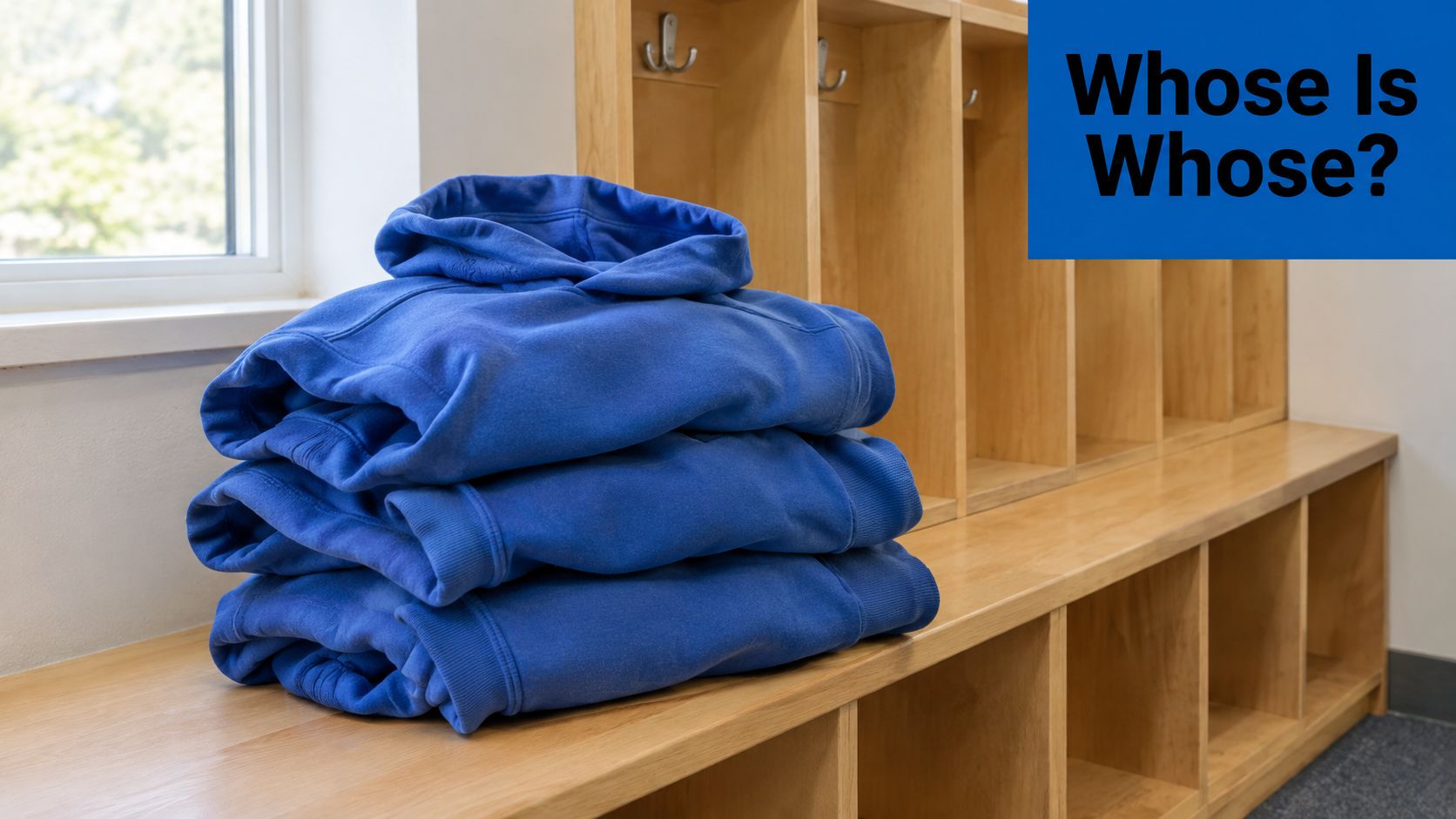
Most parents start with the manufacturer tag and assume that's enough. It isn't. A printed “3T” helps with fit, but it doesn't tell a daycare worker which child owns the shirt, whether it belongs in the extra-clothes bin, or whether that sweater was supposed to go home Friday and didn't.
Where mix-ups actually happen
The trouble usually shows up in a few predictable spots:
- Outerwear at drop-off: Coats and sweatshirts come off fast, especially when several children arrive at once.
- Spare clothes after accidents: Clean changes get used, folded, and sent back in a hurry.
- Nap-time layers: Cardigans, socks, and light blankets move from cot to cubby and back again.
- Hand-me-down bins at home: Siblings inherit clothes, but the labels no longer match the child wearing them.
Keep this practical: a size tag tells you what the brand intended. A name label tells everyone else what to do with the item.
That's the gap families run into. The inside tag may still be technically accurate, but for daily life, one label isn't doing enough work. Good labeling cuts down on lost clothing, reduces awkward pickup conversations, and saves you from re-buying basics you already own but can't locate.
The simple fix people overlook
Parents often focus on lunch boxes, bottles, and shoes first. Clothing gets treated as the harder category, so it stays half-solved. But garments are exactly where a simple system pays off fastest.
The useful mindset is this: fit information and identification are two different jobs. Once you separate those jobs, the whole clothing-label question becomes much easier to manage.
What Size Labels for Garments Actually Are
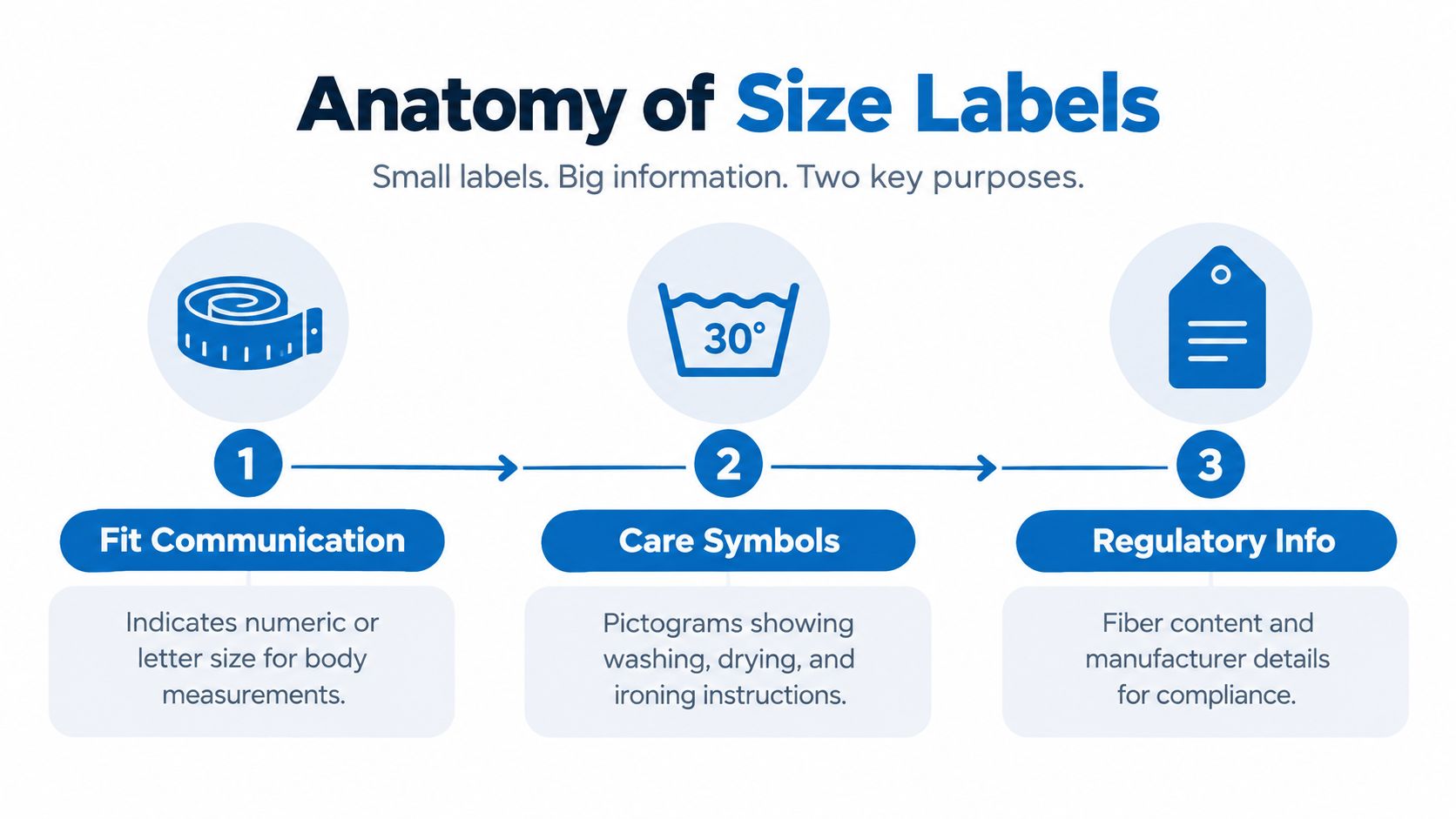
A garment size label is an information tag. It tells you the body size the garment is meant to fit, or at least what the brand says it fits. It often sits next to other label functions like care instructions, fiber content, and manufacturer details.
Why the same size can mean different things
A lot of family frustration starts. U.S. sizing became more standardized in the mid-20th century after large measurement surveys and government efforts. In 1939, the USDA measured 15,000 women, then a 1949 study helped lead to the 1958 standard, which offered women 32 sizes. That standard was updated in 1970, but the U.S. Department of Commerce withdrew the women's clothing size standard in 1983, which left brands freer to define their own sizing, as outlined in Seamwork's history of clothing sizes.
That history matters because it explains why a “4” or “3T” can drift from brand to brand. Number and letter labels feel official, but they aren't a universal language in the way most shoppers expect.
If you've ever tried to compare clothing charts outside your own household, the same logic even shows up in niche categories. A guide like how to measure your cat for clothes is useful for the same basic reason: measurements are clearer than assumptions.
What standards try to do
International standards move toward body measurements rather than vague size names. ISO developed multiple size-designation standards in the late 1970s for different garment categories, and later work such as ISO 8559-2:2017 continues that approach by specifying primary and secondary dimensions for garments based on body measurements, as described in the ISO standards catalogue.
The idea is simple. Labels are more useful when they point to actual body dimensions instead of relying only on a nominal size like S, M, or 4T.
A size label works best when it reduces guessing. It works worst when it gives a familiar code with no shared meaning.
For parents buying secondhand, receiving hand-me-downs, or packing daycare backups, that matters. The original size tag can help, but only if you treat it as a starting point, not final truth.
The two label jobs families need
For daily family use, it helps to think in two lanes:
- Informational labels show size, care, and garment details.
- Identification labels show ownership, such as a child's name or family identifier.
Sometimes both jobs can sit near each other on the same garment. If you're trying to figure out where clothing labels usually sit and how big they tend to be, this guide on the size of clothing labels is a practical reference.
Types of Garment Size Labels and How They Differ
Not all clothing labels solve the same problem. Some are built for the life of the garment. Some are built for speed. Some are excellent for a preschool sweatshirt and terrible for a soft baby onesie.
The main categories
The most common label types families run into are:
- Sewn-in woven labels that stay attached long-term and handle frequent washing well.
- Printed fabric labels that feel flatter and softer but can become harder to read over time.
- Plastic hang tags that help at the point of sale, then disappear as soon as the garment is worn.
- Adhesive clothing labels that attach to care tags or fabric, depending on the product design.
- Silicone or wrap-style bands used more often on gear than on garments, but still part of some family systems.
Below is the fast comparison most parents need.
Garment Size Label Types at a Glance
| Label Type | Material | Durability | Best For |
|---|---|---|---|
| Sewn-in woven label | Woven fabric | High | Long-term garments, uniforms, hand-me-downs |
| Printed fabric label | Fabric with printed text | Medium | Soft everyday basics where comfort matters |
| Plastic tag label | Plastic or cardstock with fastener | Low after purchase | Retail display and initial size identification |
| Adhesive clothing label | Sticker-style label | Medium, varies by use | Daycare clothes with existing care tags |
| Silicone sleeve band | Flexible silicone | High for gear, limited for garments | Accessories or items with loops or straps |
What works and what doesn't
Sewn-in woven labels last. That's their main advantage. If you're managing a shared hand-me-down system across siblings or cousins, woven labels make sense because they don't rely on sticky adhesive and they stay readable.
Printed labels feel gentler against skin, which matters for younger children. The trade-off is that softness and longevity don't always travel together. If the print fades or the edges curl, the label may still be attached while no longer being useful.
Adhesive labels are what many busy families choose first because they're fast. That's a smart choice in plenty of cases, especially when you need to label a week's worth of daycare clothes tonight, not someday. The weakness is predictable: some labels eventually lift, especially if they're applied to the wrong surface or pushed through high heat over and over.
Practical rule: The easier a label is to apply, the more carefully you need to match it to the garment and laundry routine.
Placement matters as much as label type
A good label in a bad spot still fails. Neck areas are easy to find, but not always comfortable. Side seams can be less irritating. Care tags are often ideal because they're already there and easy for staff to check quickly.
If you want a visual sense of where sewn labels sit on sleepwear and why placement affects comfort, this piece on perfect label placement on pyjamas is worth a look.
For families focused more on ownership than retail-style sizing, products like personalized name tags for clothes are often more practical than replacing the original size tag itself. That's usually the better move. Keep the manufacturer size label for fit reference, then add a separate ownership label that does the daycare job.
How to Choose the Right Label System for Your Family
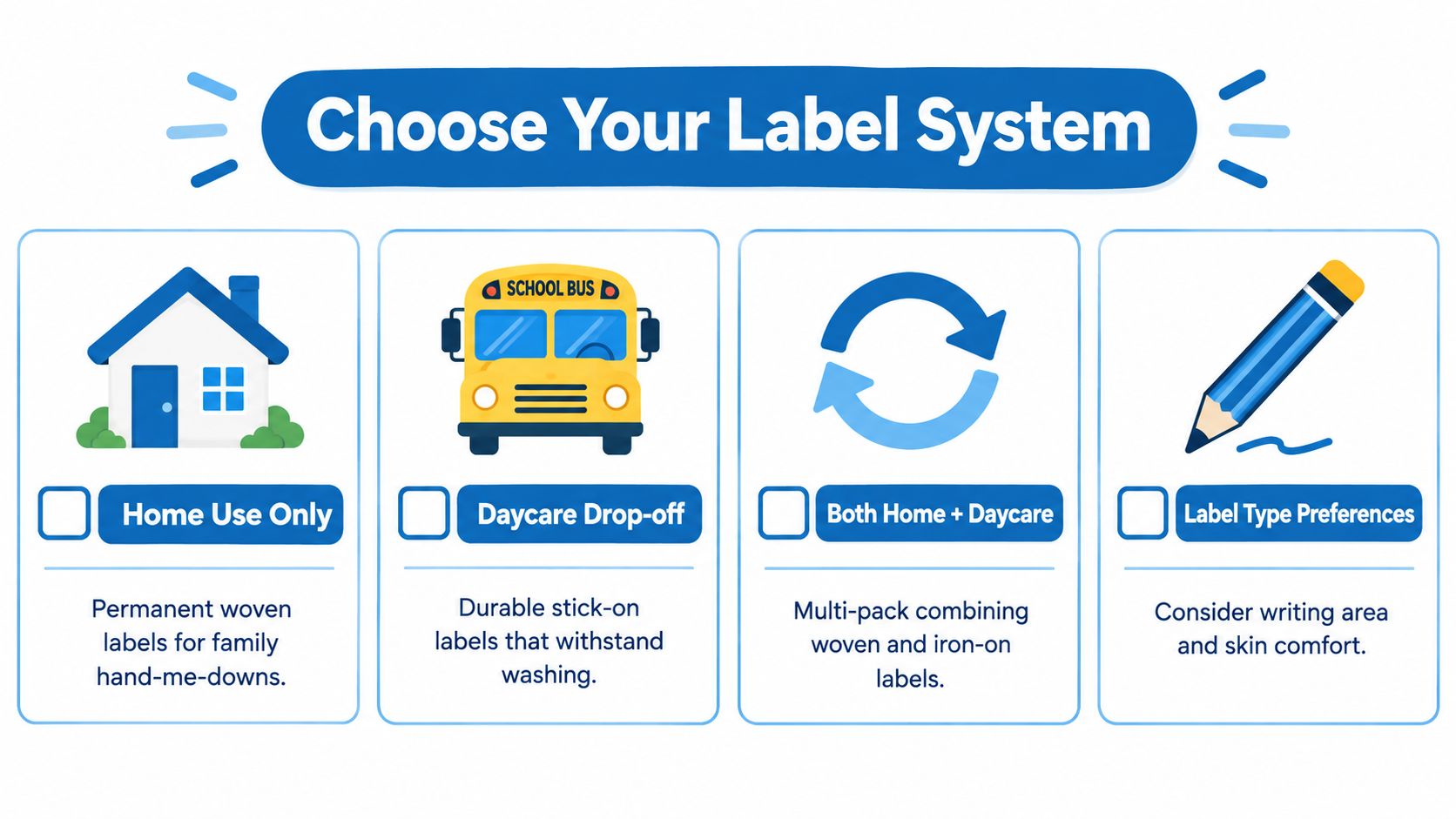
The right system depends less on the garment and more on your routine. A family that mostly dresses at home and hands clothes down to younger siblings needs one thing. A family sending backup outfits to daycare every weekday needs another.
Start with the real use case
Ask four questions before you buy anything.
- Where will the garment spend its time: mostly at home, mostly at daycare, or moving constantly between both?
- How often will it be washed: occasional wash, frequent machine wash, or heavy rotation with heat drying?
- Does the child outgrow clothes quickly: if yes, you may want something easy to update rather than highly permanent.
- Do you need one label to do two jobs: some families only need ownership; others also want quick size visibility for sorting bins.
If your child is in a rapid growth phase, don't overbuild the system. A permanent sew-in solution for every single T-shirt can be more work than the clothes justify. Save that effort for coats, sweaters, uniforms, and pieces likely to be passed down.
A simple decision matrix
| Situation | Strongest option | Why it fits |
|---|---|---|
| Home use and hand-me-down storage | Sewn-in or woven labels | Stays with the garment over time |
| Daycare daily rotation | Adhesive labels on care tags | Fast to apply and easy for staff to spot |
| Both home and daycare | Mixed system | Permanent labels on core items, quicker labels on basics |
| Sensitive skin or delicate knits | Soft printed or small-format labels | Less bulky and more comfortable |
A mixed system is what works for many families. Use durable identification on high-value or high-loss items like outerwear. Use quicker labels on leggings, extra shirts, and backup clothes that cycle fast.
What to prioritize when you're tired and busy
Readability beats elegance. If daycare staff can't find the name fast, the label hasn't done its job. Durability matters, but so does placement. A label hidden deep in a seam may survive forever while still being useless in the moment you need it.
One practical option in this category is clothing labels designed for children's garments, such as InchBug's TagPal labels, which are made for naming clothes without replacing the garment's original size information. That kind of setup works well when you want the size tag to stay intact and the ownership marker to do the daily heavy lifting.
Sizing and Labeling for Kids in Daycare Settings
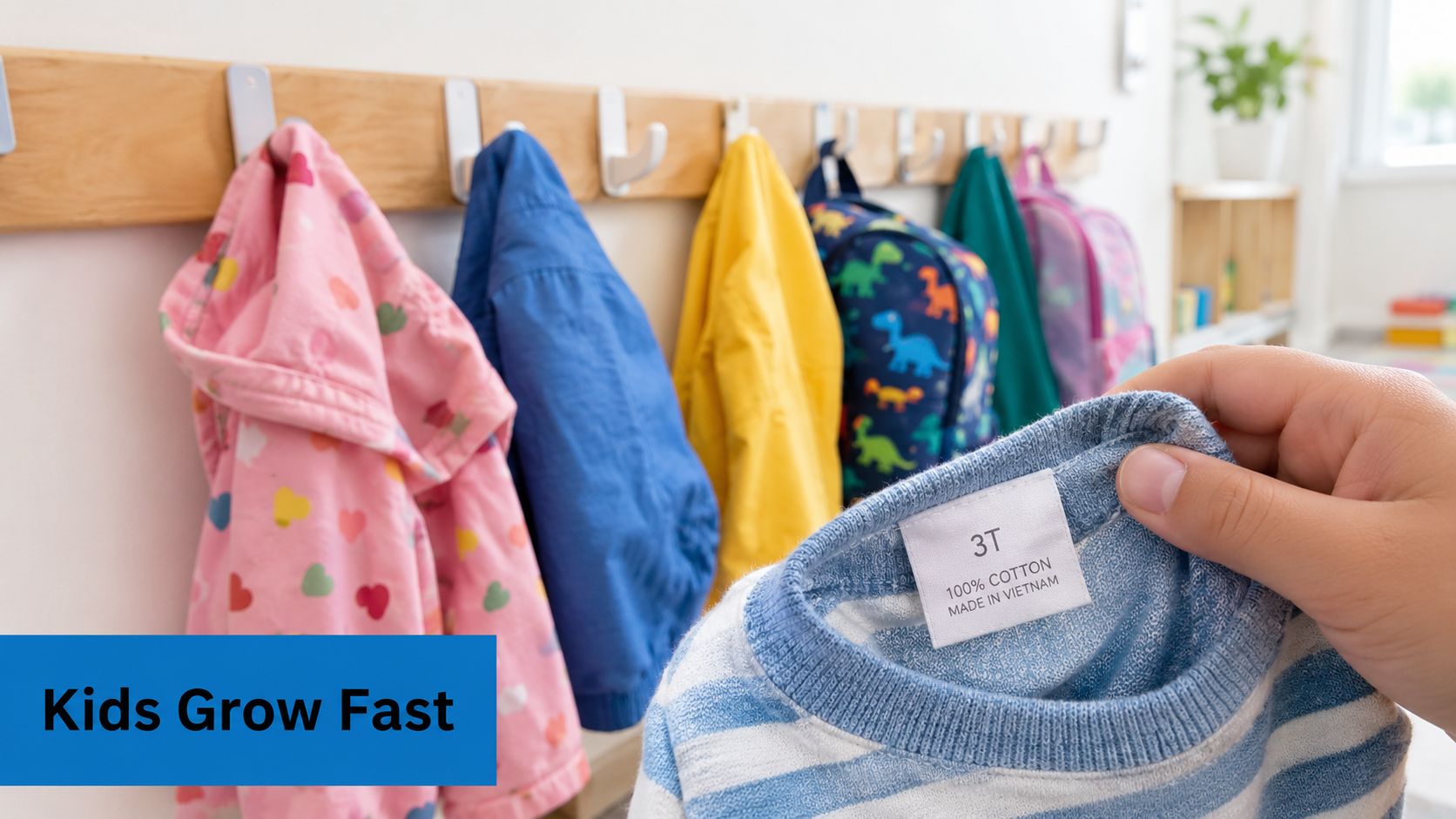
Children's clothing has two built-in problems. The first is obvious. Kids outgrow sizes fast. The second is the one parents underestimate. Daycare staff don't have time to decode three brands' idea of 2T while twenty other things are happening at once.
One study noted that over 98% of respondents reported noticing size variations, and it also points to confusion when multiple size systems appear on the same garment, according to this research on consumer interpretation of clothing size labels. That confusion gets sharper in daycare because garments move quickly between adults who didn't buy them, didn't fit-test them, and may be sorting several children's items at once.
Why the manufacturer tag isn't enough
A factory size tag tells staff almost nothing about ownership. Even fit can be misleading when one brand's size runs differently from another's. In daycare, the useful question usually isn't “What size did the brand assign?” It's “Whose clean shirt is this, and can I identify it fast?”
That's why a dual-label approach works better than relying on one tag alone:
- Keep the original size label for fit reference and future hand-me-down sorting.
- Add a clear ownership label that survives washing and stays readable.
- Use consistent placement so staff know where to look every time.
For baby and toddler clothes, consistency matters more than perfection. A slightly plain label in the same spot on every shirt beats a clever system nobody can find.
Extra needs families shouldn't ignore
Some children also need labels that flag more than ownership. Allergy alerts, sensory considerations, or instructions about spare clothing can matter just as much as the name.
Daycare labeling works when another adult can understand it in one quick glance.
If you want a practical walkthrough focused specifically on younger children's clothing, how to label baby clothes for daycare is a useful starting point. The broad principle holds across ages: use the garment's size label for fit, then add a second label that solves the world handoff problem.
Caring for and Washing Your Garment Labels
A label only helps if it stays attached and readable. “Washable” sounds reassuring, but labels fail in different ways. Some peel. Some crack. Some stay on the garment while the text fades enough to become useless.
What usually shortens label life
Heat is a common culprit. So is rough placement. Labels attached near edges that rub constantly can lift sooner, and labels placed on stretchy areas may distort if the product wasn't designed for that movement.
The care routine should match the label type, not the marketing word on the package.
- Iron-on labels: follow the application instructions closely and avoid direct reheating on the printed face unless the product instructions say it's safe.
- Adhesive labels: press them firmly onto the recommended surface, then avoid aggressive high-heat drying if the label product warns against it.
- Sewn-in woven labels: check stitching if corners start to fray or curl.
- Plastic or silicone identifiers: inspect for cracking, warping, or text wear if they're exposed to repeated wash or heat cycles.
A quick care chart
| Label type | Main risk | Best habit |
|---|---|---|
| Sewn-in woven | Edge wear or scratchiness | Check stitching and trim loose threads |
| Printed fabric | Fading or cracking text | Wash normally, replace if text becomes hard to read |
| Adhesive | Corner lifting | Apply to the correct surface and avoid unnecessary high heat |
| Iron-on | Weak bond from poor application | Use correct heat and pressure from the start |
| Silicone or plastic | Warping or text wear | Inspect regularly after repeated washing |
When to replace instead of hoping
If you have to squint, daycare staff won't read it either. Replace labels before they become a mystery tag. That's especially important for backup outfits and outerwear, where ownership confusion tends to linger for days before anyone notices.
A solid family habit is to check labels at the same time you rotate sizes or switch seasonal clothes. For a practical reference on upkeep, label care instructions can help you match care habits to label type.
Your Action Plan for Labeling Success
Keep the system simple enough that you'll maintain it. Use the original garment tag for size reference. Add a separate ownership label for daycare, school, and handoff moments. Choose permanence based on the item, not on good intentions you'll resent later.
Use this checklist and you'll avoid most clothing mix-ups:
- Match the label to the garment: permanent for coats and uniforms, faster solutions for rotating basics.
- Separate fit from ownership: one tag doesn't need to do everything.
- Check readability after washing: if the text is fading, replace it.
- Standardize placement: put labels in the same spot across similar items.
- Show caregivers the system: one quick explanation saves repeat confusion.
If you're comparing methods before buying, this overview of label application methods can help you narrow down what fits your household.
InchBug offers practical labeling options for the exact clothing chaos most families deal with, including clothing labels, bottle labels, shoe labels, and allergy tags designed for everyday daycare and school use. If you want a system that helps garments stay identifiable after laundry, cubby swaps, and pickup rushes, visit InchBug.