

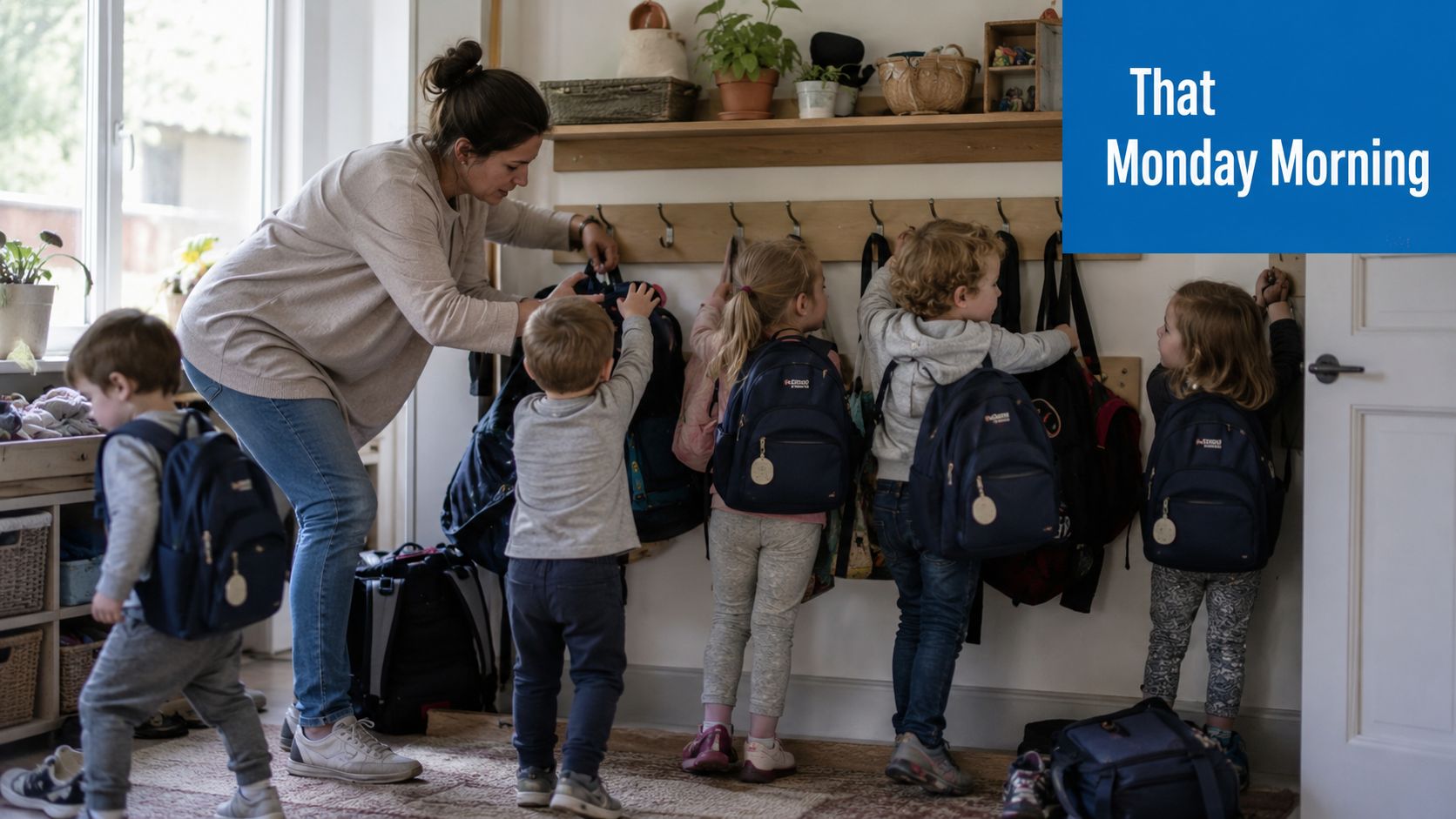
Monday morning in daycare has a way of exposing every weak label in the house. Five kids show up with nearly identical backpacks, one teacher is holding a pile of stray mittens, and a toddler is already reaching for the wrong lunch bag because it looks close enough. That is exactly the kind of moment photo bag tags are built to fix, with a child's face doing the heavy lifting when names alone are too slow to read.
If you're choosing gear for a nursery or preschool room, the practical questions start long before the first drop-off. Parents often need help choose the right nursery setting before they even get to the labeling drawer, because once school starts, the little details become the difference between a calm handoff and a scramble at the door.
The Drop-Off Moment Every Parent Knows Too Well
The scene is familiar. A daycare teacher lines up a row of navy backpacks, all of them the same size, all of them zipped shut, all of them looking interchangeable in a hurry. Someone says, “This one's probably Ava's,” and then a second adult has to check again because the name tag is turned inward or the font is too small to read from the doorway.
That's the problem photo bag tags solve in the simplest possible way. A face gives caregivers and kids a quick visual cue, and in a room full of similar coats, lunch kits, and cubby bins, that matters more than pretty styling.
Practical rule: if a label takes more than a glance to identify at drop-off, it's already slowing the room down.
For toddlers, the photo can be the whole point. A two-year-old may not read their name, but they can spot their own face and point to the right backpack, which cuts down on mix-ups before the morning even gets going. For teachers, that same tag can speed up arrival, dismissal, and the end-of-day “whose is this?” pile that always seems to appear.
There's also a real recovery angle here. A child's bag goes home in another family's car, lands in the wrong cubby, or gets left in a stroller basket, and the tag becomes the first thing a grown-up uses to sort it out. That's why the product isn't just about decoration, it's about making ownership obvious when everyone's tired and moving fast.
What Photo Bag Tags Actually Are
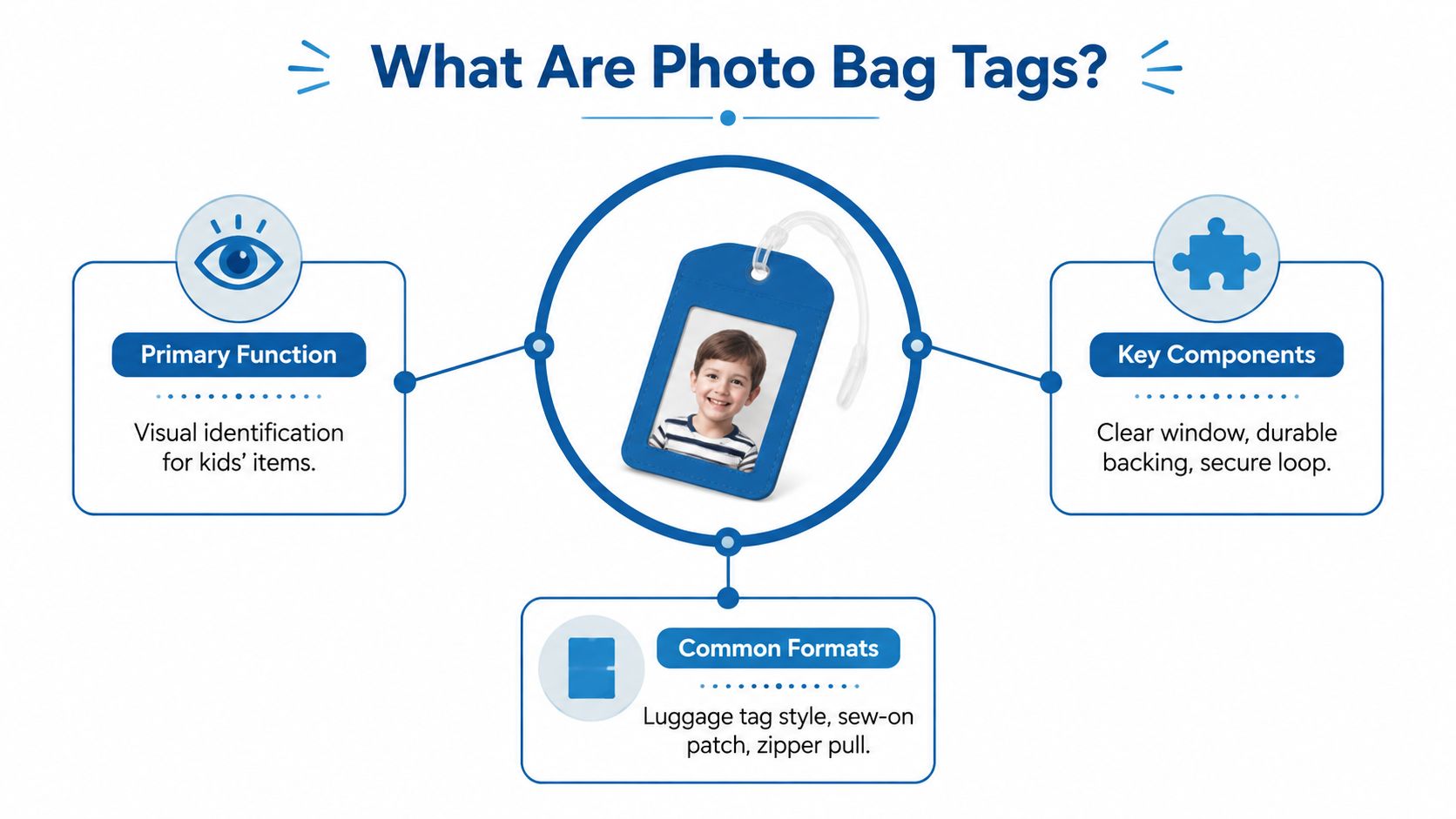
A photo bag tag is a small identification tag that hangs from a backpack, lunch box, diaper bag, travel bag, or sports gear and shows a child's picture alongside their name or other identifying text. Think of it as a sturdier, more visible cousin of a name sticker, but with a photo so the label works for adults and non-readers too.
How they differ from plain name labels
A name-only sticker depends on literacy and attention. A photo tag adds a second layer, so a teacher can match the face to the bag even if the name is partially hidden or the room is noisy. That's why these tags are so helpful in daycare rooms, nursery settings, and early elementary classrooms where adults are often doing ten things at once.
They also sit in a different place in the labeling ecosystem. Allergy alert tags are built to flag medical needs, reusable bottle bands stay on drinkware, and standard stickers are often flat and fixed. A photo bag tag is meant to hang, swing, and stay visible on a strap, handle, or zipper pull.
When a photo helps more than text alone
Use a photo tag when the item is likely to be shared, swapped, or stacked with near-identical gear. A lunch bag in a classroom fridge, a diaper bag at a nursery cubby, or a sports bag in a team pile all benefit from fast recognition.
InchBug's Rectangle Kids Bag Tags fit into that category too, since they're made for larger items like backpacks, lunch boxes, duffel bags, and diaper bags. They're a practical example of how the format can work like a luggage tag while still feeling kid-specific and personal.
A good tag should answer one question immediately, “Whose is this?” If it makes anyone squint, it's doing too much and not enough at the same time.
Materials, Durability, and Safety Features That Matter
A cute design fades fast if the tag cracks, fades, or pulls apart at the loop. In real daycare use, the material and construction matter more than the photo itself, because kids drag bags across floors, toss them into lockers, and hand them to adults with more enthusiasm than care.
What Photo Bag Tags Are
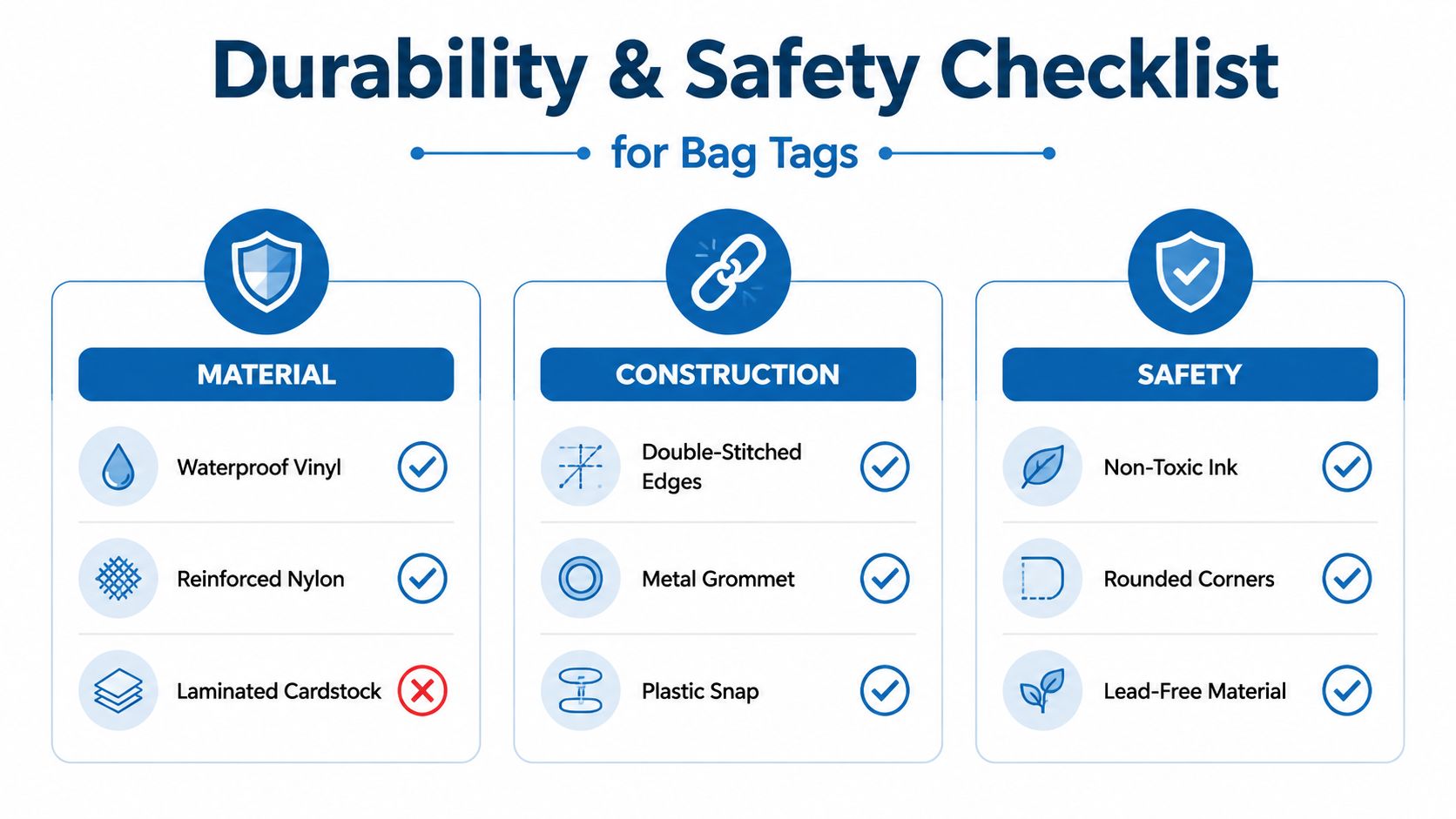
Commercial photo bag tags commonly use rigid 30 to 40 mil PVC or 4 mm plastic with full-color, full-bleed printing. Thin plastics and weak mounting points are more likely to crack, delaminate, or detach under repeated handling and abrasion, so those heavier materials give you a better chance of surviving real use. Typical retail sizes cluster around 2.25" × 3.5" to 2.5" × 4.25", which leaves enough room for a portrait while keeping the tag small enough for backpacks and luggage. Those specs show up on product listings because they balance visibility and wear resistance, not because they look fancy on a shelf. See one common photo bag tag spec sheet
The attachment matters just as much. A tag with a weak plastic snap or flimsy loop may look fine on day one and fail after repeated tugging, which is exactly what happens when a preschooler insists on carrying their own bag to the door. Rounded corners, secure stitching on fabric loops, and abrasion-resistant surfaces all help reduce the “something peeled off in the coatroom” problem.
Safety and Readability Are Part of Durability
If a tag is for a child, safety details should stay in view from the start. Look for waterproofing, UV resistance, and materials that are described as child-safe or BPA-safe when relevant, because sunlight, splash damage, and daily handling are the main reasons printed surfaces start to look tired. Even a sharp print can fail if the substrate is too soft or the edges chip easily.
For a practical testing mindset, I like the durability approach in this label durability testing guide, because it asks the same questions I ask after a bag tag has been kicked across a classroom floor for a month.
Buy for the handle, not just the picture. If the loop, hole, or snap looks weak, the tag will be the first thing to disappear from the bag.
Personalization Options and Design Tips
The best-looking tag isn't always the easiest one to use. I've tested enough labels through daycare drop-offs, school years, and the washing machine to know that the winning design is usually the one a tired adult can read in bad light, from arm's length, while juggling snacks and shoes.
Start with the photo, then build around it
Pick a current, front-facing, well-lit headshot. A smiling picture works better than a cropped school portrait in most cases because caregivers and kids recognize facial features faster when the face is clear and centered. If the child has had a haircut or a new pair of glasses, update the image sooner rather than later.
Text should work like a helper, not a puzzle. Put the name where it's easy to scan, use a font with clear letter shapes, and keep contrast strong, because dark text on a light background is easier to read in a busy room. Decorative borders and favorite colors are fine, but they shouldn't crowd the photo or shrink the name so much that staff have to lean in.
Keep the useful details simple
A second identifier can help, especially for kids with medical needs or shared custody routines. Some families add a phone number, allergy note, or short recovery message, but the tag still needs to stay uncluttered enough for quick use.
These label design ideas are helpful because they reinforce a rule I wish more parent guides would say plainly, readability wins over decoration every time.
Here's the filter I use before ordering:
- Can I recognize the child at a glance? If the photo is too tiny or too dark, the tag loses its main job.
- Can a teacher read the name without turning the bag over? If not, the font or layout needs work.
- Does the design still make sense in a crowded cubby? Busy patterns often disappear in real-life clutter.
- Is the extra information useful? If it isn't helping recovery or safety, leave it off.
A beautiful tag that slows people down isn't really beautiful for long.
Where and How to Use Photo Bag Tags
A photo tag works best when it lives where people already reach for the bag. That's why the attachment style matters so much, because a backpack loop, lunch-box handle, and suitcase strap all ask different things from the hardware.
| Item | Recommended Attachment | Why It Works |
|---|---|---|
| Backpack | Carabiner clip or sturdy loop | Easy to attach to zipper pulls or side handles, and simple for kids to carry |
| Lunch box | Loop strap around the handle | Stays visible in cubbies and fridges without dangling too far |
| Diaper bag | Secure loop or buckle strap | Holds up to heavier bags and frequent adult handling |
| Sports gear | Clip or reinforced loop | Fast to swap between practice bags, cleats, and duffels |
| Travel suitcase | Buckle strap or strong loop | Keeps the tag attached through checked luggage and repeated lifting |
Backpacks and lunch boxes are the obvious starting point, but photo tags also make sense on diaper bags, music cases, and sports gear that moves between home, school, and the car several times a day. A bag in a team pile needs instant identification, while a suitcase needs a tag that stays put when it's tossed onto a conveyor or stacked into a van.
Daycare staff notice the placement almost immediately. If every child's bag hangs the same way on the same hook, teachers can sort arrivals faster, hand off the right gear, and avoid the awkward “this one looks like yours, but I'm not sure” moment. That's one reason a consistent placement routine helps the whole room move more smoothly.
For families organizing multiple bags, the backpack organization guide pairs well with this habit, because the tag works best when the bag itself has a predictable home.
Care and Maintenance to Make Tags Last
Most tags don't fail all at once. They fade a little, get scuffed near the edges, or start to loosen at the strap after months of daily use, and then one day you notice the photo isn't as crisp as it used to be. That's normal wear, not a mystery.
The simplest care routine
A weekly wipe with a soft cloth is usually enough for everyday grime. If a tag is printed on durable plastic, gentle soap and water are safer choices than harsh cleaners, which can dull the surface or weaken printed areas over time. I'd treat abrasive scrubbing the same way I treat glitter in the kitchen, unnecessary and likely to create a bigger cleanup later.
One thing parents ask me about a lot is machine cleaning. Some quality tags are built to tolerate more than a quick wipe, and many are described as dishwasher-safe on the top rack, but I still tell families to check the maker's care instructions before tossing anything into a hot cycle. If a tag is attached to a bag that goes through the wash, take a minute to inspect the loop and the print afterward.
Signs it's time to replace one
Sun exposure on car seats can fade photos. Repeated yanking can fray strap loops. A hard fall onto tile can crack corners. Those are all replacement cues, not maintenance failures.
If a tag is starting to peel, lose contrast, or look hard to recognize from a teacher's distance, it's already past its prime. The same goes for school-year photos that no longer match the child's current haircut or glasses, because the whole point is quick recognition, not nostalgia.
Families who like washer-safe naming systems often already use dishwasher-safe name labels, and the same habit of checking wear before it becomes a problem works well here too.
Simple rule for parents: if you'd hesitate to hand the tag to a teacher without explaining it, it's time for a replacement.
Buying Checklist and Common Questions
A good purchase comes down to a few practical checks. You do not need design training, just a clear head and a short list. I also like to start with a question I would ask if I were standing in a daycare cubby room with a stack of nearly identical bags: will this tag still be readable after a week of being tugged, wiped, and stuffed into a pocket?
Quick buying checklist
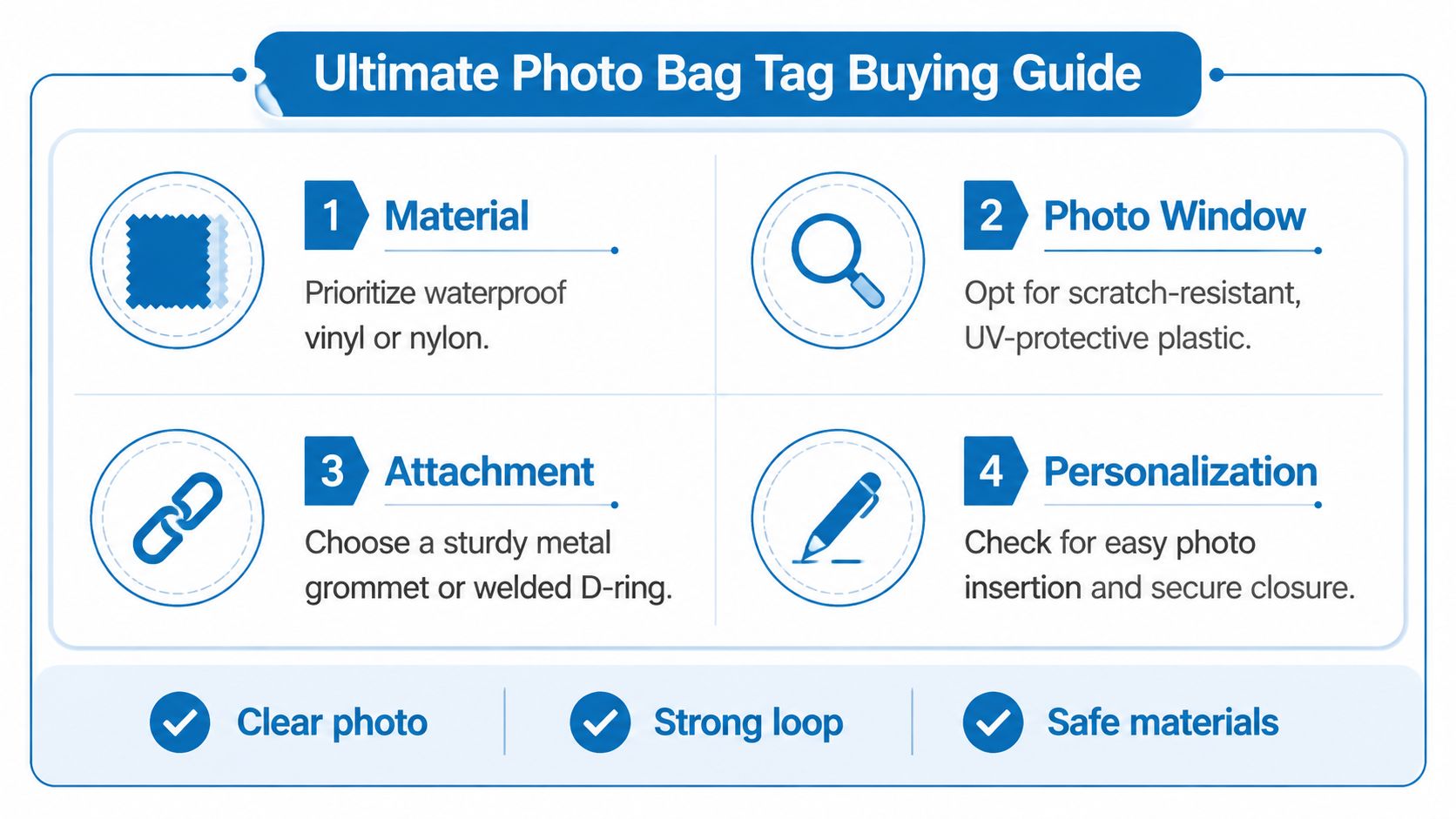
- Material: Choose waterproof, rigid plastic or reinforced material over thin cardstock.
- Photo clarity: Make sure the image will print sharply and not blur at smaller sizes.
- Attachment strength: Look for a sturdy loop, welded ring, or secure strap that won't pull off easily.
- Personalization: Check how many lines of text fit and whether the reverse side has a useful backup layout.
- Safety: Confirm child-safe materials and smooth edges if the tag will live on a toddler's bag.
- Use case: Match the format to the item, because a diaper bag, lunch box, and suitcase don't need the same hardware.
- Update ease: If your child changes quickly, choose a tag style that's easy to refresh without replacing the whole system.
I also tell parents to test the tag in the same places children use it. A cubby hook, a lunch tote, and a backpack strap each stress a tag in a different way, much like a teacher learns which coat loops hold and which ones give up at pickup time. If you are sorting through options for daycare, school, or travel, our help-me-choose guide can help you match the label style to the kind of daily wear you expect.
If you're comparing bag sets or branded school gear, the same logic applies to matching accessories. For example, branded drawstring bag options are useful when you want the bag itself and the tag to work together as a clear identifier instead of relying on one small label to do everything.
Common questions parents ask
Will a photo tag survive a backpack going through the wash? Sometimes, but that depends on the attachment and the maker's care guidance. A tag attached inside a bag may fare better than one swinging loose on an exterior strap, because the bag body gives it a little shelter.
Are these okay for travel? Yes, especially for family suitcases and overnight bags, because a photo makes ownership obvious to adults and older kids. For air travel, the goal is quick identification, not security screening, so keep the tag simple and durable.
Should I choose a template or a custom design service? A template works well if you want speed and consistency. A custom layout makes more sense when you need extra text, a second identifier, or a cleaner fit for a school or daycare group.
What should I prioritize if I'm only buying one? Start with durability, then readability, then decoration. That order saves the most frustration later.
If you want a place to start without overthinking it, InchBug offers personalized kid-friendly labels and bag tags designed for the kinds of everyday mix-ups parents deal with all year long. Visit InchBug to look at practical labeling options for daycare bags, school gear, and the items that keep coming home from the wrong cubby.