

The paper comes home crumpled at the bottom of the backpack. Your child is thrilled. You, meanwhile, are doing the mental math. Lunch. Water bottle. Sneakers. Sunscreen. Permission slip. Meds. Spare clothes. Which adult is in charge? Will your child really stay with the group? Will that beloved hoodie come home again?
That mix of excitement and low-grade panic is normal. I've learned that field trip preparation feels chaotic only when it starts too late or stays too vague. Once you turn it into a short series of concrete decisions, the whole day gets easier for everyone involved.
Good field trip preparation also matters more than is often realized. Successful field trips have long been treated as a three-stage process of preparation, activities, and follow-up, with teacher prep such as pre-visiting the venue, setting learning goals, and training chaperones shaping whether the outing becomes real instruction or just a bus ride and a snack break, as described in this field trip research overview.
The Field Trip Permission Slip Arrives
The first thing I do when that slip appears is stop treating it like a form and start treating it like a plan.
A permission slip isn't just asking for a signature. It's telling you that your child is about to spend a day in a new environment with different adults, different routines, different sensory demands, and a lot more moving parts than a regular school day. That's why the parents who seem calm about field trips usually aren't “laid back.” They're prepared.
What smart parents do first
Start with a fast scan, then a pencil-and-calendar pass.
Look for these basics right away:
- Trip date and departure time: Put it on your calendar immediately.
- Location details: Indoor, outdoor, museum, farm, zoo, park, theater. Packing changes with the setting.
- Food instructions: Packed lunch, disposable lunch, school lunch, snack rules.
- Adult contact expectations: Know who's leading and how the school handles emergencies.
- Money or supply requests: Don't wait until the night before to discover them.
Then make one short list called “trip needs.” That list might include a signed form, closed-toe shoes, a labeled water bottle, allergy medication, a spare shirt, or a conversation with the teacher.
Practical rule: If a field trip item can get forgotten, lost, or mixed up, label it and decide where it will live the night before.
I also strongly recommend checking that your child's emergency details are current. If you need a refresher on what adults should have handy, this guide to emergency contact information is a useful starting point.
The shift that makes field trips easier
The biggest mindset change is this: don't prepare only for transportation. Prepare for the child you have.
If your child gets shy in new groups, prep for that. If they melt down when they're hungry, prep for that. If they always take off their sweatshirt and leave it somewhere mysterious, definitely prep for that.
The goal isn't perfection. The goal is a day that feels manageable, safe, and enjoyable.
Your Field Trip Preparation Timeline
The cleanest way to handle field trip preparation is to work backward from the trip date. That's not just a nice idea. It's a reliable workflow. Guidance for school trips recommends planning backward, sending permission and emergency forms at least a month ahead, keeping paperwork in one binder, and avoiding the last-minute mistake of failing to confirm group size, meals, or transportation, as outlined in this field trip planning workflow.
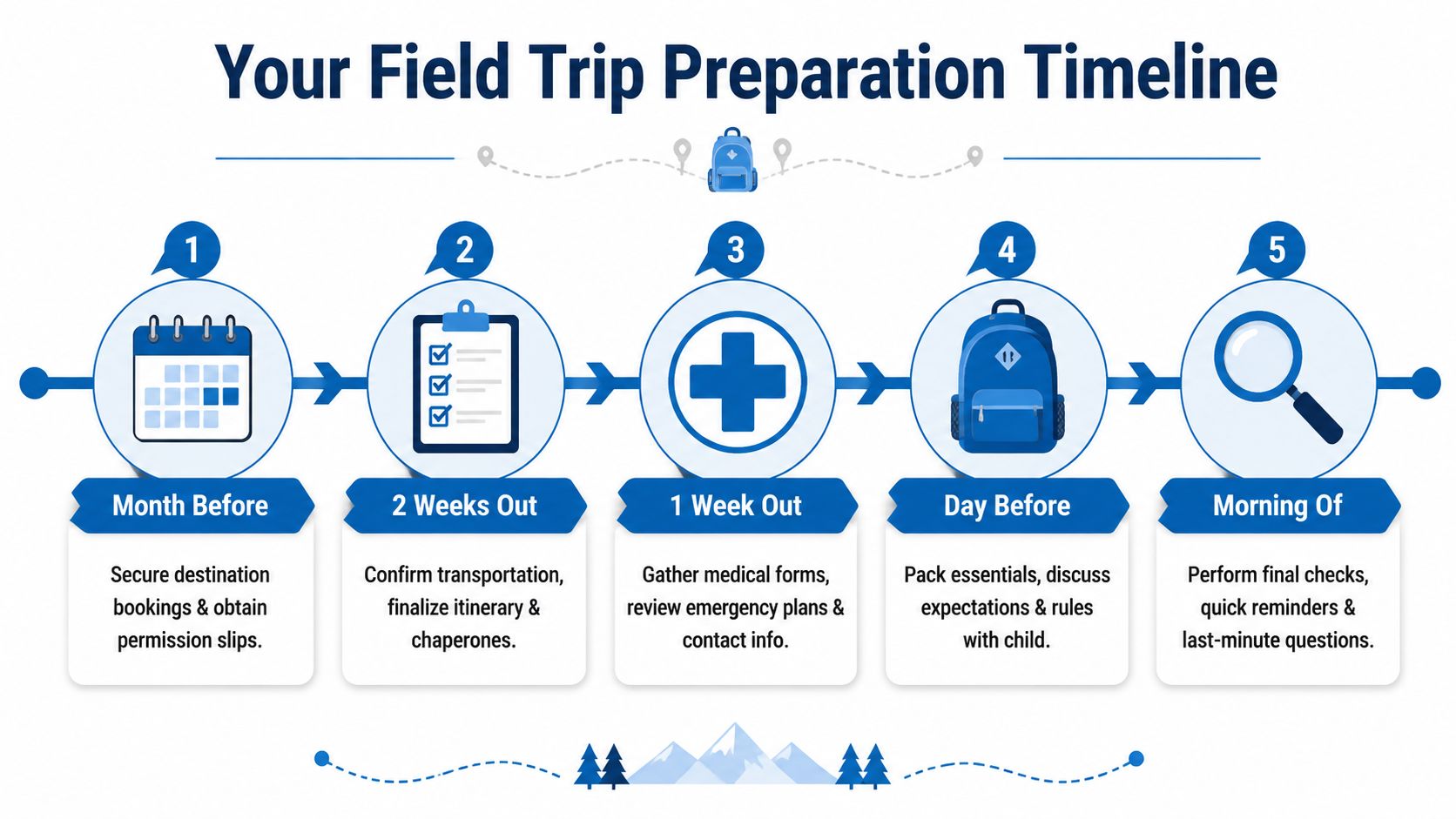
A month before
This is when the trip is still easy.
Parents should sign forms immediately, not “set them aside for later.” Teachers should already be locking in approvals, transportation, venue details, and adult coverage. If you're a room parent or organizer, this is also the time to speak up about anything your child needs, especially medical, sensory, or mobility support.
Use this checklist:
- Return permission paperwork early. Early forms give teachers time to catch missing details.
- Clarify health needs. If your child has allergies, asthma, or medication needs, don't rely on a note scribbled in the margin.
- Ask about schedule details. Younger kids do better when parents can preview the day.
- Start gear planning. Make sure shoes fit, outerwear works, and lunch containers are easy for your child to open.
Two weeks out
This is the point where details should stop floating around in text threads and start becoming fixed.
For parents, confirm whether your child needs a packed lunch, water bottle, weather gear, or spending money. For teachers, finalize chaperones and assign children to specific groups. Don't leave adult assignments fuzzy. Ambiguity creates avoidable chaos in parking lots, bathrooms, and lunch breaks.
A few good habits matter here:
- Write the child's name on everything they'll carry or remove.
- Choose simple gear your child already knows how to use.
- Tell your child who their adult is if they won't stay with the classroom teacher all day.
One week out
Now focus on the things that get forgotten because they aren't dramatic.
That includes medical forms, backup clothing, rain gear, and the conversation about behavior. Don't save all expectations for the morning rush. A child who knows the plan behaves better than a child who only hears, “Listen to your teacher.”
Pack for transitions, not just destinations. Bus to site, site to bathroom, lunch to regrouping. That's where kids lose things and adults lose time.
The night before
This is not the time for “I'll remember in the morning.” You won't.
Set out:
- Clothes and shoes
- Packed lunch
- Filled water bottle in the fridge
- Any medication that must go with the school
- Jacket or sweatshirt
- Backpack by the door
Have one calm conversation with your child. Keep it short. Where are you going? Who's your adult? What do you do if you need help? Where do your belongings go when you take them off?
The morning of
Do a final check, then stop fussing.
Children absorb your energy. If you act like the day is a problem, they'll feel it. If you act like the day has a plan, they'll borrow that confidence.
Before they leave, check these five things:
- Body: dressed for the weather
- Bag: lunch, water, needed extras
- Forms: already turned in
- Health: medication communicated and handed off correctly
- Mindset: one reminder about staying with the group and asking for help
The Smart Packing and Labeling Checklist
Packing for a field trip isn't about sending more stuff. It's about sending the right stuff, in the right format, labeled so adults can sort it out fast.
Many parents often overpack and under-think. A giant backpack full of “just in case” items isn't helpful if your child can't find anything, open anything, or keep track of anything. For field trip preparation, simple beats impressive every time.
Pack for independence
Your child should be able to manage most of what you send without adult rescue.
That means:
- A water bottle they can open themselves
- A lunch container that doesn't require adult-level grip strength
- A jacket they can identify instantly
- Shoes already broken in
- One small bag, not several loose items
For preschoolers and early elementary kids, reduce friction. Choose easy zippers, familiar containers, and foods that don't spill, squish, or require assembly.
For older elementary kids, give a little more responsibility. They can usually manage a full lunch and a checklist, but they still benefit from visible labels and a simple bag layout.
Labeling is not optional
Kids remove layers. They set down lunch bags. They swap seats on the bus. Adults gather abandoned sweatshirts in armfuls. If an item isn't labeled, it becomes “miscellaneous.”
I like a system with different label types for different surfaces. Reusable bottle bands work well for water bottles and thermoses. Adhesive name labels make sense for lunch containers. Clothing tags or clip-on identifiers help with jackets and hoodies. Bag tags are useful for backpacks that all look identical from ten feet away.
If you want one place to compare common label uses for school and outings, this article on labels for camp is practical and easy to adapt for field trips too.
Field Trip Packing Checklist
| Item Category | What to Pack | Pro Tip & Labeling Solution |
|---|---|---|
| Food | Easy lunch, one snack, no messy dips or hard-to-open packaging | Label lunch containers clearly. If there's an allergy concern, make that visible too. |
| Water | Reusable water bottle | Use a bottle label or band that stays attached through washing and refills. |
| Clothing | Weather-appropriate outfit, light layer, extra socks for younger kids if needed | Put your child's name on jackets and sweatshirts. These are the first things left behind. |
| Bag | Small backpack your child can carry | Add a bag tag so adults can spot it quickly in a pile. |
| Health | Teacher-approved medication or care items if required | Pack exactly what the school requests and label it clearly. |
| Comfort | Small comfort item only if allowed and useful | Keep it small and familiar. Don't send anything irreplaceable. |
| Sun and weather | Hat, rain layer, sunscreen if the school requests it | Check school policy first. Don't assume staff can apply everything. |
| Activity items | Only what the school asks for | Skip toys, gadgets, and extras that create distraction or loss. |
What I'd actually send
For most school-age kids, my practical list looks like this:
- Lunch that can survive being jostled: sandwich, wrap, pasta, fruit that won't bruise easily
- One snack with quick energy: crackers, pretzels, granola bar if allowed
- Full water bottle
- Light sweatshirt or rain jacket
- Tissues
- Any required medication through the school process
And that's about it.
For younger children, I'd consider one extra clothing item if the trip involves outdoor play, animals, water tables, mud, or a long bus ride.
One product note that genuinely helps
In this category, organization tools earn their keep. InchBug makes several label formats that match common field trip problems: Orbit Labels for bottles, adhesive labels for lunch gear, TagPal clothing labels for removable layers, and bag tags for backpacks. That's useful because the issue usually isn't packing the item. It's getting the right item back to the right child without slowing down the whole group.
If a child can identify their own things quickly, you've prevented half the common field trip drama before the bus even leaves.
What not to pack
A few things cause more trouble than they solve:
- Complicated lunches: too many pieces, sauce containers, peel-back packaging
- Special toys: they get lost or become a distraction
- Brand-new shoes: field trip blisters are miserable
- Bulky coats when a lighter layer will do: hard to carry, easy to abandon
- Unlabeled duplicates: two blue water bottles in one class is all it takes
The strongest packing strategy is boring in the best possible way. Familiar items. Clear labels. Easy access. Nothing precious.
Navigating Safety and Medical Needs
Safety prep is where adults need to be crisp, not casual. If your child has a medical need, the field trip plan should state who has what, who knows about it, and what happens if something goes wrong. “Someone will probably know” is not a plan.
Research summarized by Edutopia found that well-designed field trips were linked with stronger academic and behavioral outcomes, and those benefits lasted two to three years in that reporting, which is a good reminder that serious preparation matters because the trip itself matters. You can read that summary in this Edutopia article on why field trips are worth the effort.
For parents with medical concerns
Tell the teacher early and in writing. Then confirm the day-of plan.
That means being clear about:
- Allergies and triggers
- Asthma symptoms and inhaler access
- Seizure plans or other condition-specific instructions
- Food restrictions
- Emergency contacts reachable by phone
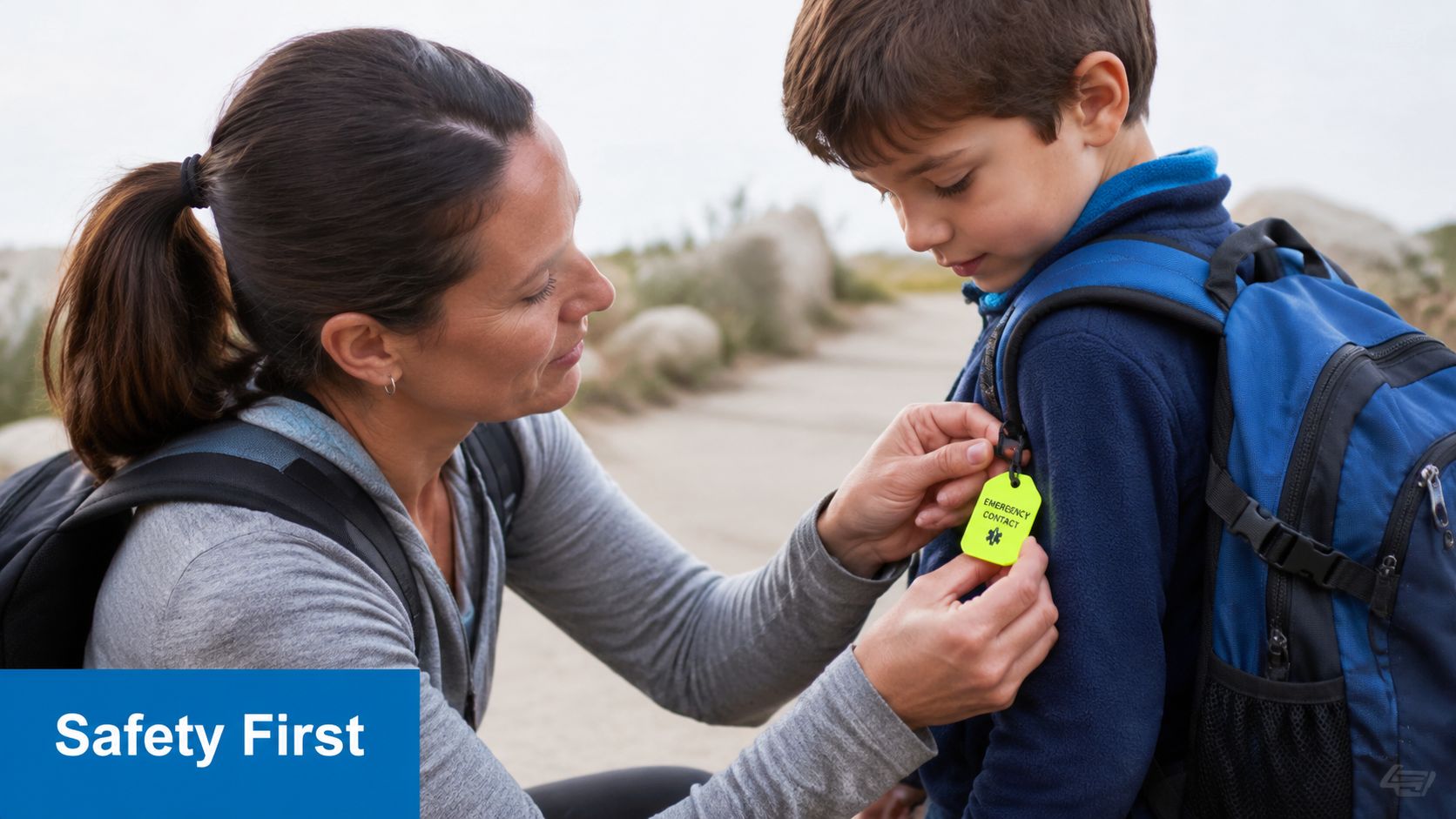
Visible labeling helps too. If your child carries allergy-related gear, a highly visible marker can help adults identify critical information fast. This guide on how allergy alerts can help keep your child safe shows the logic well.
For teachers and chaperones
Keep groups small and adult responsibility specific.
Don't say, “Watch these kids.” Say, “These are your students. You lead bathroom breaks, headcounts, and lunch check-ins for this group.” Adults handle field trips better when roles are assigned, not implied.
Use a basic safety routine:
- Headcount before departure
- Headcount on arrival
- Headcount after bathroom breaks
- Headcount before leaving the site
- Headcount after reboarding transportation
A minor incident becomes a major problem when adults don't know who has the medication, the contact list, or the authority to act.
Every school trip team should also review core first-aid basics. If you want a straightforward refresher on one vital lifesaving first aid skill, the recovery position is worth understanding before you need it.
Make the information visible
Safety falls apart when critical details are hidden in email threads, stuffed into a teacher tote, or known by only one person. Keep medical instructions, contact details, and student group assignments together and accessible on-site. If the lead teacher has to search for paperwork while a child is crying, wheezing, or vomiting, the system failed.
That sounds blunt because it is. Safety prep is mandatory.
Beyond the Backpack Preparing Kids Emotionally
A child can have the right shoes, the right lunch, and the signed form and still have a hard day.
That's why whole-child field trip preparation matters. Research frameworks for effective field trips point to social interactions, active learning, and students' feelings, attitudes, and beliefs as part of good design, and guidance highlighted there also recommends using books, photos, videos, and discussion to help children know what to expect in new settings. You can read that perspective in this research framework for field trips in natural settings.

Why kids get overwhelmed
Field trips compress a lot into one day. Noise. Waiting. New bathrooms. Unexpected smells. Crowds. Different adults. A broken routine. Even excited kids can get flooded.
That's especially true for younger children and neurodivergent learners, but many kids struggle more than adults realize because they don't have the language to say, “This is too much.”
Common stress points include:
- Transitions: classroom to bus, bus to venue, venue to lunch
- Sensory load: loud spaces, bright rooms, animal smells, packed hallways
- Social pressure: choosing partners, staying with a group, asking for help
- Uncertainty: not knowing where the bathroom is or what happens next
Prep the child, not just the bag
The best emotional prep is concrete.
Talk through the day using simple steps. Show photos of the place if you can. Explain where they'll sit, when they'll eat, and what they should do if they feel confused or need help. If your child benefits from visual supports, make a tiny picture schedule or a few note-card reminders.
This is also a good time to rehearse social scripts:
- “I need help.”
- “I need the bathroom.”
- “I can't find my group.”
- “This is too loud.”
- “Can I stand next to you?”
If drop-offs or separations are already hard for your child, the same strategies used for school mornings can help. This piece on handling difficult drop-offs has ideas that adapt well to field trip days.
Give them a regulation plan
Don't just say, “Be good.” Give them tools.
A regulation plan might include:
- One comfort phrase: “My teacher knows where I am and what to do.”
- One grounding action: hold backpack straps, take slow breaths, count five blue things
- One support item if allowed: a small smooth token, quiet fidget, or photo tucked in a pocket
- One agreed signal: a hand signal or phrase to use with the teacher when they need a break
Here's a helpful visual resource you can use with kids when talking about feelings and coping skills before a big day:
When the problem is bigger than the trip
Sometimes a child's distress around outings isn't just pre-trip nerves. If your child regularly shuts down, panics, or struggles with transitions across settings, it may help to get outside support. Families looking for help for Vernon's youth can find counseling options that address anxiety, emotional regulation, and day-to-day coping.
Children usually do better when adults rehearse the hard parts in advance instead of only celebrating the fun parts.
That one shift changes a lot. The child feels seen. The teacher gets better behavior. The trip becomes accessible, not just possible.
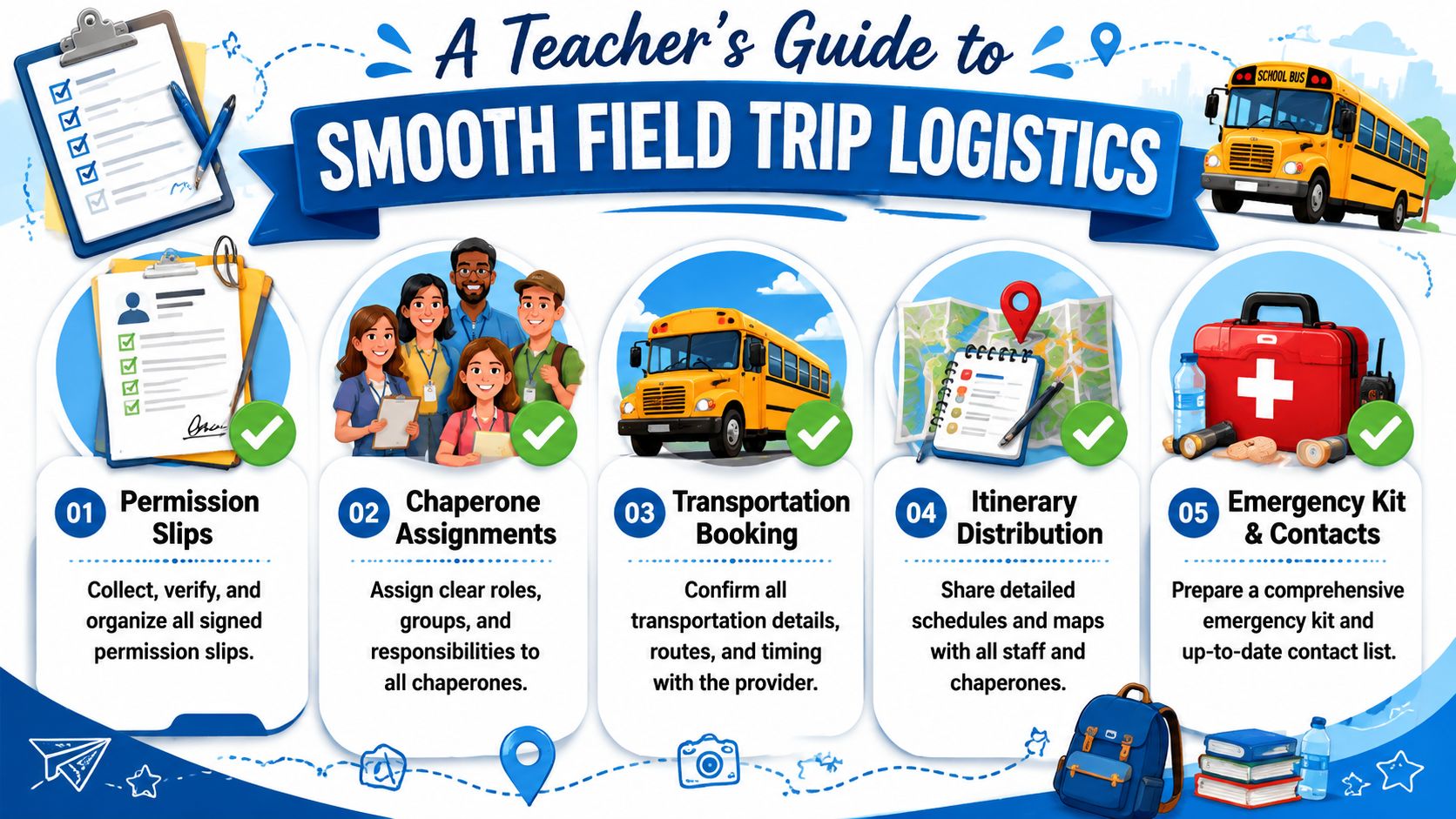
A Teacher's Guide to Smooth Field Trip Logistics
Teachers carry the invisible weight of field trip preparation. Parents see the permission slip. Teachers see transportation calls, roster changes, lunch confusion, chaperone no-shows, medication handoffs, and the student whose family never found the right shoes.
That's why smooth logistics depend on one thing above all. Systems.
Build a repeatable system
Keep one master packet or binder for the trip. Put group lists, contacts, medical notes, schedules, and venue information in one place. Assign one adult to carry it and one backup adult who knows where it is.
Then make communication explicit:
- Families need one clear message with date, clothing guidance, lunch instructions, and required forms.
- Chaperones need one role sheet with student names, meeting points, and behavior expectations.
- Staff need one shared itinerary so no one improvises timing on the fly.
If you want classroom systems that support smoother outings too, this guide to best classroom management strategies connects well with trip-day group handling.
Equity has to be planned
This is the part too many schools still leave to chance. An overlooked problem in field trip prep is equity. Costs tied to lunches, clothing, or fees can block participation for low-income families, and inclusive planning such as fee waivers or backup supplies helps prevent exclusion, as discussed in this guidance on making school field trip planning easier.
A few fixes are simple and respectful:
- Offer supply support. Keep extra ponchos, sweatshirts, sunscreen, and lunches available without making students ask publicly.
- Use inclusive packing lists. Write “If you have it, send it” where appropriate, and name what the school can provide.
- Be transparent about costs early. Families need time and clarity.
- Avoid assumption-heavy instructions. Not every family can send themed shirts, disposable lunches, or extra spending money.
- Plan for dietary and medical needs without burdening the family to solve everything alone.
What teachers should stop doing
Stop sending vague reminders. Stop assuming families understand the hidden expectations. Stop relying on one heroic teacher bag stuffed with every answer.
Use checklists. Pre-assign groups. Prepare backup supplies. Make it easy for families to succeed.
That's what good field trip preparation looks like in real life. It's organized, compassionate, and specific.
A well-run trip doesn't happen because everyone remembers everything. It happens because the details are visible, labeled, and easy to manage. If you want practical tools for bottles, bags, lunch gear, clothing, and allergy alerts, take a look at InchBug.