

The bus is coming, the water bottle is still sticky from yesterday's juice box, and the name label you just peeled back has curled into a tiny plastic argument. A lot of parenting life feels like that, one small product choice turning into an extra minute, then two, then a full-on morning stall. That's why ease of use ratings matter, not as a fancy product term, but as a way to predict which things will quietly fit your routine and which ones will demand a backup plan.
Parents feel this most with kids' gear because the cost of friction is immediate. A lunch container that takes three hands to open, a label that won't stick, a car seat that takes too much guesswork, all of it adds up in the exact moments when you're already moving fast. Vendors care for the same reason, because a score that feels honest can build trust before a family ever clicks “buy.”
The Morning Struggle That Started This Guide
That sticker on the bottle is a tiny test. If it lifts at the corners, leaves residue, or needs a perfectly dry surface and a calm five minutes, the product may still be fine, but it's not easy in the way a tired parent needs easy.
Friction is the thing people remember
Parents rarely remember a product because it was ordinary. They remember the label that went on cleanly, the lunchbox latch that clicked shut the first time, and the bottle band that stayed put after dishwashing. They also remember the opposite, because every extra step lands on a day that already has too many steps.
Practical rule: if a kid's product makes you stop and think twice during a rushed morning, the product has already failed part of its ease-of-use promise.
That's the core value of a rating. It provides a shortcut for deciding whether a product might save energy or spend it. A good score doesn't replace your judgment, but it does help you avoid trial-and-error shopping on things you'll use every day.
Parents comparing labels, bottles, and organizers can also think in terms of the same basics used in product testing. If you're sorting options for school supplies or daycare gear, a practical reference like the free tutoring invoice generator can be a reminder of how much smoother a good tool feels when the steps are simple and obvious. The same principle shows up in small tasks: fewer surprises, less guessing, faster completion.
What Ease of Use Ratings Actually Measure
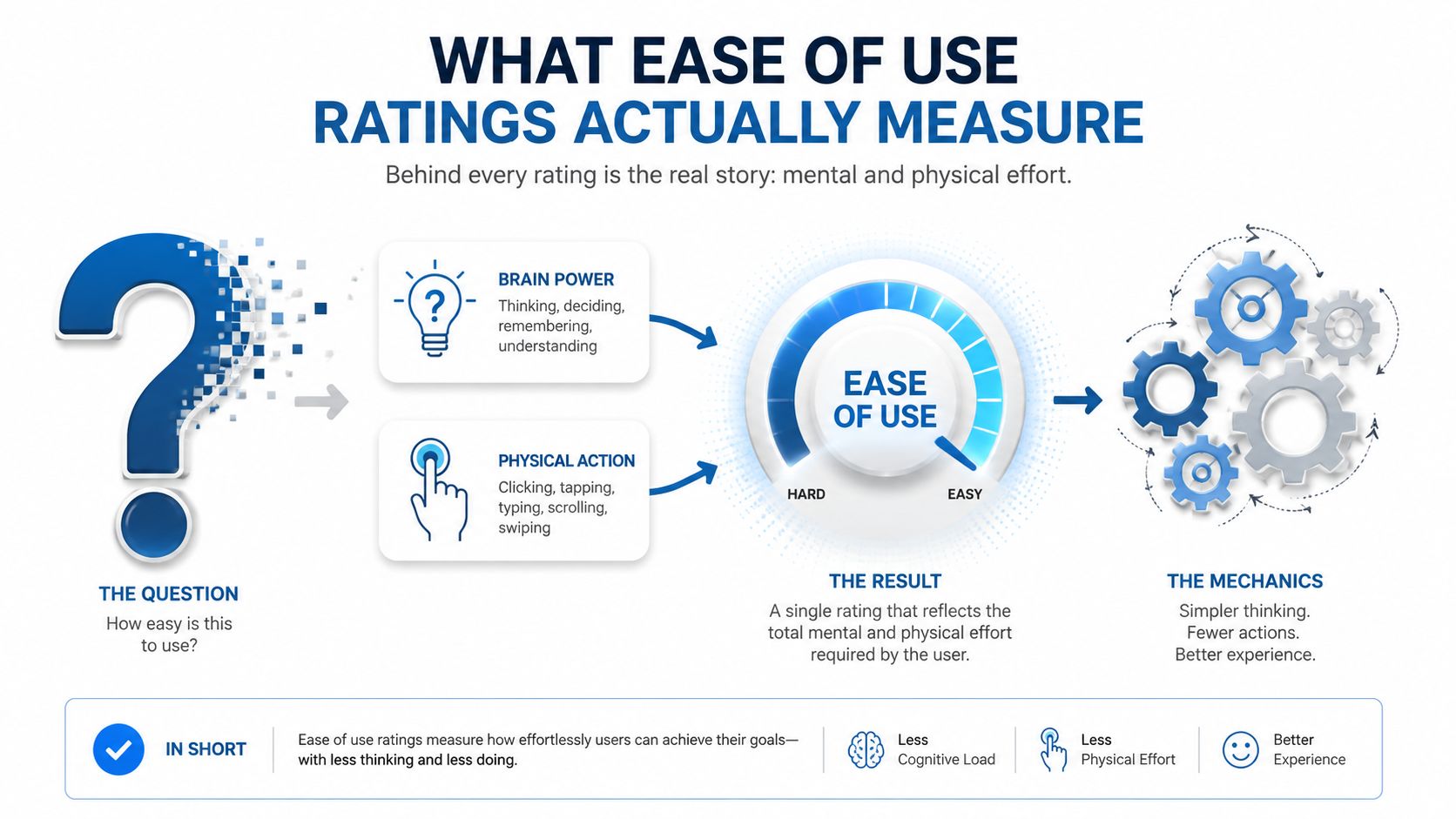
An ease of use rating asks one question: how much effort does it take to get a product to do its job? That effort can be mental, like figuring out a confusing latch, or physical, like pressing too hard on a seal that should've been simple from the start.
A rating is not the same as quality
A product can be durable and still be awkward. A product can look cute and still frustrate you every time you use it. Ease of use is narrower than overall quality, because it focuses on the steps between opening the box and getting a useful result.
The best-known consumer benchmark for this kind of measurement is the System Usability Scale, or SUS. Across more than 500 products, the average SUS score was 68, while consumer products averaged 77, and observed scores ranged from 57 to 87. That consumer average sits around the 80th percentile, which means it scored well above the overall norm and gives you a practical baseline for what “easy to use” looks like in major software markets. You can see the benchmark details in the research summary on consumer software UX.
For parents, the takeaway is simple. A product score isn't impressive just because it's above average. It's impressive when it clears a baseline that already reflects normal, everyday usability.
Read the score as a measure of effort, not a personality trait
A label that goes on cleanly isn't “smart.” A bottle that resists leaking isn't “friendly.” Those are marketing words. A good rating says the object required less effort than similar alternatives, and that difference matters because it changes whether a parent will keep using it or avoid it after the first frustrating try.
If you want a simple mental model, think of ease of use as the product's answer to your fatigue. The less energy it asks from you, the more likely it is to fit into real life.
For a plain-language look at one way labels are tested in practice, the article on label durability testing is a useful companion because durability and ease often get confused, even though they're not the same thing.
The Main Scoring Methods Explained Simply
A product page can show a clean star rating while hiding the method behind it. For parents, that matters because the number may look reassuring even when the scoring process was measuring something narrower than the full experience.
Three common ways the score gets built
The SUS is a structured survey. People answer a fixed set of questions after using something, and the responses are turned into a score. It works well as a common benchmark, but it still reflects perceived usability, not every detail a parent notices while trying to use the product at home.
The Single Ease Question, or SEQ, is even more direct. It is a post-task question that asks how easy a specific task felt, usually on a 7-point scale. That makes it useful for single actions, like closing a lunch container or attaching a clothing label, but it works best when paired with task success and time-on-task, because someone can report that something felt easy even if it took longer than expected. The SEQ guidance on post-task ease measurement explains that tradeoff clearly.
Structured expert reviews take a different route. PURE is a more rigorous composite approach that asks reviewers to define the user type, choose the key tasks, score the happy path step by step with three expert raters, check whether those raters agree, reconcile differences, and only then total the scores. The Nielsen Norman Group's explanation of the PURE method lays out that process in detail.
A label that stays on after washing can also be tested in a very practical way, and a label adhesion test helps show why that matters. Adhesion is close to ease of use in one simple sense, if the label fails too early, the parent ends up doing extra work, even if the first application felt easy.
Why the method changes what the score means
A quick survey can be useful, but it can miss friction. An expert review can be more defensible, but it is rarer on everyday products. Parents should never read the number alone. They need to ask what kind of testing sits behind it.
A score without a method is just a number with confidence styling.
The same task can call for different methods. Applying a clothing label may be a short action that is easy to rate after one try. Car-seat installation depends on more steps, more judgment, and more room for confusion. The scoring method should match the task being judged.
If you are trying to decide whether a sports bag or uniform set will be easy to manage, the guide by Villarreal Houston Academy is a useful reminder that “easy” depends on the gear, the routine, and how many steps a family has to repeat.
Why a High Rating Does Not Always Mean Easy for You
A high rating can still miss your situation if the test didn't include your context. That's the part often overlooked, and it's the reason some products with decent numbers still feel awkward in a real kitchen, a real car, or a real daycare drop-off.
The rating is tied to the task being scored
The clearest example is the NHTSA car-seat program. It rates instructions, vehicle installation, labels, and securing the child separately, and the overall star rating is meant to compare ease of use for those defined features rather than replace deeper testing. The published framework also notes that stars can relate to fewer real-world errors, but they still don't cover every source of confusion or installation failure in a family's actual routine. You can read the framework summary in the article on car-seat ease of use ratings.
That structure matters because it changes the question parents should ask. Instead of “Is this product easy?”, ask “Which steps were scored, for whom, and under what conditions?” That is the only way to tell whether the rating matches your use case.
The same score can feel different in different homes
A bottle band that works beautifully in a calm product demo may feel different when you're juggling a toddler, a wet counter, and a school bag. A label that reads clearly in bright light may be harder to trust under fluorescent daycare lighting. The score may still be honest, but it's honest about a specific task, not every messy variation of family life.
For vendors, that's not bad news. It's a chance to be clearer. For parents, it's a chance to buy more carefully and blame less of their own experience on a number that never promised to cover everything.
How Parents Can Stress-Test a Product Before Buying
A product page can say “kid-friendly” all day long. That phrase only helps if you can translate it into something a tired adult can test in the store, on a phone, or in five seconds between errands.
Turn vague promises into concrete checks
- “Easy to apply” becomes, does it stick cleanly the first time, on a real surface, without special tools or prep?
- “Kid-friendly” becomes, can a child use it without an adult re-explaining the steps every time?
- “Durable” becomes, will it still look usable after the kind of washing, squeezing, or backpack abuse your family puts it through?
- “Simple setup” becomes, can you complete the main task without opening a separate help page?
- “Fast” becomes, does the product work in one smooth pass, or does it create a second chore?
Useful habit: if you can't describe the test in one sentence, the marketing phrase is too vague to trust.
A good product page should help you imagine the first use, not just admire the packaging. Reviews help too, especially when they mention the same action you care about, like sticking, washing, opening, or attaching. For a related maintenance lens, the quality assurance process is worth a glance because consistency is part of perceived ease, even when shoppers don't call it that.
| Marketing Promise | What to Actually Test |
|---|---|
| Easy to apply | Does it go on cleanly the first time, on the surface you'll really use? |
| Kid-friendly | Can a child or caregiver complete the main step without confusion? |
| Durable | Does it hold up through the conditions your family puts it through? |
| Simple setup | Can you finish the task without extra instructions or tools? |
The best shopping question is the boring one
Ask, “What happened the first time someone used it?” That question cuts through the wording and gets you closer to the lived experience behind the score. It's the same for labels, lunch gear, and everything else that has to survive real family use.
How Vendors and Product Pages Can Earn a Credible Score
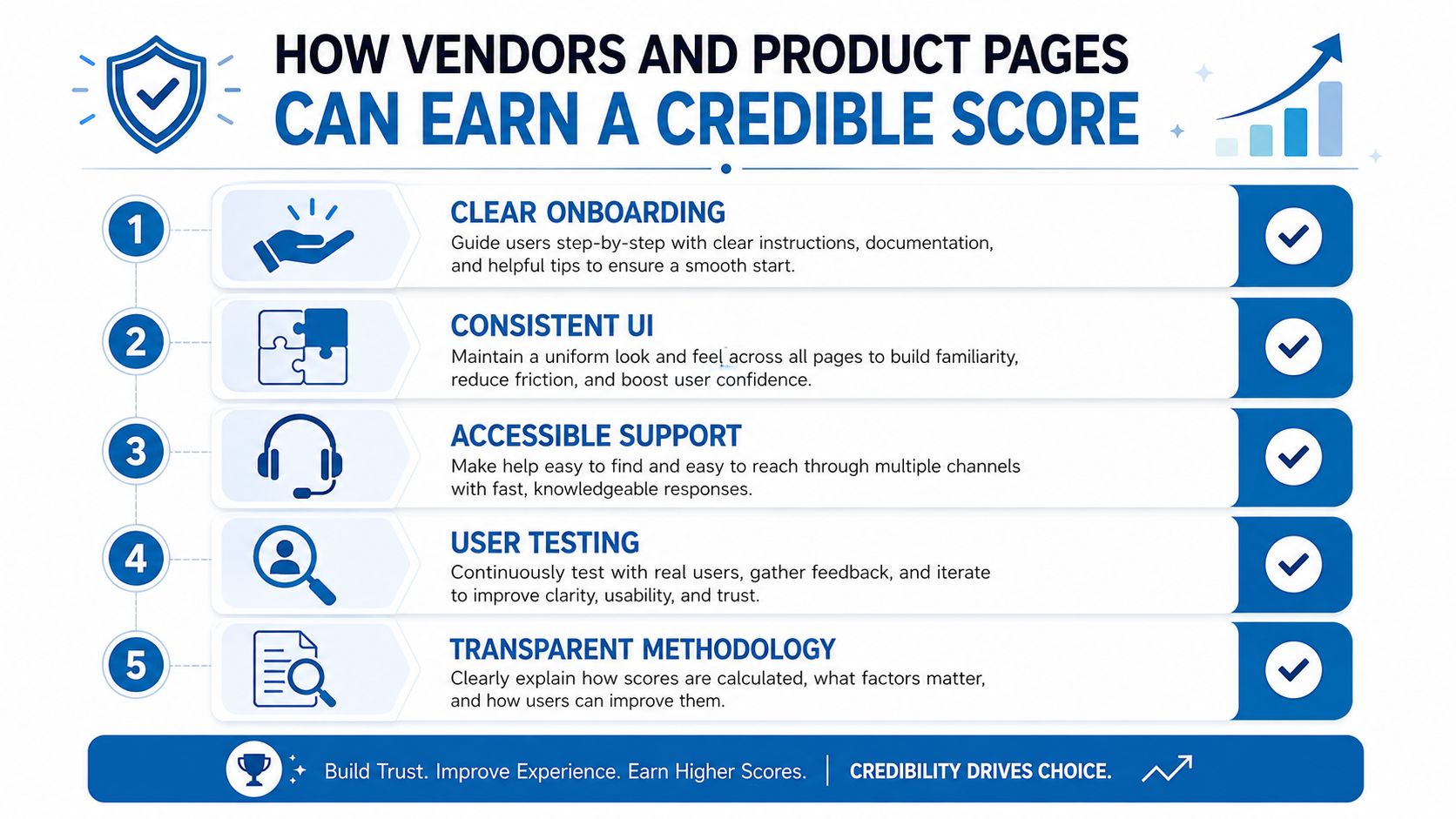
Parents are tired of polished claims, and vendors know it. A score earns trust when a product page shows how the number was built, not just when it displays the number itself. That makes the rating feel like evidence, the kind a careful parent can use while comparing lunch gear, labels, or any other product that has to work in real life.
The basics that make a score believable
Start with the method. Say whether the score comes from SUS, SEQ, or an expert review, and explain which tasks were included in the test. Then identify who was tested, because a score from one audience does not automatically carry over to another.
Specificity matters just as much. If a page only shows stars, readers have to guess what those stars mean. If the page names the task, the user type, and the context, the score becomes easier to compare and easier to trust. That matters for kids' products, where a label for daycare tubs, a bottle band, and a shoe tag each creates a different kind of friction.
Product reliability also shapes whether a score feels believable, because a product that works one time but fails the next does not feel easy for long. A page that connects ease-of-use claims with product reliability gives shoppers a better way to judge whether the experience will hold up after the first use.
For brands that want a cleaner yardstick, the parent-facing product ecosystem works best when reviews, testing notes, and product details all point in the same direction. InchBug, for example, publishes customer ratings and review signals for some products on third-party review pages, which gives shoppers a place to look for how people experienced the product rather than only how the brand describes it.
What to avoid on a product page
- Bare stars with no context leave shoppers guessing what was measured.
- Method names without explanation sound technical but do not inform.
- Rounded-up language can make a score feel more certain than the evidence supports.
- Population mismatch matters when a score was collected from a group unlike the one buying the product.
If you are publishing a score, honesty is part of the feature set. If you are shopping, transparency is the filter that helps you decide quickly without feeling tricked. The two sides meet on the same page, where a tired parent needs enough detail to choose with confidence.
Why Ease of Use Is So Tightly Linked to Satisfaction
Ease and satisfaction are closely tied because people tend to judge the whole experience by the effort it took to get what they wanted. In human-factors research, one study reported participant-level correlations of r = 0.79 for task-level measures and r = 0.71 for product-level measures, rising to r = 0.93 and r = 0.92 when correlated at the task and product levels, respectively. The same work found that mean satisfaction and ease ratings differed by only about 1% on average, which suggests that people often treat them as nearly interchangeable in practice. You can read the research summary at how much satisfaction correlates with ease.
What that means in a household, not a lab
For parents, this is less abstract than it sounds. If a bottle label sticks cleanly, the bottle feels better to own. If a lunch container opens the first time without a fight, it feels like a smarter purchase. That positive feeling compounds because the product keeps being used instead of resented.
But there's a small trap here. A score can look impressive because the test group found the task easy, while your family might face a different setup, a different vehicle, a different hand size, or a different rush level. That's why the method and the tested task matter just as much as the number.
Good rule of thumb: a trustworthy ease rating is one of the strongest clues that the product won't annoy you later, but it still isn't a promise about every home, every child, or every morning.
For a parent-friendly example of how subjective feedback can support a score, the page on parent testimonials is a reminder that satisfaction often shows up in the language families use after repeated use, not just at first glance.
A Simple Way to Use Ease of Use Ratings Next Time You Shop
Use a three-part check. First, find out what was measured. Second, ask who was tested. Third, look for how the score was built. If any of those answers are missing, treat the rating as a hint, not a verdict.
For parents, that one-minute ritual is enough to separate a helpful number from a decorative one. For vendors, it's a reminder that clear methods, honest context, and task-specific scoring make a page more believable.
The next time you're comparing labels, bottles, or lunch gear, don't ask only whether the product looks good. Ask whether the score fits your actual day.
If you want kids' labels and personalized essentials that are built for school bags, lunch boxes, bottles, and the other small things that have to work without drama, take a look at InchBug. Their products are designed for the same real-world routines this guide talks about, where trust comes from clear use, not flashy claims.