

The bottle mix-up usually starts before breakfast. You're hurrying through daycare drop-off with two stainless-steel bottles, both the same shape, both sitting beside several nearly identical bottles in a teacher's tote. By pickup, you're trying to remember which one your child carried in, while the teacher is sorting cubbies, lunch bags, jackets, and lost-and-found items.
Cute water bottle stickers solve more than an appearance problem. A dinosaur, unicorn, flower, or sports design gives a child a bottle they recognize and enjoy carrying. A name, icon, or distinctive color pattern gives adults a quick ownership cue when bottles gather in shared spaces. The right choice depends on more than the artwork, though. Material, placement, cleaning habits, and the child's age all determine whether a sticker remains useful after daily handling.
The Daycare Drop-Off Mix-Up Every Parent Knows
At the classroom door, your child may be focused on a friend, a favorite toy, or getting to the morning activity. The teacher has a different job. She's placing bottles in the right cubbies while managing arrivals, and a plain silver bottle offers almost no help when several children bring the same style.
A cute sticker gives your child an immediate visual marker. A bright dinosaur beside their name can be easier to recognize than a name alone, especially for children who are still learning letters. For younger children, the design becomes the ownership signal. For teachers and caregivers, the printed name confirms the match.
Practical rule: A bottle label should be readable by an adult and recognizable by a child.
The distinction matters in busy daycare environments. Bottles move between cubbies, tables, playground bags, and washing areas. A clear identifier can reduce confusion without requiring a caregiver to open every bottle or ask each child to claim one. Families preparing for a new childcare routine may also find practical guidance in this daycare bottle-labeling guide.
Cleanliness is part of the same routine. Daycare teams manage high-touch surfaces and shared spaces every day, so parents who want to understand the broader maintenance environment can review Arelli Cleaning daycare services for context on professional daycare and school cleaning.
The best sticker, then, serves two audiences. It's fun enough that a child wants it on the bottle, but distinctive enough that a caregiver can identify it during a rushed transition. That combination is why a cute design works better than a decorative decal with no name, and why a plain name label may be less effective with a child who can't yet read it.
What Cute Water Bottle Stickers Actually Do
Cute water bottle stickers sit between decorative bottle art and functional identification labels. A generic laptop decal may look appealing, but it usually prioritizes appearance. A traditional name label does the opposite, giving adults the information they need without necessarily giving a child any say in the design.
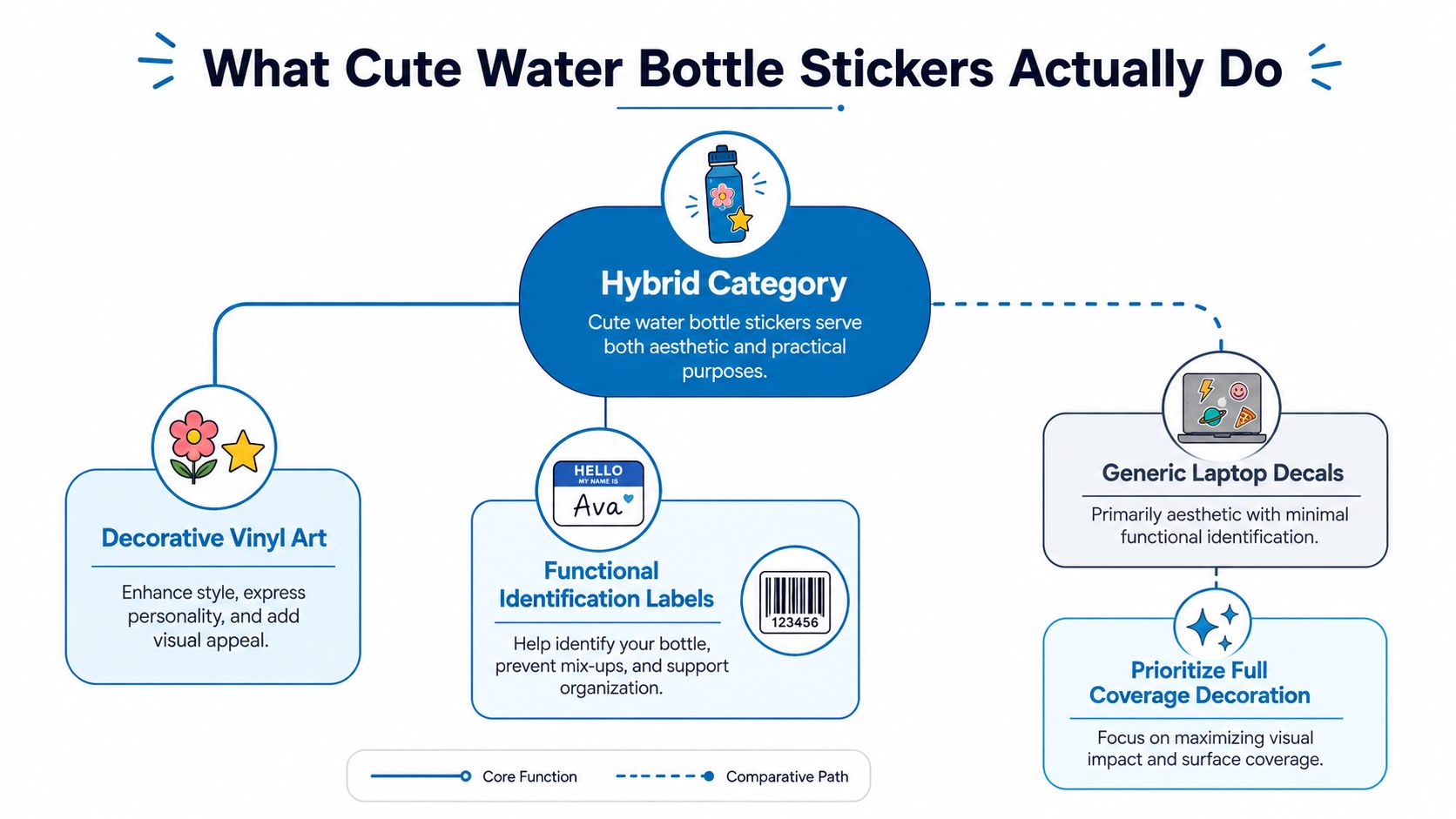
For a child's bottle, that hybrid role is useful. The sticker can:
- Identify ownership: A printed name helps adults sort bottles in cubbies, lunch areas, classrooms, and sports bags.
- Support recognition: A child may identify a chosen animal, color, or symbol before they can confidently read their full name.
- Add a practical reminder: A short message such as “please don't share” can support classroom routines when a bottle has a specific purpose.
- Create attachment: Children are more likely to feel that a plain bottle belongs to them when it reflects their interests.
- Separate similar items: A distinctive graphic helps a teacher or caregiver distinguish one bottle from another at a glance.
The material has to match the job. Paper craft stickers are suitable for temporary projects, but they aren't designed for condensation, repeated handling, soap, or machine washing. A bottle sticker needs a water-resistant or waterproof face, ink that won't smear, and adhesive suited to the bottle's surface.
“Dishwasher-safe” also needs careful interpretation. Independent guidance notes that polypropylene and polyester can be safer choices than standard vinyl when bottles face frequent machine washing, because repeated heat and detergent exposure can weaken adhesive bonds at approximately 55 to 65°C (materials guidance for waterproof stickers). The failure usually appears at the edges first, not as an instant disappearance of the printed design.
A decorative sticker can make a bottle charming. A functional sticker makes it findable. The parent-friendly option does both without sacrificing legibility.
Materials That Survive the Dishwasher
A bottle can leave daycare looking perfect and come home with a peeling label after one hot wash. Cute artwork matters, but the face material, protective layer, and adhesive determine whether the sticker survives condensation, detergent, repeated handling, and the occasional drop. Choose for the bottle's real routine, not the product photo.
Basic vinyl
Basic vinyl is the budget option. It can work for gentle hand-washing or short-term use, but I would not choose uncoated vinyl for a child's main daily bottle. Hot cycles make edge lift, curling, and adhesive creep more likely.
Use it for a camp bottle, seasonal design, or bottle that stays out of the dishwasher. “Waterproof” does not mean unlimited machine washing.
Polypropylene and polyester
Polypropylene, or PP, is flexible and moisture-resistant. It suits a contoured plastic bottle or a temporary school setup when the label must flex instead of crack. Check the printing and surface protection, because those affect appearance, and extended sunlight can fade the design.
Polyester, or PET, is stiffer and resists tearing. It fits bottles that get heavy handling, provided the adhesive matches the bottle surface and the maker gives clear care instructions.
Laminated vinyl
Laminated vinyl places a clear protective layer over the printed face. That layer shields ink from abrasion, moisture, and detergent, so it is a practical choice for a daily stainless-steel bottle. Independent testing summarized by Paperlust found that vinyl with laminate remained in perfect condition through 3, 6, and 12 months of daily washing, with only minor edge lift. Paper with gloss laminate peeled by day 30 and was gone by day 90 (waterproof sticker material testing).
| Material | Construction | Dishwasher Survival | Best For |
|---|---|---|---|
| Basic vinyl | Printed vinyl without substantial overlaminate | Conditional, with edge lifting more likely | Hand-washed or temporary bottles |
| PP | Flexible polypropylene face stock | Suitable when the product specifies machine washing | Contoured bottles and short-term use |
| PET | More rigid polyester face stock | Strong moisture and tear resistance | Rough handling and frequent use |
| Laminated vinyl | Printed vinyl sealed beneath a protective clear layer | Stronger protection, but follow the maker's care instructions | A kindergartner's everyday bottle |
For daycare and elementary school, choose a label that specifies top-rack washing and normal or lower-temperature cycles. Dishwasher guidance also warns that waterproof vinyl is not automatically dishwasher-safe, so follow the maker's care instructions rather than trusting the material name alone (dishwasher-safe sticker guidance). InchBug's guide to dishwasher-safe name labels is useful when comparing those claims.
A decorative sticker makes a bottle appealing. A durable, readable sticker makes it identifiable after a full day of daycare mix-ups. Choose the construction that handles both jobs.
Sizing and Design Choices for Kid Bottles
A sticker can be technically durable and still fail if it's too wide, too small, or placed across a curve. Start by measuring the usable panel, not the bottle's total height. The cap, seam, silicone sleeve, and molded grip areas all reduce the space available for a clean application.
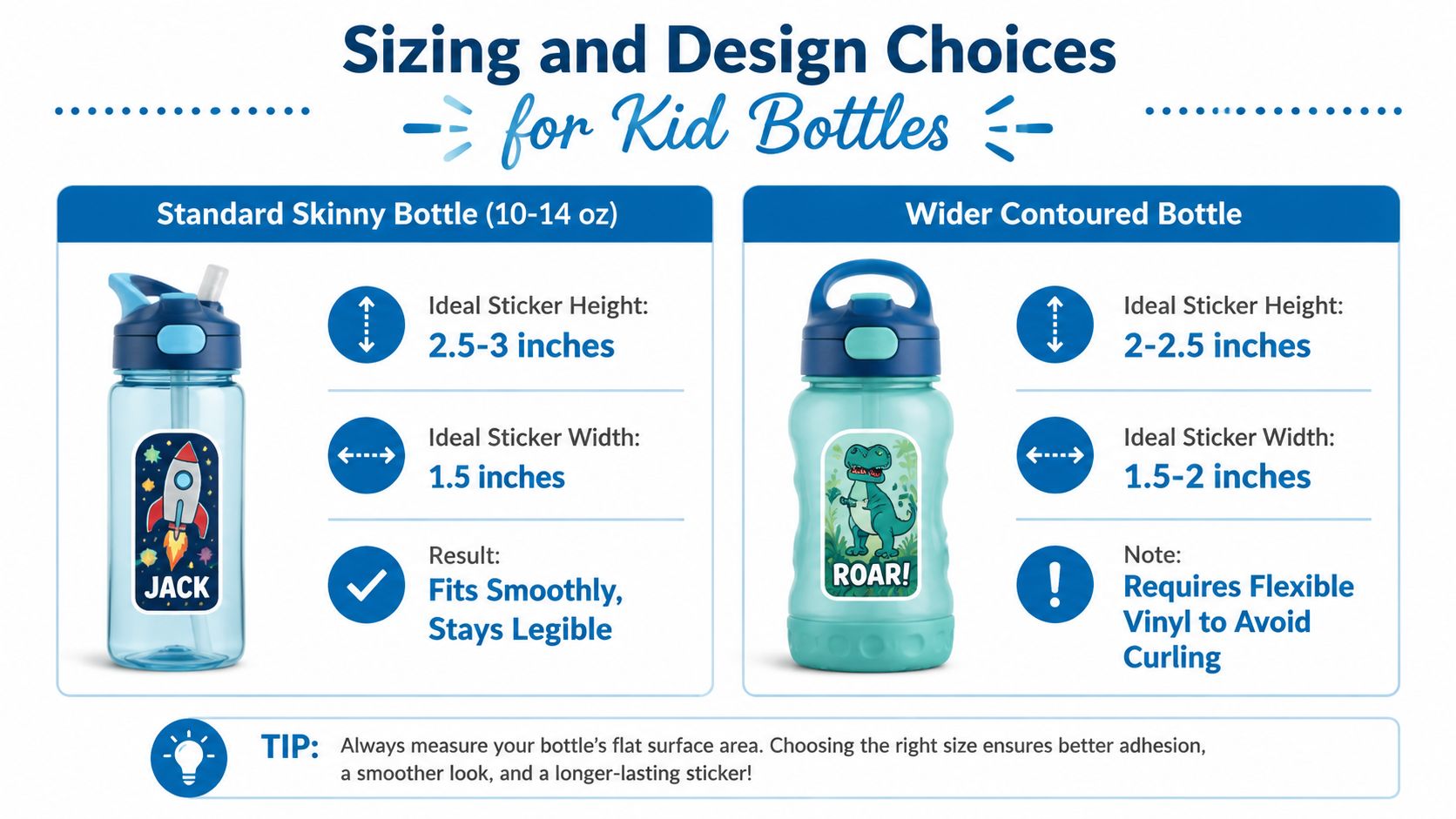
For a standard skinny bottle, a sticker around 2.5 to 3 inches tall and 1.5 inches wide can fit a straight panel while leaving room for a name and graphic. Wider or contoured bottles need more caution. A label around 2 to 2.5 inches tall and 1.5 to 2 inches wide may work when the material can flex without curling.
Keep the name readable
Use a name large enough for a teacher to read without picking up the bottle. The supplied sizing guidance recommends lettering over 6 millimeters tall, and high contrast is more reliable than subtle color combinations. Dark text on a light background, or light text on a dark background, remains easier to scan than pale text over a busy holographic design.
A beautiful label that can't be read from a cubby is decoration, not identification.
Match the shape to the bottle
Flat labels suit straight-sided stainless steel bottles. Flexible bands or wraparound identifiers work better on curved plastic bottles, bottles with tapered bodies, or bottles with silicone sleeves. Keep at least a quarter-inch margin from seams, the lid base, and sleeve edges so the sticker doesn't catch during handling.
Place the main graphic vertically when possible. A character placed too low may disappear behind the cap, while artwork crossing the bottle's curved center line can wrinkle or lift. Parents comparing a bottle's usable area with a label's dimensions can use the Orbit Label size guide before ordering.
Real-World Use Cases From Infant Daycare to Elementary School
An infant daycare bottle needs almost no decoration. The caregiver's priority is individual tracking, so a small name label on a 5-ounce bottle is enough to identify the bottle without taking up the entire surface. Parents should prioritize clear printing, secure adhesion, and compatibility with the way the daycare washes and stores bottles.
A preschooler's bottle needs more visual support. After an art project, children may return to the room with paint on their hands and little interest in reading a small label. A wider sticker with the child's name and a simple icon, such as an animal or flower, gives both the child and teacher a faster recognition cue.
Preschool test: If the child can point to the right bottle before reading the name, the design is doing useful work.
Elementary students need a tougher system because their bottles travel farther. A 20-ounce insulated bottle may go from the classroom to sports practice, then into a crowded gym bag. A wraparound name band can provide the main identifier, while a second flat label on the lid gives the family a backup if the exterior band gets scuffed.
Allergy-aware classrooms benefit from a short, direct reminder beneath the name. “Please don't share” is more useful than a crowded design that buries the message. The bottle itself becomes a visible prompt for adults and children, though it shouldn't replace the school's formal allergy procedures.
By elementary school, sticker duty has shifted. The bottle still needs a name, but the child also wants ownership and personal style. That's where a sports graphic, bold color, or favorite character can make a practical label feel chosen rather than imposed. While organizing clothing and gear for the same transition, a back to school clothes checklist can help families coordinate the rest of the child's labeled belongings.
Application and Care Steps That Make Stickers Last
Most early sticker failures begin before the first wash. Oil from fingers, leftover soap, condensation, and dust create a weak layer between the adhesive and the bottle. Surface preparation takes only a few minutes, but it makes a noticeable difference.
Prepare the surface
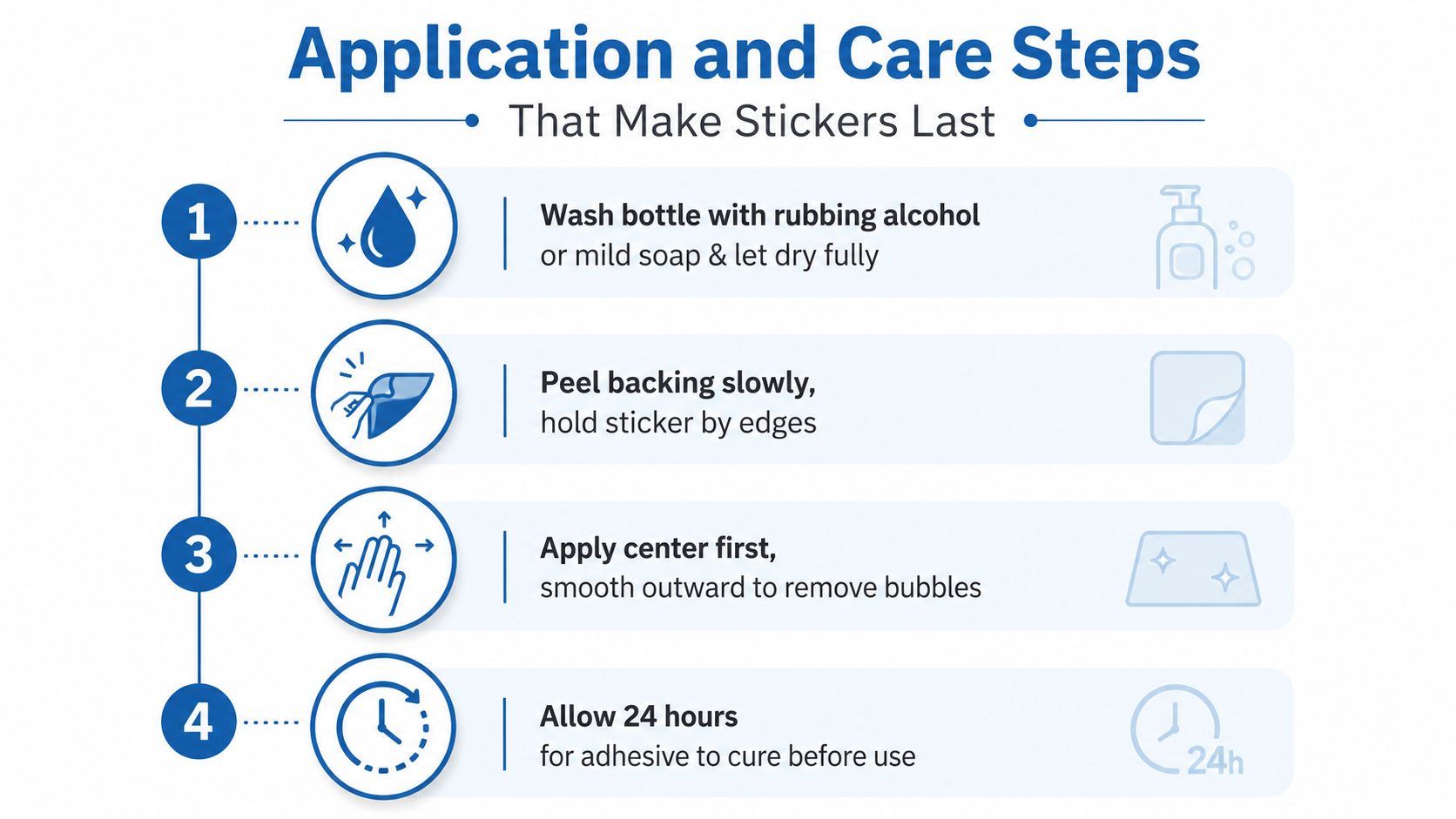
Wash the bottle with mild soap, or wipe the application area with rubbing alcohol when the material allows it. Let the surface dry completely. Don't apply a sticker to a cold, wet bottle straight from the refrigerator, and don't rush because the child is already waiting by the door.
Hold the sticker by its edges as you peel the backing. Center it on the flattest available panel, then press from the middle outward with your thumb or a clean card. This pushes air toward the edges instead of trapping bubbles under the printed area.
Give the adhesive time
Wait at least 24 hours before the first dishwasher run. The adhesive needs time to establish its bond, and immediate washing can loosen a corner before it has settled.
Use the top rack and a normal cycle when the product instructions allow machine washing. Sanitizing cycles run hotter and can accelerate fading or edge lift. Avoid bleach pods resting directly against the sticker, and keep abrasive sponges away from the label area.
Fix small failures early
If a corner begins lifting, press it down while the area is clean and dry. A clear laminate patch can protect a vulnerable edge, though replacement is the cleaner option when dirt has already collected underneath. For removal, warm the sticker gently with a hair dryer on low heat, soften the adhesive, and peel slowly rather than scraping the bottle.
Parents who want a product-specific maintenance reference can review InchBug's label care instructions, then follow the exact cleaning guidance for the chosen material.
Putting It Together With InchBug
The simplest setup separates identification from personality. Use a durable name-focused option for the bottle's core ownership cue, then add decorative art only where it won't hide the name, wrap across a difficult curve, or interfere with cleaning.
For daycare and school bottles, InchBug Orbit Labels provide a reusable bottle-band approach with personalized names and a fit designed for standard-sized children's bottles. The publisher describes the bands as dishwasher-safe and available in bright colors, which makes them useful when a child needs both a readable name and an easy visual marker.
The product choice can follow a straightforward checklist:
- Need a durable identification base? Start with an Orbit Label or another name-focused bottle identifier.
- Need more personality? Add a themed sticker pack with animals, dinosaurs, space, sports, or another interest your child recognizes.
- Need labels for siblings? Choose a combo bundle so each child's bottles, bags, or lunch items can use coordinated but distinct names and colors.
- Need a daily dishwasher routine? Confirm the material, protective finish, and top-rack care instructions before applying anything.
Use decoration to make the bottle appealing, but never let it compete with the name. A child should know which design is theirs, and a teacher should be able to confirm it quickly.
InchBug offers personalized bottle labels, reusable Orbit Labels, themed sticker packs, and coordinated labeling options for daycare and school gear. Visit InchBug to choose a readable, child-friendly setup that fits your bottle, your cleaning routine, and your child's style.