

The bags are lined up outside the courts, mostly black, mostly the same shape, and all carrying someone's favorite racket. A child comes off court ready for the next match, but three families are reaching for nearly identical zippers. Someone checks an inside pocket, another parent calls a name, and the player's warm-up window disappears while everyone works out which bag belongs to whom.
I've organized tennis gear for three children through more tournaments than I can count, and I learned that a bag tag isn't a decorative extra. It's part of a simple identification system that helps children, parents, coaches, and teammates keep equipment together. The right custom tennis bag tags also need to survive sweat, rain, sun, rough benches, travel, and the privacy concerns that come with putting a child's information on a visible item.
Why Custom Tennis Bag Tags Matter for Busy Families
At one crowded weekend tournament, my youngest left a navy racket bag beside the wrong court. Several bags looked identical, and the name label was stitched inside the main compartment. By the time we found it, a coach had already moved the bags to make room for another group. A bright tag on the handle would have solved the problem before it started.
A visible tag helps a coach hand the correct bag to the correct player during a busy practice. It can also reduce accidental racket swaps, especially when several children use similar equipment. Parents often begin with masking tape or a paper card, but those quick fixes peel, curl, and become unreadable after rain or repeated handling. A purpose-made tag gives the bag a clear visual marker that children can recognize without reading a long label.
The benefit is practical, but it's also emotional. A child who chooses the color, icon, or lettering may feel that the bag belongs to them, not merely that an adult marked it. Grandparents can identify the right bag from across a pavilion, and children moving between school, club, and tournament settings can keep their gear recognizable throughout the day.
Practical rule: Put identification where another person can see it quickly, not only where a parent can find it after opening every pocket.
The broader luggage-tag category provides useful context. PW Consulting estimated the luggage tag market at USD 408.0 million in 2023, rising to a projected USD 638.37 million by 2032, with online retail accounting for 57.8% of global revenue in 2025, according to its luggage tag market research. Tennis tags are a smaller use case within that wider category, but the pattern explains why families can find many personalization styles online.
For children with allergies, a tag can also signal that an allergy alert or additional information is inside the bag. Keep sensitive details limited, and use the tag as one part of a broader system. Guidance on labels for kids' backpacks is useful when the same child carries school and sports bags through different locations.
What Custom Tennis Bag Tags Are
A custom tennis bag tag is a hanging identifier, similar to a luggage tag on a suitcase, made for a racket bag, gym bag, backpack, or sports tote. It marks the item from the outside and usually connects to a zipper pull, handle, or D-ring with a loop, strap, ring, or clasp.
The terms can blur together, so identify the product before choosing a design:
- Tag: A rigid or semi-rigid piece that hangs from the bag and stays visible.
- Label: An adhesive name sticker, iron-on mark, or sewn patch attached directly to fabric or another surface.
- Charm: A smaller decorative accent that may show a symbol or initial, but often provides less identification information.
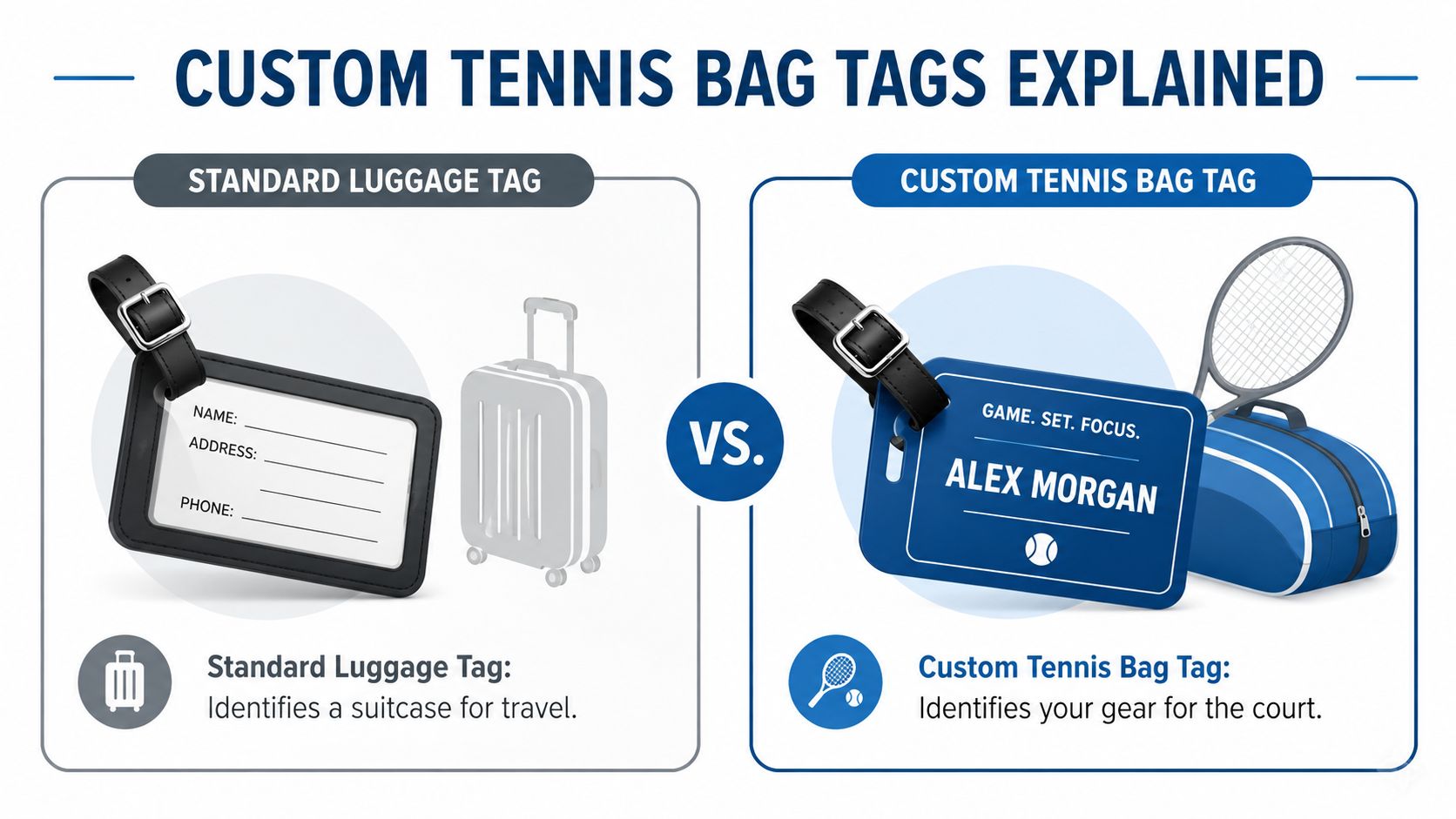
Each option serves a different role. An inside label keeps information discreet. A hanging tag lets a child or coach identify the bag without opening every pocket. A charm adds personality, though it should not be the only marker when teammates carry similar bags.
Check the attachment before choosing details
The attachment should fit a handle or loop without interfering with the zipper. Common choices include split rings, plastic loops, nylon straps, and small clasps. For an active child, select hardware that tolerates pulling and repeated movement instead of relying on a thin decorative cord.
Attachment is also part of a larger gear-identification system. Pair the visible tag with a discreet label inside the bag, especially when contact or medical information must stay private. A name, initials, or team identifier on the outside may be enough for quick recognition, while sensitive details belong elsewhere.
A racket bag may sit on damp ground, rub against court fencing, collect sunscreen, and get pushed under a bench. Those conditions explain why a sports tag needs a secure attachment and a design suited to regular handling. Material and printing choices belong in the next comparison, after the attachment and information plan are clear.
Choosing the Right Material and Shape
Material choice should follow the child's routine, not just the color of the sample photo. A flexible tag suits a young player who throws a bag into the car, while a rigid plastic tag may be better for crisp graphics and repeated outdoor use. Rigid PVC and polycarbonate are especially relevant because they offer dimensional stability plus resistance to water and abrasion, as described in this custom bag tag material overview.
Compare the main material options
| Material | Durability | Print Method | Best For |
|---|---|---|---|
| Silicone | Flexible and comfortable against fabric | Molded or printed details | Young players, soft bags, and gear that gets handled roughly |
| Engraved anodized aluminum | Rigid with a premium, permanent-feeling surface | Laser engraving | Older players, simple names, and a polished tournament look |
| UV-printed plastic | Water and abrasion resistance depend on the substrate and finish | UV printing or protected subsurface printing | Bright colors, team designs, and high-contrast graphics |
| Genuine leather | Develops a classic appearance but needs more care around moisture | Debossing, engraving, or surface printing | Gift tags and traditional tournament styling |
A UV-printed rigid plastic tag works well when the child wants a bright mascot, racket graphic, or team color. UV printing cures ink into a harder surface layer, improving scratch resistance and color retention on rigid plastics. Subsurface printing on polycarbonate places the graphic beneath the surface, which can protect it from direct abrasion. The StyleMark premium label information also reflects an important design principle: water, laundering, and weathering are separate stresses, so passing one test doesn't guarantee performance in every condition.
Silicone handles bending and sweat well, but its softer surface can collect dust and may be harder to read if the lettering is too small. Aluminum offers a clean, durable finish, though some children dislike the sound of metal against a zipper. Leather looks lovely for a gift, but rain and damp kit bags require more attention.
Shape and hardware matter too
Rounded rectangles and ovals are dependable choices for racket bags. Rounded corners are less likely to catch on fabric, fencing, or another bag's straps. Bone shapes can work for a playful design, while rounded squares give more usable space for a longer name.
For attachment, a plastic loop is quiet and light. A split ring is secure but can be harder for small hands to open. A lobster clasp is convenient for adults changing the tag between bags, while a riveted leather loop looks finished but is less flexible for frequent switching.
I'd pair a rounded rigid plastic tag with a strong plastic loop for most junior players. For an older player who wants a minimal design, engraved aluminum with a split ring is a sensible alternative. Families considering metal can also review guidance on personalized metal tags before choosing the finish.
Personalization Best Practices for Readability and Safety
A beautiful tag fails if a coach can't read it from a few steps away. Start with the information another person needs, then add style only if space remains.
For younger children, a first name or familiar nickname may be enough, especially when the tag is used at a local practice. Older players who travel more independently may benefit from a full name, but public visibility changes the privacy decision. A parent phone number can help with returns, while a home address, school name, and full birthdate should stay off the tag.
Build the front for quick recognition
Use a bold, uncomplicated font. Decorative script can look attractive in a proof and become difficult to read when the tag swings, gets scratched, or is viewed in poor light. Strong contrast helps. Neon lettering on a dark bag or dark lettering on a light tag generally stands out faster than pale text on a busy background.
A small icon can help a child identify their tag before they read it. Choose one meaningful marker, such as a tennis ball, a star, or a team symbol. A jersey number can distinguish siblings with the same first name, but don't crowd the name with several slogans, icons, and decorative borders.
| Element | Recommended | Avoid |
|---|---|---|
| Name | First name, initials, or a carefully chosen full name | Long text that becomes tiny |
| Font | Simple, bold, high-contrast lettering | Thin script and ornate flourishes |
| Color | Dark text on a light background or bright text on a dark one | Low-contrast combinations |
| Extra marker | One icon, team symbol, or jersey number | A crowded collection of graphics |
| Contact details | A parent phone number when appropriate | Home address, school name, or birthdate |
Safety check: Ask whether a stranger needs to know this information to return the bag. If the answer is no, leave it off.
Privacy and durability belong in the same decision. A tag needs to remain readable after sweat, rain, bench hooks, and repeated handling, but that doesn't mean every available detail should be printed. Waterproof, washable materials and UV-cured inks are commonly recommended for outdoor-use name tags, as discussed in this water-resistant bag labeling guidance.
Before approving a proof, reduce it on your phone or print it at a similar size. Look at it from across a room, then check it in bright daylight and indoor shade. If you need to squint, remove a line or simplify the design. More information isn't always more useful.
For additional guidance on choosing readable lettering, consult this resource on font size for labels.
Ordering Workflows for Parents, Coaches, and Gift Shoppers
The ordering process changes depending on whether you need one tag, a roster, or a surprise present. The safest habit is to treat the proof as part of the order, not as a formality.
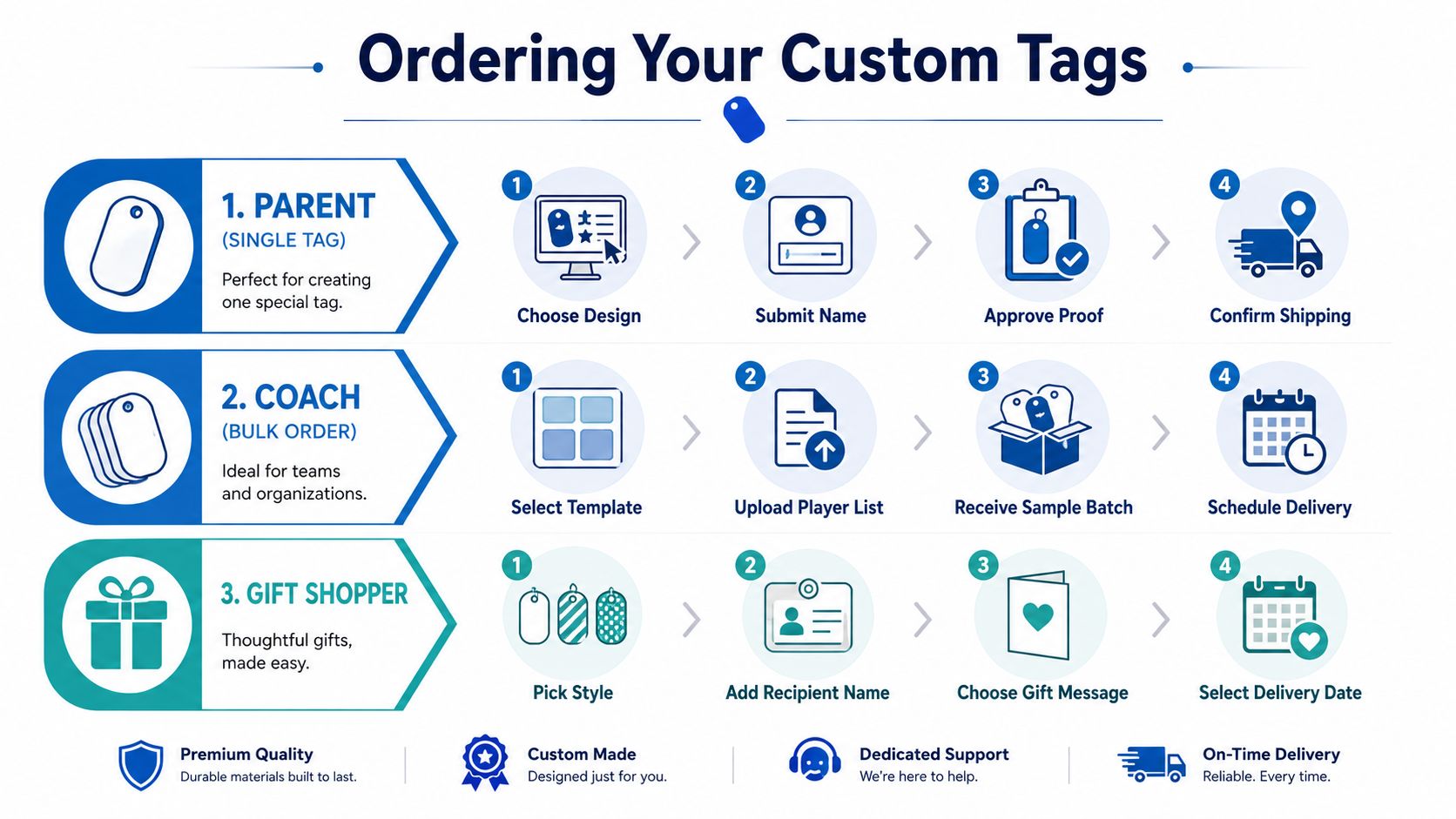
For a parent ordering one tag
- Choose the tag shape, material, color, and attachment.
- Enter the name exactly as it should appear.
- Review the digital proof for spelling, capitalization, spacing, and contrast.
- Confirm the shipping date against the next practice or tournament.
Save the final proof in your email. If a child has a nickname, verify whether the nickname or legal first name will make recognition easier in that setting.
For a coach ordering for a team
Start with a shared roster rather than collecting names through scattered messages. Useful columns include player name, preferred spelling, jersey number, team color, and pronunciation notes. Send one completed sample to the coach before approving the full batch, especially if the design includes a school mascot or several color elements.
Ask the supplier how bulk pricing works. The exact breakpoints vary, so request a written quote rather than assuming a discount applies. Also ask whether each player receives an individual proof, how corrections are handled, and whether tags arrive sorted by roster order.
The same discipline used for personalized school supplies in bulk can help teams avoid mismatched names and last-minute sorting.
For a gift shopper
Confirm the recipient's preferred name, bag color, and sport style before ordering. Leave extra time for personalization, proof approval, production, and delivery, and ask about gift receipts or discreet packaging if the tag is meant to be a surprise. If you're choosing gifts for a family, a practical resource such as this new parent gift guide can help you pair a personalized item with other useful gear.
Before payment: Read every name aloud, compare every color to the approved design, and check the delivery address before placing the order.
Real-Life Examples of Tags in Action
At a Saturday clinic, a group of children leaves thirty red-ball bags near the entrance. The bags are mostly the same navy shade, and the players are eager to get back on court. Bright tags let the coach sort them quickly by first name instead of opening compartments or asking children to describe their equipment.
Takeaway: Use high contrast and a name large enough to recognize during a rushed handoff.
During a tournament, a rain delay sends players and families under different covered areas. One bag is left beside a court after the schedule changes. A tag carrying the player's name and a carefully chosen tournament identifier helps a volunteer reconnect it with the right family without exposing unnecessary personal information.
Takeaway: Add a useful secondary identifier only when it helps event staff, and keep private details limited.
Travel creates a longer chain of handoffs. A family may move from home to car, airport, hotel, club, and tournament venue in a single trip. Matching identification on the tennis bag and suitcase helps parents confirm that the gear stayed with the same family group throughout the journey.
Takeaway: Think of tags as links in a gear chain, not isolated decorations.
A team tag can also become a keepsake. Matching designs with a school mascot or team color mark the bags during the season, then remind players of the group after the final event. Keep the front functional, and let the shared design provide the sentimental value.
Takeaway: A team order can serve both daily organization and a meaningful end-of-season gift.
These examples point to a broader routine. Identification works best when children check their bag before practice, coaches do a quick sweep after play, and families reset loose items at home. Sports-organization guidance recommends identifying gear in more than one location and pairing tags with repeatable checks, because a single visible tag can't account for a water bottle, sweatshirt, racket cover, or pair of shoes left behind separately.
Care, Bundles, Costs, and Common Questions
A tag lasts longer when the care routine matches the material. Wipe silicone and plastic with a soft damp cloth after sweaty practices, then let them dry before the bag goes into a closet. Leather needs gentler cleaning and should not be treated as if it were waterproof plastic. Metal can be wiped dry to prevent residue from collecting around the attachment.
Machine washing depends on the bag and the attachment, not just the tag. Remove hanging tags before washing a sports bag unless the maker specifically says the loop and tag can remain attached. Keep spare tags flat in a small pouch or envelope, away from heat and direct sun, so they don't bend or fade before use.
Replace a tag when the name is no longer readable, the attachment is splitting, or the surface has sharp edges. A faded tag isn't merely unattractive. It no longer performs its identification job.
Choose bundles around your real routine
A sibling pair may need separate tags with distinct colors or icons. A coach may prefer one coordinated team order, while a tournament gift might combine a tag with another small piece of gear. Confirm quantity, personalization limits, proofing, and delivery before comparing prices.
| Bundle Type | Typical Quantity | Average Price Range | Best For |
|---|---|---|---|
| Single personalized tag | One | Varies by material and supplier | One child or replacement |
| Sibling set | Multiple individual tags | Varies by design and finish | Families managing several bags |
| Team order | Roster-sized batch | Varies with quantity and customization | Coaches and clubs |
| Gift set | Tag plus selected gear | Varies by included items | Birthdays, awards, and season milestones |
Prices usually rise with engraving, premium substrates, complex hardware, and individually approved artwork. Printed plastic can be a practical everyday choice, while engraved metal or leather may suit a keepsake. Bulk discounts and shipping schedules depend on the supplier, so ask for the complete delivered cost rather than comparing the tag price alone.
For longer product life, follow the maker's specific label care instructions.
Common questions
Do tags survive the dishwasher?
Don't assume they do. A bag tag isn't automatically dishwasher-safe, and the attachment may be the weak point. Check the product's care instructions, and remove the tag before washing the bag.
Can I reorder one tag if my child loses it?
Often, yes, if the supplier retains your design or order record. Save the original proof so you can reproduce the name, colors, and layout accurately.
What information should I leave off?
Leave off home addresses, school names, and full birthdates. Consider whether a parent phone number is appropriate for the setting, and use only information that helps a responsible adult return the item.
Are metal tags loud against zippers?
They can make more noise than plastic or silicone. A nylon strap, soft sleeve, or plastic loop can reduce contact, while a quieter material may be better for a child who finds zipper noise distracting.
Should I identify other gear too?
Yes. Add discreet labels to items that commonly separate from the bag, such as water bottles, jackets, racket covers, and shoes. The bag tag provides the outside marker, while smaller identifiers support the rest of the recovery system.
InchBug offers personalized Circle Kids Bag Tags and Rectangle Kids Bag Tags for backpacks, sports bags, lunchboxes, diaper bags, and luggage, with multiple lines of personalization and a plastic loop for attachment. Visit InchBug to choose a visible gear marker and build a practical identification system for your child's tennis season.