

The fastest way to ruin a family trip is to stand at baggage claim, staring at a child's suitcase with a ripped-off tag and no obvious way to prove it's yours. I've had that moment with a damp duffel after a rainy curbside drop-off, and with a backpack that came off a conveyor looking like it had been dragged under a bus. That's why custom luggage tags metal are more than a style choice for parents, they're a practical answer to the things that destroy flimsy tags in real travel.
The market agrees that durability still matters. The global luggage tag market was valued at about USD 420 million in 2024 and is forecast to reach USD 680 million by 2033, a 5.5% CAGR from 2025 to 2033, which means the category is still growing instead of fading out DataHorizzon Research. For families, that growth makes sense. Kids' bags get tossed into trunks, daycare cubbies, sports bins, and overhead bins, and a tag that survives all of that has real value.
Why Metal Tags Survive When Plastic Fails
The first time a tag fails, parents usually blame bad luck. Usually, it's just bad materials. Plastic cracks in cold cargo handling, printed information fades after moisture exposure, and soft loops tear where the tag meets the handle. Metal changes the failure pattern because the plate itself keeps its shape and its markings stay readable longer.
I've seen the worst failures happen in exactly the places families rely on most. A suitcase tag catches on a conveyor edge, a backpack tag gets bent against a daycare cubby hook, or a camp bag comes home with a marker-written label washed into a blur. Those are the moments when durability is not a luxury feature, it's the whole point.
Practical rule: if the tag can't survive baggage handling, it won't survive a school year.
A useful benchmark comes from the broader luggage-tag category. A 2022 study cited in an industry article reported that 25% of lost luggage claims stemmed from damaged tags, which explains why parents and frequent travelers keep moving toward tougher materials Shun Ding. Metal is often chosen because the tag itself is less likely to snap, bend out of shape, or lose legibility after repeated abuse.
For parents, that durability matters in a second way too. Kids rarely treat luggage tags gently. They pull on them, catch them on zippers, and drag bags by the handle. A stronger tag doesn't just last longer, it stays attached long enough to do its job. If you're comparing options for family travel, InchBug's personalized metal tags fit that use case well because they're built around the basic need parents have, not the fantasy version where every bag rides gently in a padded compartment.
Understanding Metal Tag Construction and Durability
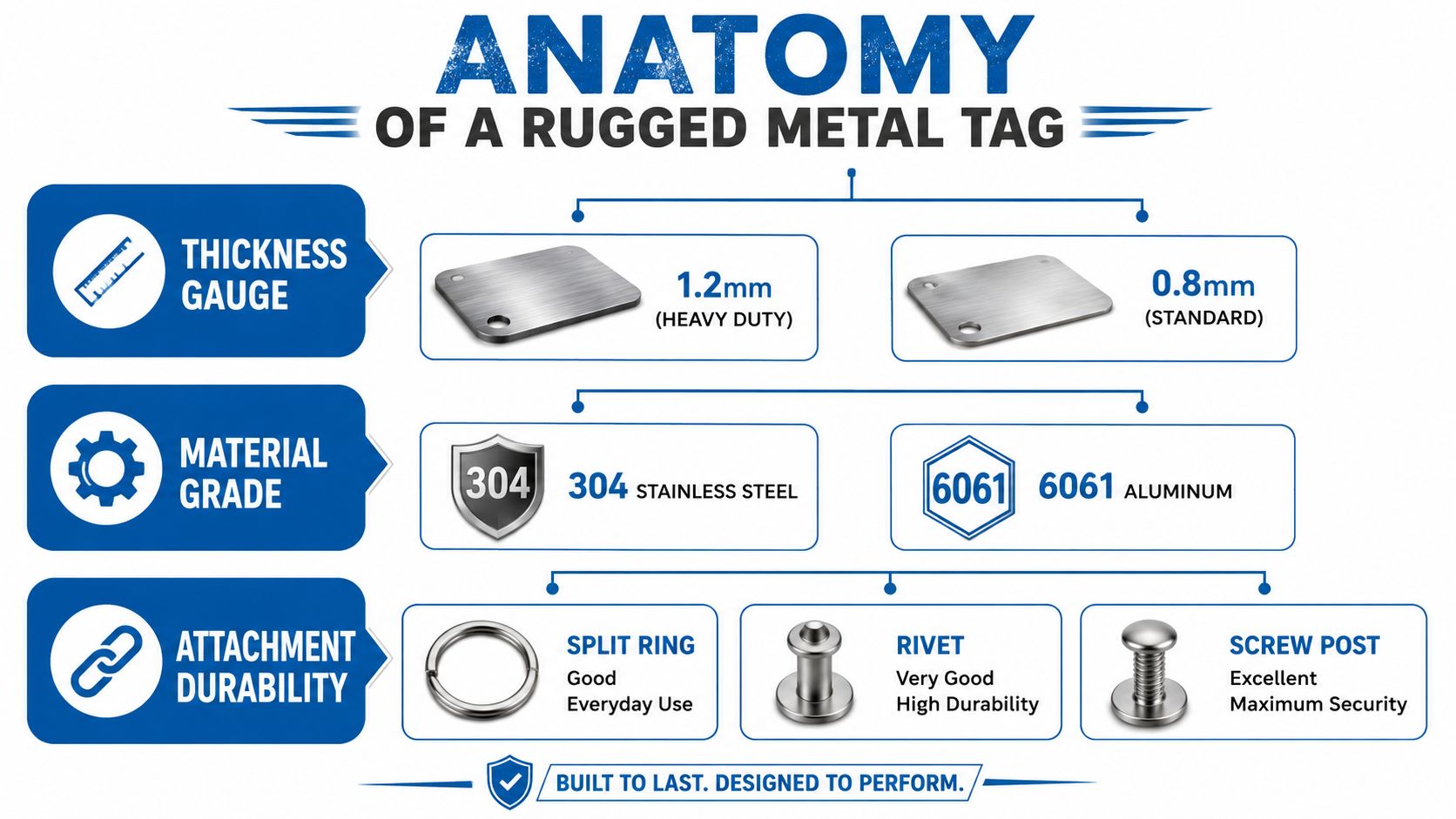
Thickness, material, and the part parents usually overlook
The practical difference between a tag that lasts and one that bends usually starts with thickness. Products in this category often sit in a narrow size range, with examples such as 85 × 52 mm to 85 × 54 mm, and thicknesses that can run from 0.8 mm brushed stainless steel up to 1/16 in, about 1.6 mm, aluminum sheets Pure Metal Cards. That extra thickness helps the tag keep its shape when a suitcase gets packed tight, dropped, or squeezed under heavier luggage.
Material changes how the tag holds up after repeated use. Stainless steel and anodized aluminum both give better resistance to corrosion, which matters because family travel includes rain, humidity, sticky hands, and bags that sit on damp floors. For markings, laser etching is the safer choice because it stays readable without depending on ink or a printed coating, so the information does not fade when the tag gets scraped against other bags.
A good way to read product listings is to ask three questions. What is the thickness, how is the information marked, and what protects the metal from wear? If a listing only says “metal” and stops there, the buyer still does not know much about how it will perform.
Why the connector deserves as much attention as the plate
The connector is where many tags fail first. A strong plate still does nothing if the loop stretches, cracks, or slips off under load. Some metal luggage tags use a steel wire rope or stainless-steel loops coated with nylon, and that detail matters because the attachment point is what keeps the tag on the bag through hard handling Amazon product specification example.
For a different long-wear example, the metal treatment used in a shop memorial vehicle graphics product shows the same practical idea, a hard surface is only useful if the piece is built to stay intact after repeated contact. That is a helpful mindset for luggage tags too. Parents should look for loops that stay tight, resist sharp bends, and do not rely on a fragile clasp that can catch on a backpack strap or daycare hook.
Metal is only part of the answer. The plate, the marking method, and the loop have to work together.
If the tag is for a child's backpack, the details matter more than the glossy photo. A thicker plate helps, but the connector decides whether the tag is still there after a week of school drop-off, cubby storage, and being dragged through a crowded hallway. Families who want a practical durability reference can also review InchBug's label durability testing notes for a clear look at how tags and labels get pushed past normal use.
Choosing the Right Metal Type and Finish
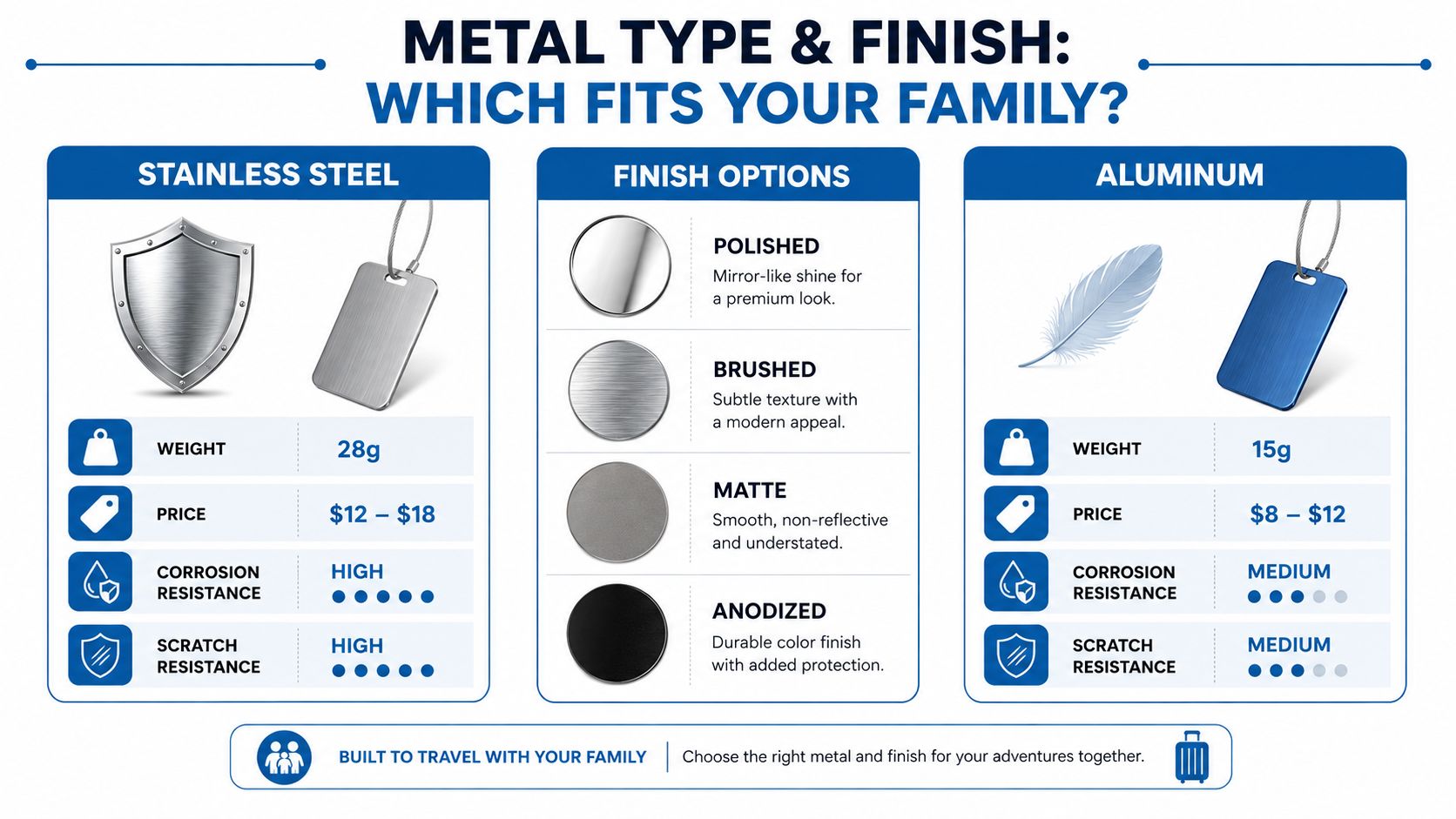
Stainless steel and aluminum serve different family needs
For most parents, the choice comes down to stainless steel versus aluminum. Stainless steel usually makes sense when durability and scratch resistance matter most, especially for bags that travel constantly or get tossed into shared gear piles. Aluminum is the lighter-feeling option and often makes more sense when you want a premium look without adding unnecessary heft to a child's backpack or a soft-sided overnight bag.
The finish changes the experience too. Brushed and matte surfaces hide scuffs better than polished ones, which matters because kids don't keep tags pristine. Anodized aluminum gives you more color options without giving up the metal look, so it's a smart middle ground for families who want something easy to spot on a crowded luggage cart.
A parent's decision framework that actually works
If the bag belongs to a frequent flyer or a child going to sleepaway camp, prioritize long life and attachment strength over cute styling. If the tag is for a vacation suitcase that gets used a few times a year, lightweight aluminum can be the more reasonable buy. If the tag is for a child's daycare backpack, the question is whether the rigid plate will stay comfortable and unobtrusive against a small bag.
Here's a simple filter:
- Pick stainless steel if the bag gets rough handling, exposure to wet conditions, or repeated travel.
- Pick aluminum if you want a lighter tag with a cleaner, more customizable look.
- Choose brushed or matte if you care about hiding wear.
- Choose polished only if appearance matters more than scratch camouflage.
A lot of buyers assume the “premium” choice is always the heaviest one. That's not how family travel works. For kids, the right finish is the one they'll still be able to recognize after the tag has been bumped, rubbed, and handled by people who don't care about keeping it pretty.
If you're comparing metal luggage tags with other personalized travel products, the same logic applies to Evright Industrial asset tags, which show how metal can be chosen for identification that needs to hold up in harder use environments. The use case is different, but the durability logic is the same, keep the identity visible, keep the surface legible, and keep the attachment secure.
Designing Custom Tags That Kids Can Actually Read
The cutest tag design isn't useful if your child can't pick it out in a rush or read it when the bag is half-hidden under another suitcase. For kids, legibility beats decoration. Large text, high contrast, and a simple layout almost always outperform a busy design with tiny script and too much detail.
How to make the personalization work in real life
Start with the name. Use a font that stays clear under abrasion, not one that looks fancy only on a mockup. Small text should be spaced generously, because tiny letters crowd together fast once the tag gets scratched. If the design includes a reverse side, keep the most important information on the side that's easiest to scan at a glance.
For daycare bags and school backpacks, a child often needs to recognize the tag faster than a parent does. That's why bold first names, readable initials, or a familiar nickname usually work better than formal full names. If you want more creative layout ideas, InchBug's label design ideas are a useful reference point, especially if you're thinking in terms of what kids can identify instead of what looks polished in a catalog.
Design rule: if the text looks elegant only when it's tiny, it's the wrong design for a child's bag.
A solid custom metal tag for kids usually follows three steps. First, keep the front simple. Second, use contrast the child can read in dim airport lighting or a cluttered classroom. Third, reserve decorative elements for the back or the border, where they won't compete with the name. That approach works for toddlers, elementary school kids, and older children carrying sports gear.
The one place where design becomes even more practical is when a family uses a tag as part of a larger bag-identification system. InchBug's Rectangle Kids Bag Tags offer up to 4 lines of custom text on one side, with a design on the reverse, which makes them a clear example of how personalization can still stay readable when it's built for kids' gear.
Protecting Your Child's Privacy and Safety
A metal tag can survive rough handling and still create a privacy problem if the wrong details are etched into it. Once those details are engraved, they are harder to change than a paper insert or a temporary sticker, so the first decision is not just what looks clear, but what should be visible at all. That is the part most buying guides skip. They focus on getting a bag back, but they do not spend enough time on what happens if a stranger sees your child's full name, home address, or phone number.
What belongs on the outside and what doesn't
Consumer travel guidance often recommends a first name or nickname on the outer tag and full contact details kept on an inner card Travel + Leisure. That setup makes sense for children because it limits exposure while still giving a finder enough context to identify the bag as belonging to a child. I would use that approach most strictly for younger kids, especially on daycare bags, sleepover luggage, and school travel.
A visible tag should help someone return the bag, not tell the whole story about the child carrying it. A full home address rarely adds much recovery value if a bag is found in a public place, but it does add privacy risk if the bag is stolen, photographed, or handled by someone you do not know. A better setup is straightforward, limited outer information, full details hidden inside, and only the contact data you need.
For families who want cleaner labeling, the trade-off is worth sorting out before ordering. Metal tags make information last, which is useful for durability, but that same permanence means the text needs to be proofed carefully before engraving. One poor choice on the front of a tag can stay there for a long time.
For a more detailed breakdown of what belongs on a luggage tag, InchBug's guide on what info to put on a luggage tag is a practical reference when you are deciding how much to show outside and what to keep hidden.
A smarter information structure for children's bags
- Outer surface: child's first name or nickname.
- Inner card: full parent contact details.
- Special cases: use even less visible information for young kids or unaccompanied minors.
- If the bag is school-bound: keep the label understandable to staff, not strangers.
The difference is between recovery and exposure. If a lost bag gets found quickly, a simple, readable tag does the job. If the bag does not turn up right away, you will be glad you did not publish more personal data than needed. That is the safety logic behind durable Custom Luggage Tags Metal, strength on the outside, restraint in the information they show.
Attachment Methods That Won't Fail at the Worst Moment
The tag itself can be durable and still fail at the attachment point. In family travel, that is usually the part that gives out first, especially when a child twists the tag, yanks at it, or drags the bag over a rough floor. I have seen plenty of tags survive the trip and lose the hardware instead.
What holds up and what tends to disappoint
For repeat use, steel wire rope and nylon-coated stainless loops are the attachment styles I trust most. They handle abrasion and tension better than plain plastic straps, which are easier to open but more likely to wear out early or become the weak point on a bag that gets handled constantly. For younger kids, I stay away from anything that feels flimsy or invites constant pulling.
If you want a practical reference for how a child's bag can be labeled without turning the tag into a problem, InchBug's guide to a bag with a name tag is a useful example of keeping the setup simple and readable. The same principle applies to hardware. The attachment should hold the tag in place without creating extra parts a child can fiddle with.
The industrial RFID world points in the same direction. On-metal tags are often paired with specific loop hardware because the attachment point has to hold up under harsher conditions, not just look tidy on a product page. For engraved tags, the lesson is straightforward. Inspect the loop before every trip and replace it at the first sign of fraying, slack, or distortion.
A few checks are worth making before the bag goes out the door:
- Feel for looseness before packing.
- Look for bending or kinks where the loop meets the plate.
- Swap weak hardware early instead of waiting for a failure.
- Keep spare connectors with your travel kit if your family flies often.
Child safety matters here too. Tiny detachable parts can create avoidable hazards for younger kids, so the safer choice is usually the one with fewer loose components and a closure that stays shut unless an adult opens it. The goal is not to make the tag hard to remove for a parent. The goal is to keep a child from breaking it by accident.
A bag tag should survive the same chaos as the bag it rides on. If the attachment cannot handle repeated pulls, scrapes, and quick grabs from a classroom hook or airport bench, the whole purchase is built on the wrong assumption.
When Metal Tags Make Sense and When They Don't
Metal tags earn their keep when a family needs something durable, readable, and reusable across multiple trips. That's especially true for frequent flyers, camp bags, sports gear, and anything that gets checked, tossed, or handled by strangers. In those cases, the higher-value feel is a bonus, not the main reason to buy.
Best fit and poor fit are not the same thing
For travel-heavy families, the appeal is obvious. Metal keeps its shape, the marking stays legible, and the tag feels more permanent than the disposable alternatives. For school and daycare, though, you need to think about weight, rigidity, and how much hardware is hanging off a small bag. Some children's bags don't need a hard plate swinging from the zipper every day.
That's where simpler materials can make sense. Laminated plastic, silicone, and fabric tags are easier to replace and often lighter. They're also a better choice when the goal is quick rotation rather than long-term reuse. If a child's bags change constantly, the cost of a more durable tag may not buy you much extra value.
The business side of the category points in the same direction. The luggage-tag market is still expanding, which suggests buyers continue to care about better materials and personalization rather than treating tags as throwaway items DataHorizzon Research. But growth doesn't mean every family needs the same product. It just means the premium side has room because there's a real use case for it.
An easy way to decide is to ask two questions. Does this bag travel enough to justify a tag that lasts? And does the child need a tag that's comfortable, simple, and low-profile enough to ignore during the school week? If the answer to both is yes, metal may be worth it. If not, a lighter option probably makes more sense.
For parents who want a middle-ground travel tag, InchBug offers personalized options that fit kid gear and family routines without forcing every bag into a one-size-fits-all travel solution.
Caring for Metal Tags and Maximizing Their Lifespan
Metal tags don't need a lot of maintenance, but the little things matter. Wipe them off after rainy trips, check the engraving or etching for wear, and make sure the connector still sits tight after the bag has been handled by airports, cars, and kids. That's usually enough to keep them useful for a long time.
What to clean, what to watch, and what counts as damage
A soft cloth is enough for routine cleaning. Avoid anything abrasive that might scratch a brushed finish or dull the surface around the engraving. If the tag gets bent, inspect whether the shape has changed enough to affect readability or whether the issue is mostly cosmetic. Small dents are annoying, but they don't always mean the tag has failed.
Security concerns are easier than expected. A luggage tag isn't the sort of item that should create scanner problems, and the main practical concern is still whether it stays attached and readable. Temperature changes can also affect bags, but a well-made metal tag is built to handle normal travel conditions better than delicate printed labels.
If a tag is for a child who travels often, take a photo of the finished layout when it's new. That makes reordering or replacing it much easier later, especially if the same bag gets handed down between siblings. It also helps if you're keeping a record of what information was visible on the outside versus hidden inside.
For gifts, metal tags work well because they're personal without being fussy. They're a thoughtful option for new parents, graduation travel, or a family trip keepsake, as long as the design keeps privacy in mind. The best versions are simple, legible, and sturdy enough to survive the next trip instead of just looking good on day one.
If you want a tag system that's built for real daycare drop-offs, family trips, and the kind of bag handling kids put gear through, visit InchBug and look at the personalized labels and bag tags made for everyday family chaos. Their travel and label options are designed to help parents keep gear identified, readable, and easier to manage from preschool through family vacations.