

You're probably staring at a teacher's email address right now, wondering if you're too late, too early, or asking the wrong person. A friend tells you to “just get two teachers,” another parent says the letters won't matter much, and meanwhile the deadlines are getting real. That confusion is exactly why teacher recommendations trip up smart families.
Admissions offices read these letters as meaningful evidence and do not treat them like a throwaway checkbox. In a National Association for College Admission Counseling survey, 54% of admissions offices said teacher recommendations were considerably or moderately important, and another summary of a 2023 NACAC survey reported 50% of participating colleges rated letters of recommendation that way as well, with recommendations ranking above class rank, extracurricular activities, and AP/IB/subject test scores in perceived importance (NACAC survey summary). If you want a classroom example of why this matters, think about how teachers observe habits nobody else sees, the same idea that drives strong classroom management and student observation practices in this classroom management guide.
Why Teacher Recommendations Matter More Than You Think
A junior watches a senior friend scramble in October. The senior finally asks for recommendations, but the teachers are overloaded, the materials are scattered, and the letters turn into generic filler because there was no time to do them well. That's not an outlier, it's the standard cautionary tale, and families keep repeating it because they underestimate how much admissions readers rely on the teacher's view of a student in a real classroom.
Practical rule: A strong recommendation doesn't need to “save” an application, but it can sharpen how an admissions reader understands the rest of it.
The key point is that these letters are part of the core qualitative review. They help readers judge character, work habits, classroom maturity, intellectual curiosity, and academic potential, not just grades or test performance. That's why a generic letter is a problem. It doesn't usually sink an applicant by itself, but it wastes one of the few places where a real adult can say, with evidence, what kind of student showed up all year.
The admissions workflow reflects that reality. Most colleges ask for one or two teacher recommendation letters, and many admissions guides treat two as the standard expectation in the United States (Common App recommender system). That means the letter isn't an optional extra, it's part of the file colleges expect to complete on time. If the letter is detailed and specific, it can reinforce an otherwise ordinary transcript. If it's thin, it lowers the ceiling on how an application is read.
What readers actually want
They want fresh evidence, not a rehash of the activities list. They want to know how you act when a discussion gets messy, how you respond to feedback, and whether you improve when the work gets harder. A teacher who knows those details gives admissions officers something a transcript never can.
Building a Realistic Letter Timeline
The strongest recommendation letters do not happen by accident. Students earn them by working backward from deadlines, then treating the recommendation process like every other application task that needs a clear owner and a clear date. The Common App's recommender system is built for submitting and tracking teacher recommendations, and the right mindset is to ask early enough that a teacher has room to write something specific, not rushed.
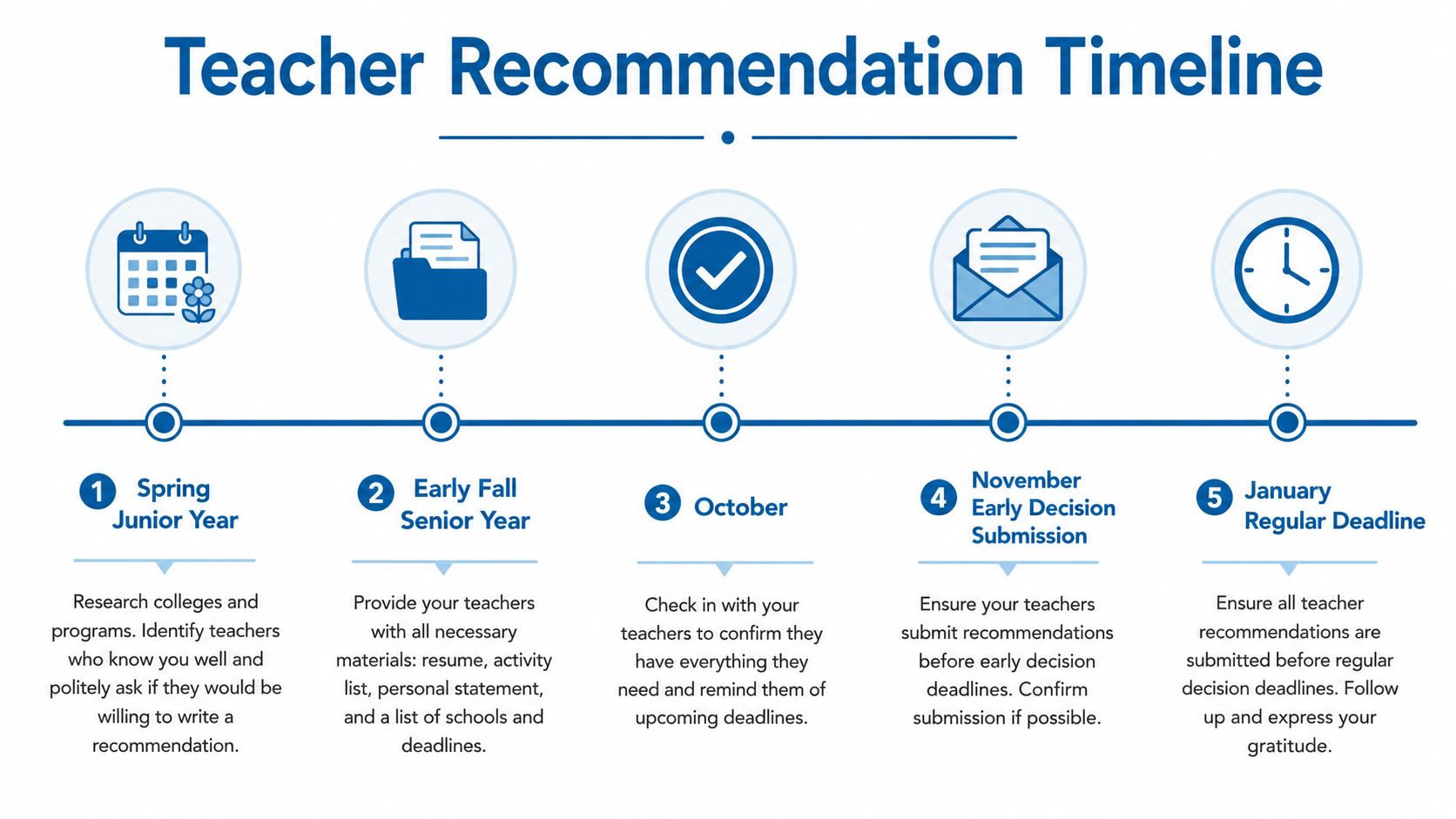
Spring junior year is the planning window
Spring junior year is the time to sort out which colleges want teacher letters, which ones have subject preferences, and which teachers know you well enough to write with detail. If you wait until the application portal opens, you are already behind. In large schools especially, teachers fill up fast, and students who wait for a perfect moment usually end up asking in a rush.
Use this window to build the relationship, not just the list. Sit where the teacher can see your work, ask questions that show you are engaged, and let them watch your habits in real time. A strong letter starts long before the request, and even small classroom routines matter, especially for teachers who are trying to prepare themselves for a packed fall, like the practical advice in how teachers can prepare for back-to-school with InchBug.
Early fall senior year is the action point
By early fall, your list of recommenders should be set, and you should have a résumé or activity summary ready to hand over. You also need a simple document with every deadline and every school that will receive the letter. The College Board recommends giving teachers a student information form or résumé, interaction notes, assignment samples, goals and interests, and deadlines, while steering clear of vague requests and last-minute panic. It also advises students to give at least two weeks' notice, which is the minimum amount of respect a teacher needs to write carefully (College Board recommendation guidance).
If you are already late, ask anyway, but ask directly. Say you understand the timing is tight, hand over the materials cleanly, and make the decision easy. A teacher can handle a late request. What they cannot handle is confusion, missing information, or a student who acts as if the deadline will somehow move.
October through January is the verification phase
Students often slip. They assume the letter is being handled and stop checking, which is how good plans turn into missed deadlines. Early action letters often need to go first, then regular deadlines follow later in the season. Confirm the submission date, check the portal, and make sure each teacher knows exactly which schools they are sending letters to.
A single tracker solves most of the mess. Use a written list with recommender names, portal status, and each deadline. That matters even more if you are applying from a transfer school, juggling multiple deadlines, or sending letters to colleges that want different numbers of recommendations. A clear record keeps you from relying on memory, and memory is where solid applications usually break down.
Choosing the Right Teacher for You
The old advice says, “Pick a core-subject teacher who knows you well.” That's decent advice, but it's not the whole story, and it's not always available. A better recommendation comes from a teacher who can speak to your academic habits, growth, and classroom contribution with real detail, even if that teacher doesn't teach the most prestigious subject on campus.
A useful way to think about it is through relationship quality, not subject mythology. A strong teacher-student connection is what makes the letter specific, and relationship-building research aimed at educators keeps pointing to the same thing, students are seen more clearly when the teacher notices them consistently and knows how they work. For a practical discussion of that relationship side, Soul Shoppe's teacher-student relationship insights are worth reading because they frame why familiarity matters before the letter is even written.
Use four criteria, not one
Start with recency. A teacher from this year or last year usually writes a sharper letter than someone who taught you three years ago and barely remembers your voice. Then check depth, because a teacher who saw your work over a full term or multiple courses can give more useful evidence than a teacher who liked you casually.
Next, ask whether the teacher is willing. A reluctant yes is not the same as a real endorsement. Finally, consider subject relevance, but don't overrate it. If you're applying to engineering, a math or science teacher may fit naturally. If the strongest evidence of your thinking came from an English seminar or an elective that required independent work, that teacher may be the better choice.
In a large school, pick the teacher who actually saw you
Large schools create a bad illusion, the idea that the “right” teacher is whoever teaches the subject colleges expect. Sometimes that teacher has 180 students and knows you as a seat number. In that case, choose the person who can name your habits, your contributions, and your growth without guessing.
The same logic applies if you transferred schools, changed schedules often, or bonded with a non-core teacher more strongly than with a core one. A counselor, coach, or elective teacher can become a backup reference, but if the college wants a teacher recommendation, use the adult who can give the clearest academic story. For organizing your materials and class records, even something as simple as a system for keeping papers and notes together, like this literacy center organization resource, can help you keep track of what each teacher has seen from you.
Asking With Confidence and Following Up Gracefully
A recommendation request is not a casual “Can you do this?” It's a small professional ask. The stronger the ask, the easier it is for the teacher to say yes with clarity, and the better the letter usually turns out.
Here's the email I'd have a student send:
Subject: College recommendation request
Hi Mr. Rivera,
I really enjoyed your class this year, especially the way you pushed me to explain my reasoning clearly in discussions and on essays. I'm applying to college this fall, and I'd be grateful if you'd consider writing one of my teacher recommendations.
I think you saw me at my best when I was [brief example], and I'd love to ask you because [specific reason]. If you're willing, I can send my résumé, a short summary of the schools I'm applying to, and the deadlines.
Thank you for considering it.
[Student Name]
For an in-person ask, keep it even cleaner:
“I'm applying to college and wanted to ask if you'd feel comfortable writing one of my teacher recommendations. I'd be happy to send you everything you need, including deadlines and a short summary of my work in your class.”
What the teacher should receive
Do not hand over a bare request and hope for the best. Give the teacher a short packet with:
- A résumé or activity summary so they can place your work in context
- A brag sheet with two or three proud moments from their class
- Assignment samples that show your thinking
- A deadline sheet with every submission date
- Portal details if the school uses a specific system
The College Board guidance is clear about this kind of prep, and it specifically warns against last-minute requests and generic letters (College Board recommendation guidance). Teachers do better when you reduce guesswork.
Follow up without becoming a nuisance
If the deadline is close and you haven't heard back, send one polite reminder. Keep it short, specific, and appreciative. Don't act like the teacher forgot because they don't care. They're busy, and your job is to make the deadline visible, not to shame them into action.
A solid reminder looks like this:
“Hi Ms. Chen, just a quick reminder that my first recommendation deadline is next Friday. I've attached the submission details again in case that's helpful. Thank you so much for writing on my behalf.”
If you want to remember that teachers are people with crowded schedules, not a service desk, resources that focus on appreciating school staff, like this guide to school staff appreciation, are a useful mindset reset.
What Great Letters Actually Sound Like
A great recommendation sounds like a teacher wrote it after watching a real student work, not after filling out a template at 9 p.m. It opens with a clear judgment, gives evidence, and closes with confidence. The voice sounds human because the details are specific enough that no one else could have written the same letter.

Generic praise is weak praise
“Hardworking and kind” sounds nice, but it's forgettable. “Hardworking and kind” could describe half the class, which means it tells admissions readers almost nothing. Boilerplate language also signals that the teacher doesn't have much to say, even if the student is excellent.
A better opening sounds more like this:
“Jasmine is one of the few students who improved the quality of class discussion every week because she listened carefully and built on other students' ideas.”
That sentence does two things. It makes a claim, and it gives a reason.
Specific evidence is what makes the letter credible
Good letters usually show the student in action. A teacher might mention a revision process, a class discussion, a lab, a paper, or a moment when the student handled difficulty well. The goal is not to pile on compliments. The goal is to give the reader a believable picture.
Strong letter rule: If a line could be copied into 20 different applications without changing much, it's too vague.
That's why the best letters don't repeat the résumé. They add color that the application itself can't provide. The teacher says what kind of thinker you are, how you behave under pressure, and what changed over time.
The closing should sound certain
A weak close hedges. A strong close commits. It tells the reader the teacher recommends the student and has enough evidence to stand behind that judgment. Admissions readers notice that difference immediately, because they can tell when a teacher is stretching for praise versus speaking from direct experience.
If you're helping a teacher write or review a draft, ask one simple question: “Would an outsider believe this student was memorable?” If the answer is no, the letter needs more specifics.
When You Don't Have the “Ideal” Teacher
This is the part too many guides dodge. Not every student has easy access to a beloved AP teacher, a small class, or a long-standing relationship with a subject expert. Large schools, school transfers, multilingual classrooms, and uneven access to consistent support all shape who gets a strong letter and who gets a weak one.
Recent education discussions keep pointing to equity concerns, including culturally relevant materials, multilingual supports, and better outreach to underserved families, but that doesn't automatically translate into recommendation advice. In practice, students who are less visible in class, newer to a school, or navigating language barriers can be harder for teachers to know well, which means the letter can reflect opportunity gaps as much as student ability. The more honest move is to name that reality and plan around it.
Build evidence before you need the letter
If you know you'll need a recommendation from a teacher who hasn't had much time with you, create reasons for that teacher to remember you. Ask one thoughtful question after class. Turn in work on time. Share a short note about what you found challenging or interesting. Teachers write better letters when they have concrete hooks.
If needed, give them a short written note they can lean on. Include:
- How you participated
- What you improved
- A project or assignment you were proud of
- Any context they should know, such as a transfer, language transition, or schedule change
Don't force the “prestige” choice
A student who did well in a famous core class doesn't automatically need that teacher's letter. If the teacher barely knows the student, the letter will read thin. A less obvious teacher who saw consistent effort may write a far stronger letter, and that's the one admissions readers will trust.
That's the contrarian truth most families need. Best doesn't always mean the most prestigious subject. It means the strongest evidence of character, growth, and contribution.
Use backup adults wisely
If a college allows supplementary references or counselor context, use them to fill gaps directly. A counselor can explain school context, and a mentor can describe commitment outside the classroom. Just don't let a weak teacher letter become a pile-on of unrelated praise. Keep every voice focused on what that adult observed.
Schools are increasingly encouraged to support underserved students through better outreach and translation, but students and families still need to ask for that help directly when they need it. The system doesn't adjust itself.
Final Week Checklist and Thank-You Etiquette
The week recommendations go out, your job gets simple. Verify, confirm, thank, and stop hovering. Most problems come from students who assume a letter is handled when it is still sitting in a portal queue or a teacher inbox.
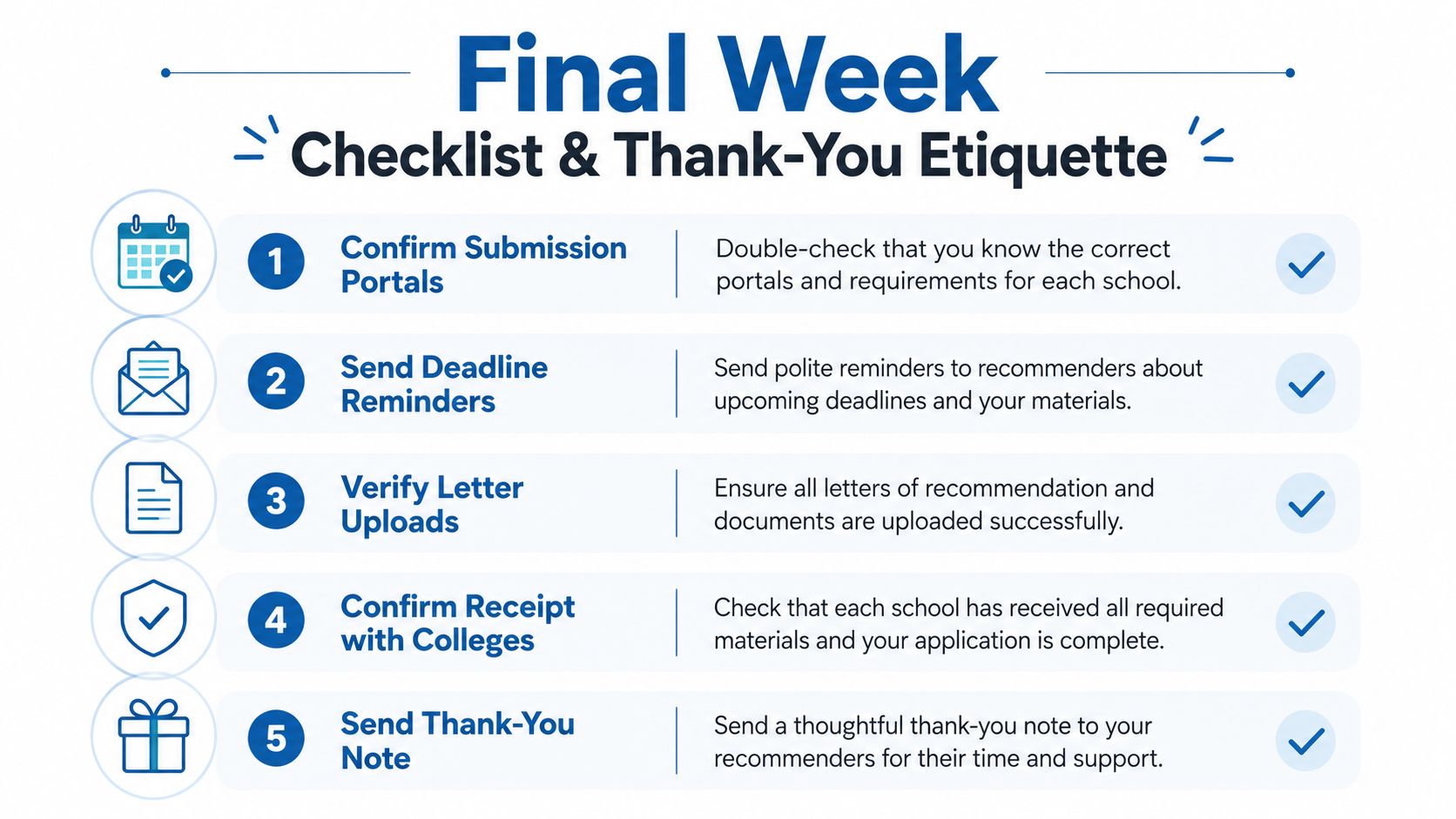
Your final-week checklist
- Check that each letter was submitted. Look at the application system and the counselor portal to make sure the status changed.
- Match each school to the right portal. Every college uses its own system, and teachers should know where each letter belongs.
- Send one short reminder if needed. A respectful nudge before the due date is fine, especially if the teacher is handling multiple students.
- Confirm receipt with the college. Do not assume a letter is in just because you sent the request.
- Write the thank-you note right away. Send it after the letter is submitted, while the effort is still fresh.
Keep the final week focused on confirmation, not new requests. If you are still asking for first-time letters at the last minute, you have already made the process harder than it needs to be.
What the thank-you should say
A handwritten note is ideal. Email is fine if that fits your school culture. Keep it warm and specific, not gushy.
“Thank you for taking the time to write my recommendation. I know it took real effort, and I appreciate the way you supported me in and out of class. I'm grateful for your help with this part of my application.”
That is enough. You do not need a speech. You do need sincerity.
If you want a practical example of how teachers are thanked thoughtfully, this teacher gift guide is less important than the tone behind the gesture. Gratitude matters because it acknowledges the labor, not because it is decorative.
Keep the relationship alive
After applications are submitted, send a short update when decisions come in. Tell the teacher where you enrolled. If a younger sibling may apply later, you will be glad you stayed in touch. Teachers remember students who close the loop.
The biggest mistakes are easy to avoid. Late requests lead to rushed letters. Mismatched teachers lead to weak evidence. Recycled letters across schools lose context. Missing deadlines creates panic. Skipping the thank-you sends the wrong message.
Do the simple thing instead. Ask early, choose the teacher who knows you, give them the materials they need, follow up politely, and thank them like a real person. If you are in a school where families need extra help communicating with staff, ask for that help directly instead of hoping the system adjusts on its own.