

We’ve all seen it. That overflowing lost-and-found bin at school, a graveyard of identical-looking pencils. As a parent, it's a familiar and frustrating sight. But I've found that using high-quality, personalized labels for pencils is the simple, stress-free fix to this daily annoyance.
Solving the Lost Pencil Problem for Good
That lost-and-found bin represents a small but constant drain on your wallet and your patience. Every lost pencil is another item to replace, something that adds to the classroom clutter and those frantic morning scrambles to find a writing tool. It’s a universal headache for parents, teachers, and even kids who get upset when their favorite pencil just vanishes.
This is where a simple little label can make a world of difference.
Modern labels are so much more than the flimsy paper stickers we had as kids. Today’s options are durable, kid-proof, and designed to survive the chaos of a busy school day. By picking the right label, you can turn this recurring problem into a win for organization.
Why Quality Pencil Labels Matter
Investing in good labels for pencils does more than just help your child hang onto their supplies. It really simplifies life for everyone involved.
- Saves Money and Reduces Waste: You'll spend way less on replacing lost supplies throughout the school year, and fewer items will end up forgotten in the lost-and-found.
- Empowers Your Child: Personalized labels help children, especially the younger ones, easily spot their own things. It’s a small thing that fosters a sense of responsibility and ownership early on.
- Reduces Classroom Chaos: When every pencil is clearly marked, teachers can spend less time sorting out who owns what and more time actually teaching. It just makes for a smoother, more organized learning environment for everyone.
The goal is to find a label that can withstand daily sharpening, sweaty hands, and the occasional tumble through a backpack. Premium brands like InchBug create labels that are waterproof, fade-resistant, and tough enough for the entire school year.
And these labels aren't just for pencils! You can use this same idea for all your child's belongings. For more ideas on organizing everything for school, you might like our guide on using name labels for school supplies.
By starting with pencils, you’re building a foundation for a much more organized and stress-free year. Trust me, it's a small step that makes a huge impact.
What Kind of Pencil Labels Actually Work?
We’ve all been there. You buy a giant pack of pencils, sharpen them all, and send them off on the first day of school, only to find the pencil case half-empty a week later. Not all labels are created equal, especially when they have to survive the daily chaos of a kid's backpack.
Choosing the right label is a bit like choosing the right shoes for your kid. A cheap paper sticker is like a pair of flimsy slippers—fine for around the house but totally useless on the playground. For something that gets sharpened, chewed on, and tossed around daily, you need the equivalent of a sturdy, all-weather boot.
This little chart shows exactly why a good label is a parent's best friend. It’s the difference between a pencil coming home and one that’s lost to the school’s black hole of a lost-and-found bin.
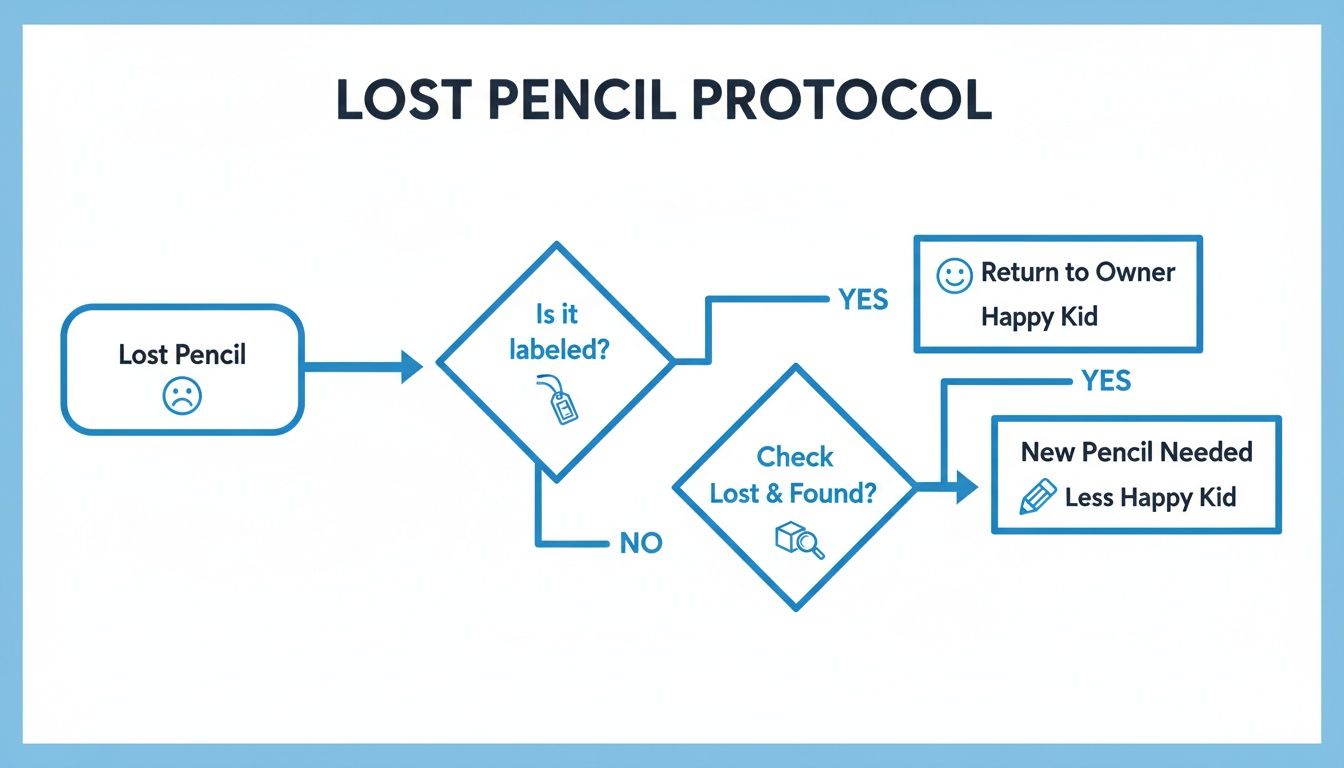
As you can see, that tiny label is a pencil’s ticket home. Let’s dive into the options that actually hold up to the challenge.
H3: Comparing Pencil Label Types at a Glance
Before we get into the nitty-gritty, here’s a quick overview to help you see the main differences between the most popular label types. Think of this as your cheat sheet for back-to-school prep.
| Label Type | Best For | Durability | Application |
|---|---|---|---|
| Adhesive Stickers | Quick and easy labeling for standard pencils. | Varies (vinyl is a must!). | Peel and stick. Super fast. |
| Wraparound Labels | Maximum peel-proof security on smooth pencils. | Excellent. Resists peeling and wear. | Fold over itself. Takes a second longer. |
| Heat-Shrink Sleeves | Ultimate, seamless durability for any pencil shape. | The best. Becomes part of the pencil. | Slide on and heat with a hairdryer. |
Each type has its place, and the best one for you really depends on your kid, the pencils, and how much time you have. Now let's look at each one a little closer.
H3: Classic Adhesive Stickers
These are the labels most of us think of first. They’re basically tiny, super-powered stickers you press right onto the pencil. Their biggest advantage is speed—when you have a whole box of pencils to label the night before school starts, fast is a huge win.
But here’s the catch: the material is everything.
- Paper Stickers: Just don't. They’ll tear, run if they get damp, and turn into a sticky, gummy mess by the end of the week.
- Vinyl Stickers: This is where you want to be. A good vinyl label is tough, waterproof, and scratch-resistant. They have a little flex, so they hug the pencil and don’t lift at the corners.
Seriously, if you go with adhesive stickers, make sure they are high-quality, waterproof vinyl. It’s the difference between a label that lasts a few days and one that makes it through the whole school year.
H3: Wraparound Labels
Wraparound labels are the next level up in the durability game. Instead of just sticking to the pencil, these clever labels are designed to fold over and stick to themselves. This creates a fully sealed, laminated-like band around the name.
That self-sealing design makes them almost impossible for curious little fingers to pick and peel off. They’re incredibly tough and hold up great against the constant friction inside a pencil case. They’re a fantastic pick for standard round or hexagonal pencils that have a nice, smooth surface for the label to grip.
H3: Heat-Shrink Sleeves
For the absolute ultimate in durability, you can’t beat heat-shrink sleeves. These are like magic. You get a little plastic tube with your child’s name printed on it, slide it over the pencil, and give it a quick blast with a hairdryer.
The sleeve instantly shrinks down to fit the pencil’s shape perfectly, creating a completely seamless label. There are no edges to catch or peel—it literally becomes part of the pencil. These are a lifesaver for oddly shaped, glittery, or textured pencils where a regular sticker just won’t get a good grip. The final look is super professional, and it's 100% waterproof and wear-proof.
How We Went from Graphite Sticks to Labeled Pencils
It’s funny to think about, but that simple yellow pencil we see everywhere has a wild history. We almost never give it a second thought, but the story of how it came to be is the perfect example of how one great idea can create a brand-new problem. Believe it or not, the reason we need labels for pencils today starts hundreds of years ago with a messy black rock and a few sheep.
Back in the mid-1500s, a huge deposit of pure, solid graphite was found in Borrowdale, England. It was a pretty big deal. At first, local shepherds just used chunks of it to mark their sheep, but artists quickly caught on to how amazing it was for drawing. The only catch? Pure graphite is super messy and breaks easily. To even hold a piece without getting black dust all over their hands, people had to wrap the delicate sticks in string or pieces of sheepskin. You can get the full scoop on this discovery and the industry it created over at the Office Museum's pencil history page.
That early wrapping wasn't about ownership—it was just to make the tool usable. It was a practical fix for a handling problem, a lot like how our modern labels fix an ownership problem.
From Raw Graphite to Classroom Staple
Those first graphite sticks were a far cry from the pencils our kids use today. For a long, long time, graphite was rare and expensive, and England kept a tight grip on it. It took centuries for manufacturing to catch up and turn the pencil into something everyone could afford and use.
As pencils became common, they also became standardized. All of a sudden, one No. 2 pencil looked exactly like every other No. 2 pencil. This is where a whole new challenge popped up.
Think of it like this: In the 1600s, nobody was going to mistake your one-of-a-kind, string-wrapped graphite stick for theirs. Today, if a whole box of identical yellow pencils spills out of a backpack, good luck telling them apart without some help.
And right there, the modern need for telling our stuff apart was born.
Why Organization Became Essential
Once pencils were in every classroom, office, and junk drawer, keeping track of them became a real headache. The very thing that made them so successful—their uniformity—also made them incredibly easy to lose, misplace, or accidentally swipe.
Putting a name on a pencil is really just the 2026 version of those first shepherds wrapping their graphite in string. It’s a smart solution to a very practical problem:
- Then: Wrapping made the tool usable.
- Now: Labeling makes the tool identifiable.
This journey from a raw chunk of rock to the organized chaos of a first-grade classroom shows that personalizing our tools is nothing new. The core problem hasn't changed. The invention of the pencil itself is what eventually made labels for pencils an absolute must-have on every back-to-school list.
A Parent’s Guide to Choosing the Best Pencil Labels
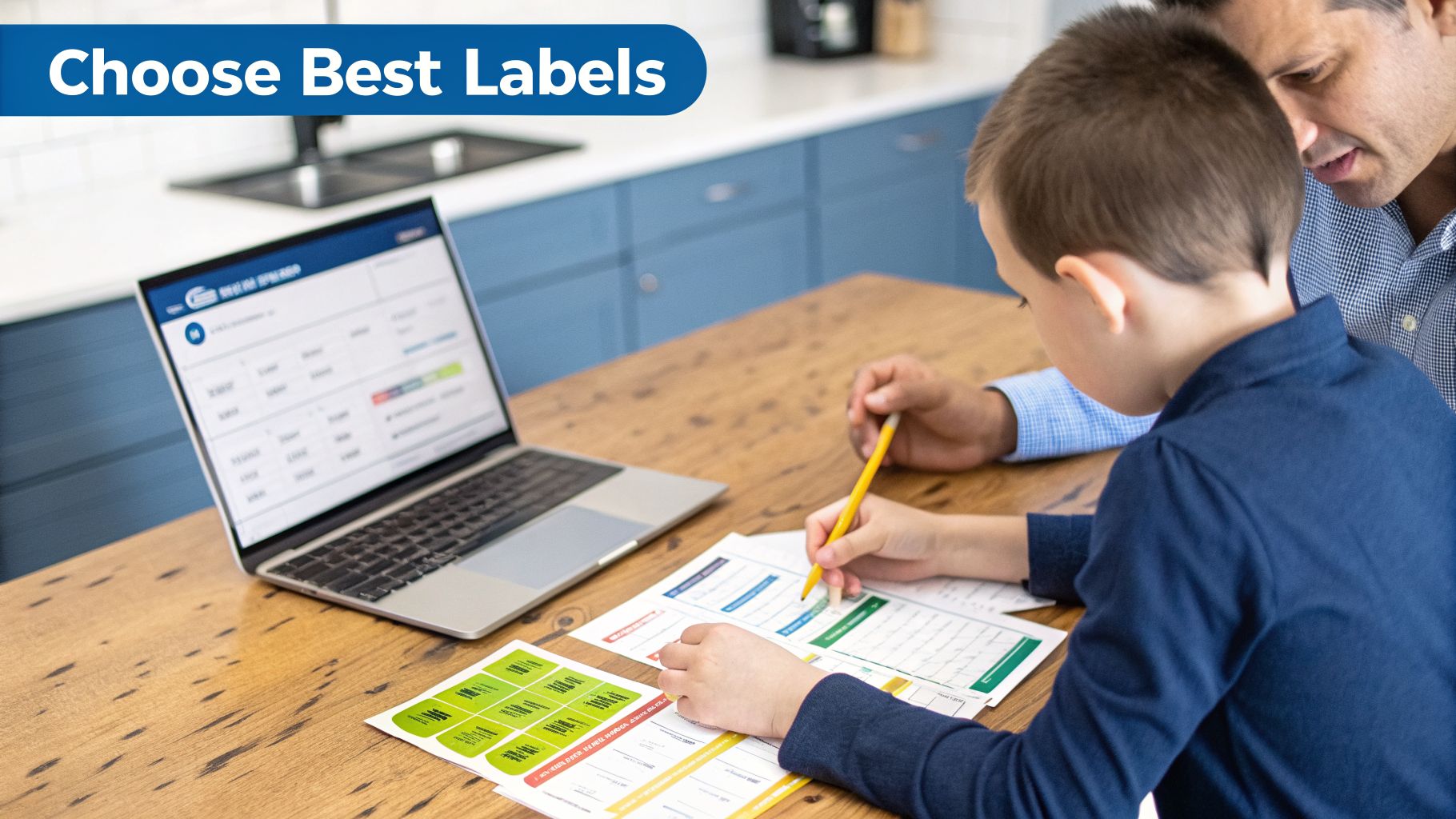
Ready to tackle the school supply list? When it comes to buying labels for pencils, it’s tempting to just grab the first cute pack you see. But trust me, it’s like picking the right gear for a sport—you need something that’s actually built for the game. Let's walk through what really matters to make sure those freshly sharpened pencils make it home every single day.
The first, and most important, thing to look at is the material. If you see paper labels, just keep on walking. They might look nice in the package, but they’ll turn into a soggy, ripped mess the first time they meet a damp hand or a leaky water bottle. Durable vinyl is the only way to go. It’s tough, flexible, and made to survive the school year.
Durability and Performance
When you’re looking at vinyl labels, there are a few things that separate a good label from a great one. These are the features I always look for.
- Waterproof: This is completely non-negotiable. From condensation on a water bottle in their backpack to accidental spills, your pencil labels have to repel water.
- Dishwasher-Safe: I know you’re probably not running pencils through the dishwasher! But this is my secret test. It’s a key sign of a high-quality adhesive that can handle both heat and moisture, proving the label is built to last.
- Fade-Resistant: The whole point of a label is being able to read it. A quality label uses inks that won't fade or rub off from constant handling or under the bright classroom lights.
Premium brands like InchBug actually engineer their labels to hit all these marks. It’s why they look just as good on the last day of school as they did on the first.
Size and Placement
Where you put the label on the pencil matters way more than you’d think. A huge label wrapped around the main part of the pencil is just asking to be eaten by the sharpener. This is where a little bit of strategy goes a long way.
Think small and smart. A compact "flag style" label applied near the eraser end of the pencil stays out of the sharpening zone, preserving the name for the entire life of the pencil.
This little trick ensures the name stays visible, even after weeks of sharpening and use. Full wrap labels can work, but I’ve found they’re often overkill and just get sharpened away, which defeats the whole purpose.
Readability and Personalization
For younger kids especially, clarity is everything. A fancy, loopy font might look stylish to us, but a simple, bold font is so much more practical for them. Your child needs to be able to spot their name at a quick glance in a crowded pencil cup.
This is also where a bit of personalization becomes a powerful tool for our little ones. Adding a small, recognizable icon—like a star, dinosaur, or heart—can help pre-readers find their supplies in a snap. A bright, unique color works wonders, too, making their pencils stand out in a sea of standard yellow.
It’s funny to think that the modern pencil was actually invented during a crisis. Back in 1795, a British blockade cut France off from English graphite. So, Nicolas-Jacques Conté created a process to make durable pencil cores from other materials. This history of innovation is ironically mirrored in today's classroom chaos, where studies show kids in major markets lose about 1 in 5 pencils each semester. You can read more about the fascinating history of the modern pencil and its origins in innovation.
How to Apply Labels So They Last All Year
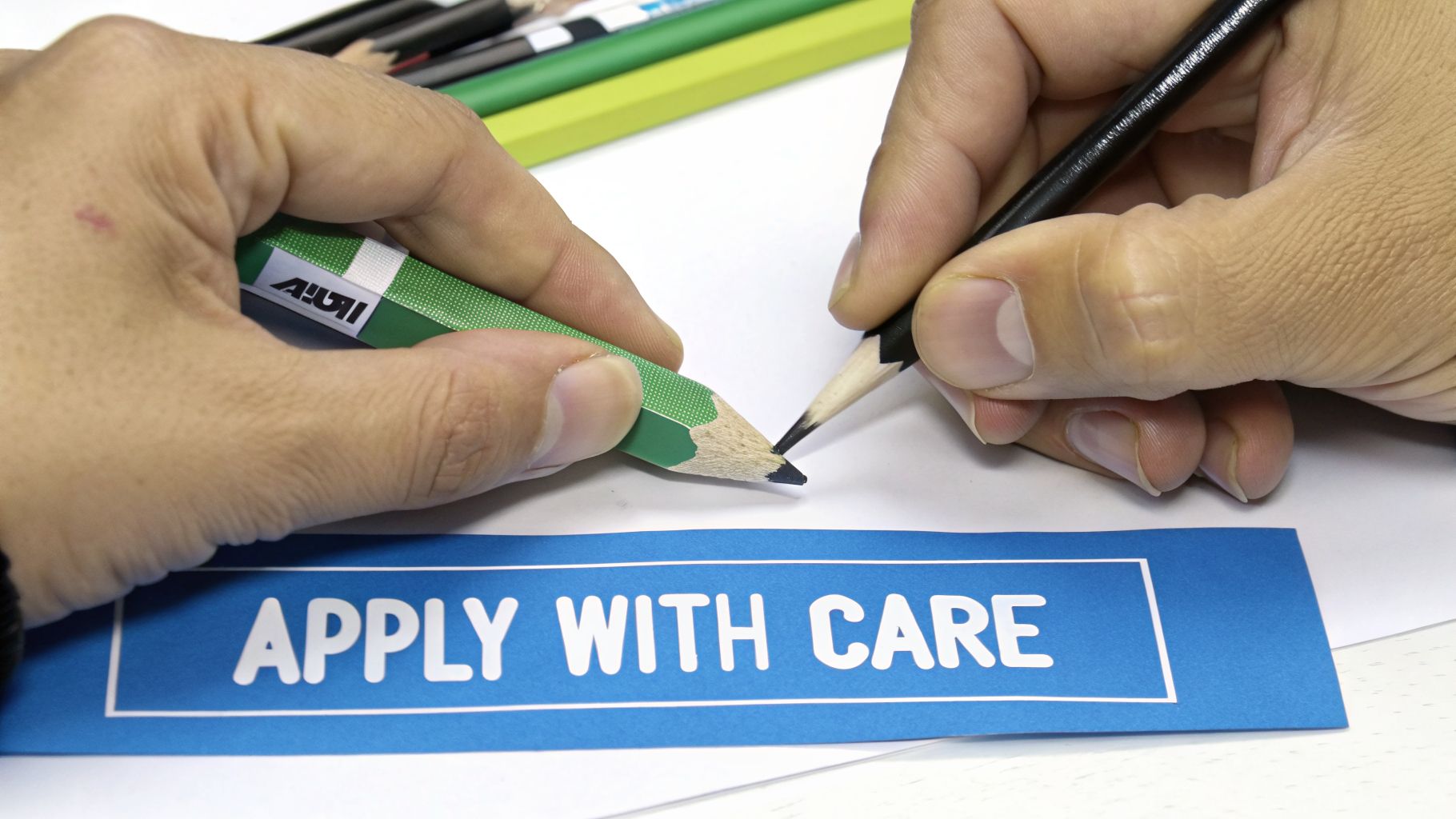
You’ve picked out the perfect labels for pencils, and now it's go-time. I've learned that taking just a few extra seconds on this step can make all the difference, turning a good label into an unstoppable force against the lost-and-found bin. The real secret is creating a perfect, lasting bond between the label and the pencil.
Think of it like putting a screen protector on your phone. A clean, smooth surface is everything. Any dust, oil from your fingers, or waxy residue on a new pencil can stop the adhesive from getting a good grip. This little prep step is your first line of defense against peeling labels later on.
The Application Process Step-by-Step
Following a simple process ensures your labels will stay put through countless sharpenings, backpack tumbles, and daily classroom chaos.
- Clean the Surface: Start by wiping the pencil with a clean, dry cloth. For those pencils with a waxy coating, a quick wipe with a cloth lightly dampened with rubbing alcohol does wonders to remove that residue. Just be sure the pencil is completely dry before you move on.
- Apply with Even Pressure: Peel the label off the sheet and carefully place it on the pencil. Press down firmly from the center and smooth your way out to the edges. This little trick pushes out any trapped air bubbles that could cause the label to lift later.
- Secure the Edges: Run your fingernail firmly along all the edges of the label. This creates a super tight seal, making it much harder for the corners to catch on things and peel up over time.
Care and Removal Tips
Even the toughest labels appreciate a little care. While our high-quality vinyl labels are incredibly resilient, helping them stay clean ensures they’re easy to read all year long. For pencils that get extra grimy, a quick wipe with a damp cloth is all it takes to make them look brand new.
If you want to dive deeper into what makes a label truly tough, our guide to dishwasher-safe name labels is a great read.
When the school year is over, the last thing you want is to be left with a sticky, gummy mess. A quality label should come off cleanly, leaving the pencil ready for donation or for next year's school supplies.
To take a label off, just pick at a corner with your fingernail and peel it back slowly. If any sticky residue is left behind—and with good labels, there usually isn't—a dab of rubbing alcohol or a product like Goo Gone on a cloth will wipe it away effortlessly. It makes that end-of-year clean-up an absolute breeze.
Labeling Beyond Pencils to Organize Everything
Once you get that little zing of satisfaction from seeing a perfectly labeled set of pencils, you start to see the possibilities everywhere. It’s a total lightbulb moment. The same durable, easy-to-read labels that solve the lost-pencil problem can bring that same sense of order to everything your child owns.
This is where you graduate from fixing one small annoyance to creating a whole system for your family.
Think about it. The qualities that make a pencil label great—being waterproof, tough as nails, and easy to read at a glance—are exactly what you need for everything else. Markers, crayons, glue sticks, and scissors can all get the same treatment. That simple act of putting a name on something makes it personal and, more importantly, makes it find its way back home.
Creating a Complete Organizational Ecosystem
This isn't just about labeling school supplies; it's about building a complete organizational ecosystem for your child. It's a system where every single item, from their water bottle to the jacket they swear they didn't leave at the park, is accounted for. The best part is that you can find specific labels designed for just about anything.
- For Drinkware: I swear by InchBug’s reusable Orbit Labels. They're non-adhesive, non-toxic silicone bands that you can stretch over any bottle or sippy cup. We've used the same ones for years!
- For Clothing: TagPals® are a total game-changer. They’re laundry-safe stickers that go right on the clothing care tag, so you don't have to iron or sew anything. Jackets, sweaters, and hoodies finally make it back from school.
- For Footwear: ShoePals® are not only adorable, but they also help kids put their shoes on the right feet with fun, split-apart designs. No more morning struggles.
By using a coordinated system, you simplify your life. I’ve found that combo packs are a super cost-effective way to get everything you need at once, so you’re ready for the entire school year from day one.
Suddenly, those labels for pencils aren't just a one-off purchase. They're the first step toward total peace of mind. And while you’re personalizing physical items, you can also capture those fleeting moments by creating other unique keepsakes, like a personalized book of memories.
For even more ideas on how to expand your labeling empire, check out our guide on using labels for storage.
Your Questions About Pencil Labels Answered
I get it. Even after you've decided to label everything, a few little "what if" questions can pop into your head. That’s totally normal! Let's walk through some of the most common worries I hear from other parents so you can feel 100% confident you’re getting the most out of your labels.
Will Pencil Labels Come Off During Sharpening?
This is the big one, right? The last thing you want is a label getting shredded in the pencil sharpener. The good news is, with the right label, this isn't an issue at all.
High-quality wraparound labels are designed to sit flush against the pencil, staying well away from the sharpening zone. If you're using smaller "flag" style stickers, just make sure to place them up near the eraser. It's really those cheap paper labels that cause all the trouble—they peel, tear, and make a mess. Trust me, investing in durable vinyl is worth every penny to avoid that headache.
Are These Labels Safe for Young Children?
Absolutely. As a parent, this is always my first concern, too. Reputable brands like InchBug design their labels specifically for kids, using non-toxic, BPA-safe materials. The adhesive is also made to be super strong, so curious little hands can't just peel them off and pop them into their mouths.
For complete peace of mind, always look for products that are explicitly certified as kid-safe. Your child's safety is the top priority, and any brand worth your money will make this information easy to find.
Can I Use the Same Labels on Crayons?
Yes, and this is one of my favorite mom hacks for getting more value out of a pack of labels! Those versatile, waterproof sticker labels are perfect for crayons. All you have to do is apply the label right over the paper wrapper.
The trick is to use small, flexible labels that can easily hug the curve of both a pencil and a crayon. This makes them a fantastic all-in-one solution for keeping all of your child’s coloring tools from getting mixed up or lost.
Ready to finally solve the lost pencil problem for good? InchBug offers durable, waterproof, and completely customizable labels designed to last the entire school year and beyond. Explore our label options and bundles to get organized today! Shop now at InchBug.com.