

You're standing in a daycare hallway, balancing a lunch bag, a jacket, and a child who has suddenly decided that shoes are optional. In the cubby area, several water bottles look alike. A teacher reaches for one, then pauses because the name has faded. Nearby, two toddlers in matching jackets are heading toward the same playground gate.
Most days, a caregiver can sort out a mix-up with a quick question. But if your child is hurt, separated from the group, or needs an adult reached quickly, guessing wastes time. Emergency contact labels are one small part of a larger safety system. They give caregivers a visible, readable identifier while a fuller emergency record stays in the right place, such as a daycare file, backpack card, or controlled digital profile.
The Daycare Drop-Off Mix-Up Every Parent Fears
A teacher opens the shared water bottle bin and finds two identical bottles. One has a faded initial near the base. The other has a cartoon sticker that both children recognize as “theirs.” Down the hallway, cubbies are crowded with raincoats, snack containers, spare clothes, and backpacks that have collected the same playground dust.
The teacher knows the children well, but group care involves constant movement. A toddler may arrive carrying a sibling's bottle, borrow a friend's jacket, or leave a backpack in the wrong cubby after an outdoor activity. Parents often assume staff will recognize every item immediately. Staff try to do exactly that, yet small organizational gaps happen when many children need help at the same time.
A clear label changes the moment. Instead of squinting at a worn name or asking several children whose bottle is whose, the caregiver can read the child's identifier and contact details directly. The label doesn't replace supervision or the center's emergency paperwork. It gives people a quick physical cue when belongings, children, and routines become mixed together.
A useful goal: Make the right child and the right adult easy to identify without requiring a login, a search, or a guess.
The same preparation helps with other daycare details. Families reviewing drop-off supplies can use this daycare checklist for parents to organize clothing, bottles, medications, and paperwork. If your child wears a face covering during busy school or childcare routines, a guide to mask options for back to school can help you think through comfort, fit, and labeling alongside the rest of the daily kit.
An emergency contact label offers reassurance because it handles a simple problem well. It helps a caregiver identify an item or reach a trusted adult quickly, while the more detailed information remains protected elsewhere.
What Emergency Contact Labels Actually Are
At the simplest level, an emergency contact label is a readable name-and-number identifier attached to a child's belongings or, where appropriate, a wearable item. Think of a luggage tag. If a bag goes missing, the tag helps someone identify the owner and make contact. An emergency label applies that same idea to daycare and school gear, then gives it a more focused purpose.
A useful label might include:
- Child identifier: A first name or familiar identifier that helps staff confirm ownership.
- Reachable adult: One or two phone numbers that someone can call during the day.
- Critical alert: A short phrase such as “PEANUT ALLERGY” when a caregiver needs to notice a serious risk quickly.
- Context: A teacher, classroom, or pickup instruction when the space allows it and the information is safe to display.
That's different from a decorative name label. A decorative sticker may focus on colors, characters, or a child's full name. An emergency contact label prioritizes legibility, reachability, and immediate action. It also differs from an iron-on clothing label, which identifies ownership but usually doesn't provide a phone number, and from a backpack identification card, which can hold more complete information inside a bag.
Families building a broader contact system may also find an emergency contact list for families useful for organizing adults, phone numbers, medical notes, and household instructions. That list belongs in a secure record or caregiver packet, not necessarily on every visible item.
What the label cannot do
A label isn't a medical chart. It shouldn't carry a full medication history, insurance information, home access instructions, or every authorized pickup detail. It also isn't a digital backup, and it doesn't replace the daycare's enrollment forms or emergency plan.
The best setup uses layers. The label handles the information someone must see quickly. A backpack card holds fuller context for a caregiver. A secure digital profile stores details that change or need controlled access. Families can use this labels for daycare guide when matching label types to bottles, clothing, shoes, and bags.
What Information Belongs on the Label
The label should answer a narrow question: Who is this child, and which trusted adult should a caregiver contact? If the text becomes so crowded that someone has to study it, the label has stopped doing its most important job.
Start with the child's first name or the identifier your daycare recognizes. Add one primary phone number and, if space permits, a second contact who can respond when the first adult is unavailable. A short medical flag may belong on the label when it affects immediate care, such as “PEANUT ALLERGY” or “ASTHMA.” Use wording a busy caregiver can understand without decoding an abbreviation.
The CDC's backpack emergency card illustrates how much fuller an emergency profile may need to be. It includes the child's name, date of birth, school, teacher, medical conditions, two contacts, an emergency pickup address, and a pediatrician. That information is valuable, but it doesn't all belong on a small sticker exposed to classmates, visitors, or strangers.
A practical information split
| Information Type | On the Label | Backpack Card | Digital Profile |
|---|---|---|---|
| Child identifier | First name or approved short identifier | Full identifying details | Full record |
| Primary contacts | One or two reachable phone numbers | Names, relationships, multiple contact methods | Current numbers, email, availability |
| Medical alert | Short, critical phrase | Conditions, reactions, instructions | Detailed medical profile and updates |
| School details | Teacher or classroom only when appropriate | School, teacher, office information | Current school and care arrangements |
| Address | Usually leave it off | Emergency pickup address if needed | Full home and backup addresses |
| Pediatrician | Usually leave it off | Name and contact information | Full provider record |
| Pickup permissions | Usually leave it off | Authorized adults and limits | Current permissions and documentation |
The label needs urgent information, not every useful detail. A full legal name, date of birth, home address, insurance number, or detailed medical instruction can create privacy concerns and make the visible text harder to scan. Put those details on the backpack card or in the profile shared with authorized caregivers.
Decision rule: If a third phone number matters more than a middle initial, keep the phone number and remove the initial. If a medical phrase matters more than a classroom detail, keep the medical phrase.
For a small bottle label, large digits and short lines usually work better than complete sentences. A caregiver should be able to identify the child and begin the call at a glance.
Materials, Durability, and Where to Place Them
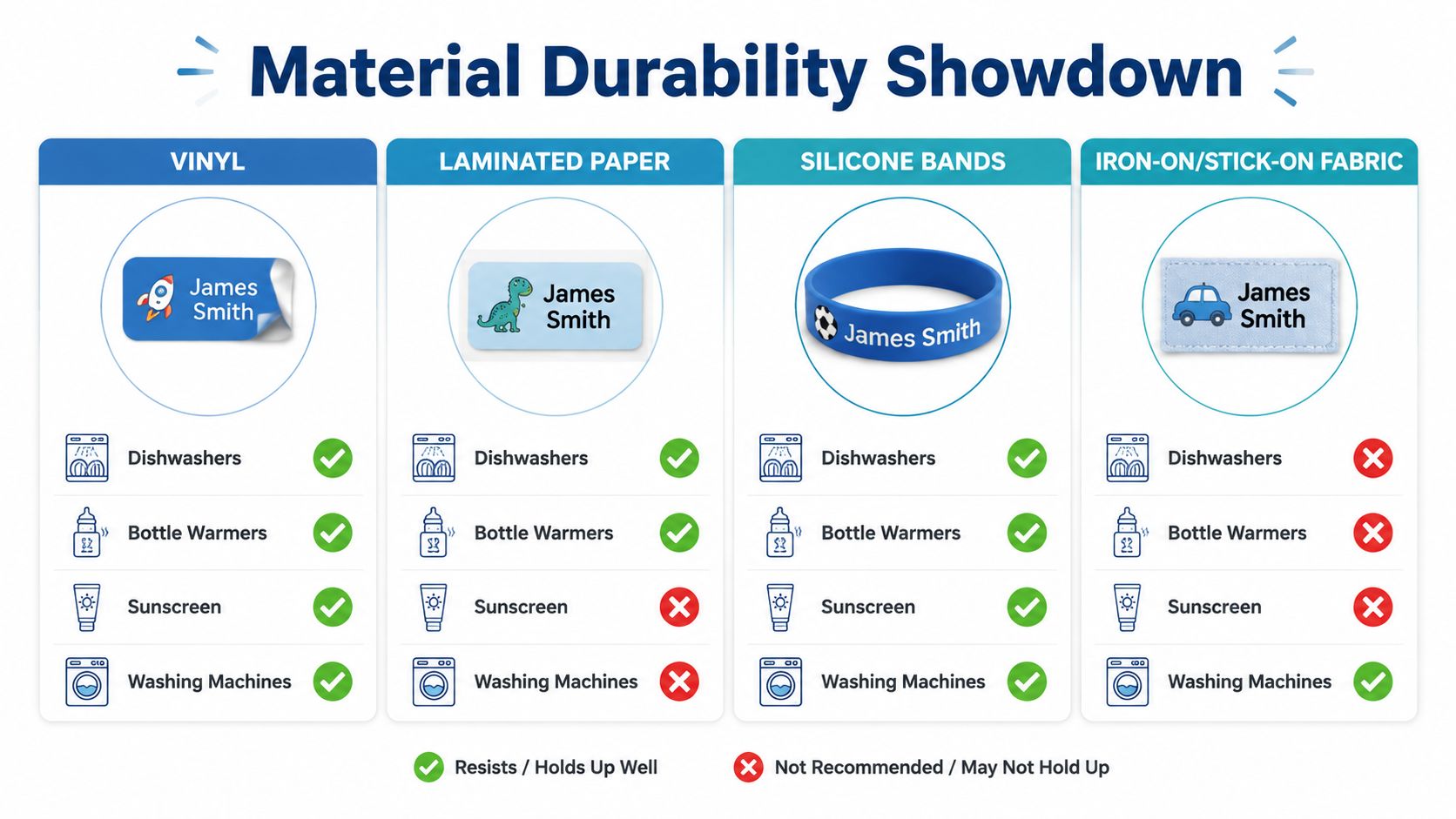
A label that looks clear at drop-off can become unreadable after repeated washing, sunscreen, spills, and playground handling. Choose the material for the item, not just for the design.
Vinyl labels suit hard, smooth surfaces such as water bottles, lunch boxes, plastic containers, and backpack tags. They're generally a practical choice for items exposed to moisture and repeated cleaning, provided the surface is clean and the label sits flat.
Laminated paper can look crisp at first and works better for protected cards or dry interior surfaces. Its corners may fray after sustained handling, especially when the item is rubbed, soaked, or pushed into a crowded bag.
Silicone bands work well on bottles and cups because they wrap around the item instead of relying on a flat adhesive area. Check that the band stays visible and doesn't slide under a handle where a caregiver can't read it.
Iron-on or stick-on fabric labels are better suited to jackets, shirts, hats, and fabric bags. Follow the manufacturer's application instructions, and test the placement before putting the item through regular washing.
Match placement to the item
- Bottles and sippy cups: Place the label on the straight side rather than under the handle, where fingers, condensation, and friction can interfere with reading.
- Lunch boxes: Use a broad, smooth panel away from hinges and latches.
- Backpacks: Put the identifier on an exterior tag or a secure interior panel, depending on your privacy preference.
- Jackets: Choose an inside area that stays visible when a teacher checks the garment.
- Shoes: Tuck the label beneath the tongue or on a stable inner surface, avoiding areas that fold sharply.
- Cloth bags: Keep the label away from seams and corners, which receive extra pulling and rubbing.
Surface preparation matters. Clean and dry hard items before applying an adhesive label, then let it set according to the product instructions. Avoid sharply curved areas because the edges can lift as the material flexes.
For families comparing adhesive performance, this explanation of label durability testing offers useful context for thinking about wear rather than relying on appearance alone. Readability is the standard. Replace a label when the name, phone number, or medical alert can't be read quickly.
Privacy, Safety, and the Case for Less on the Label
Parents often try to make one label carry everything. That instinct is understandable, especially when a child spends time with several caregivers. Yet a visible sticker containing a full name, classroom, home address, pickup code, and medical history may reveal more than a stranger needs to know.
The label's public role should stay narrow. Use a short identifier, a reachable contact number, and a critical alert when the alert changes how an adult should respond. Keep full addresses, detailed diagnoses, insurance details, and pickup permissions in a backpack card or secure profile shared with authorized people.
QR codes and NFC add capacity, not automatic safety
QR codes and NFC tags can connect a small visible identifier to a fuller profile. That can help when information changes, because the profile may be updated without replacing every physical label. It also creates questions parents should answer before using the feature:
- Visibility: What information can someone see before verification?
- Access: Can an unknown person scan the code and view phone numbers or addresses?
- Reliability: Will a helper's phone read the code or NFC tag?
- Maintenance: Who updates the destination when a contact changes?
- Fallback: What happens if the phone has no connection or the tag fails?
A child emergency ID guide highlights why access and device compatibility deserve attention. More information isn't automatically better if the wrong person can access it, or if the right person can't open it when needed.
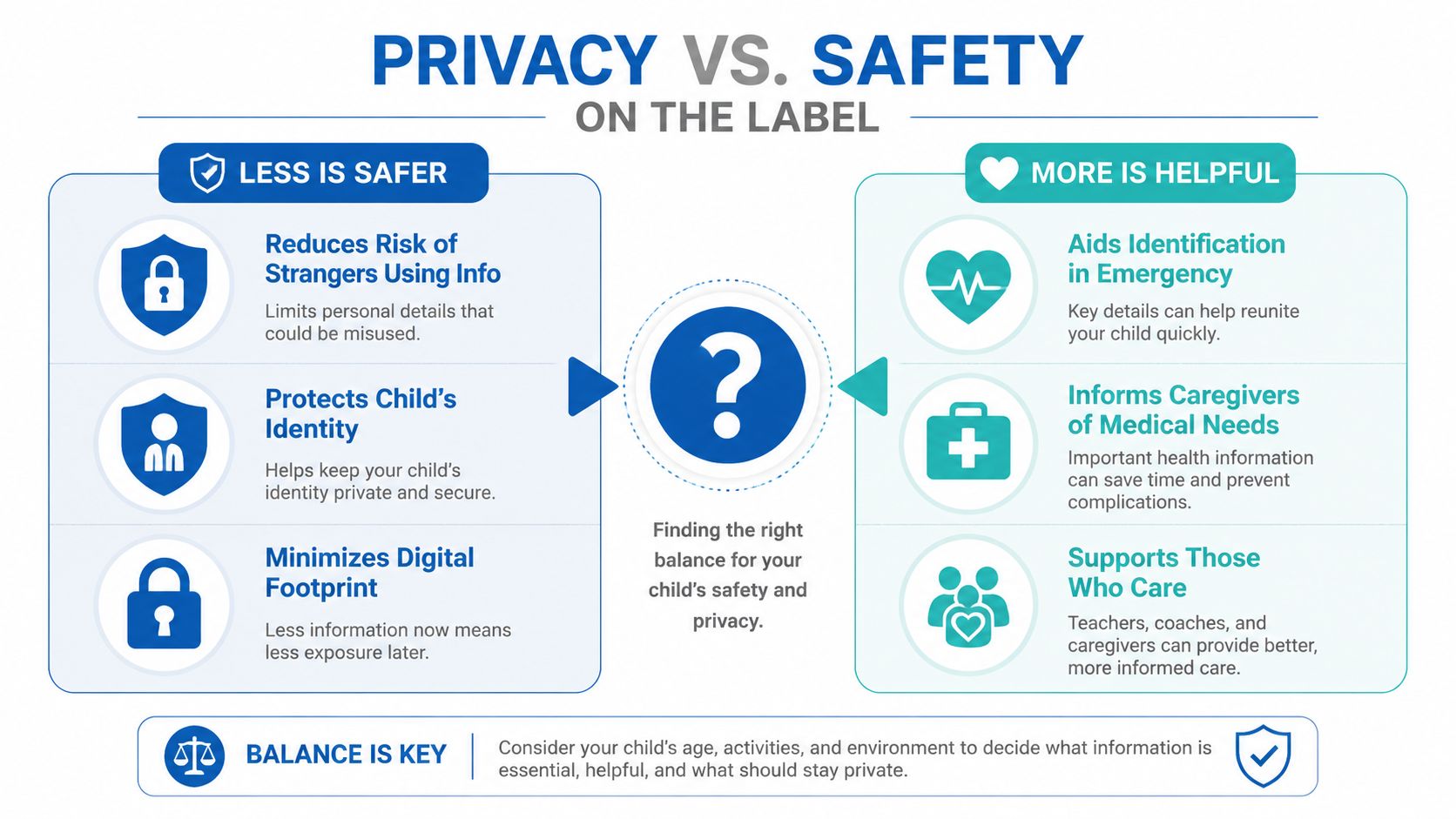
A balanced approach is often strongest: put the minimum actionable information on the item, then place fuller medical and caregiver instructions in a controlled layer. The CDC card model supports that separation by keeping detailed identification, health, school, and contact information together in a format intended for caregivers rather than public display.
Parents can also compare this approach with guidance on what information belongs on a luggage tag. The same principle applies here. Identification should help a responsible person make contact without turning a child's belongings into a public profile.
Sample Wording and Templates You Can Copy
Short wording is easier to read, update, and repeat across several belongings. Use large, plain lettering, avoid cursive, and make phone digits more prominent than decorative text. If a medical warning is necessary, give it a clear line of its own.
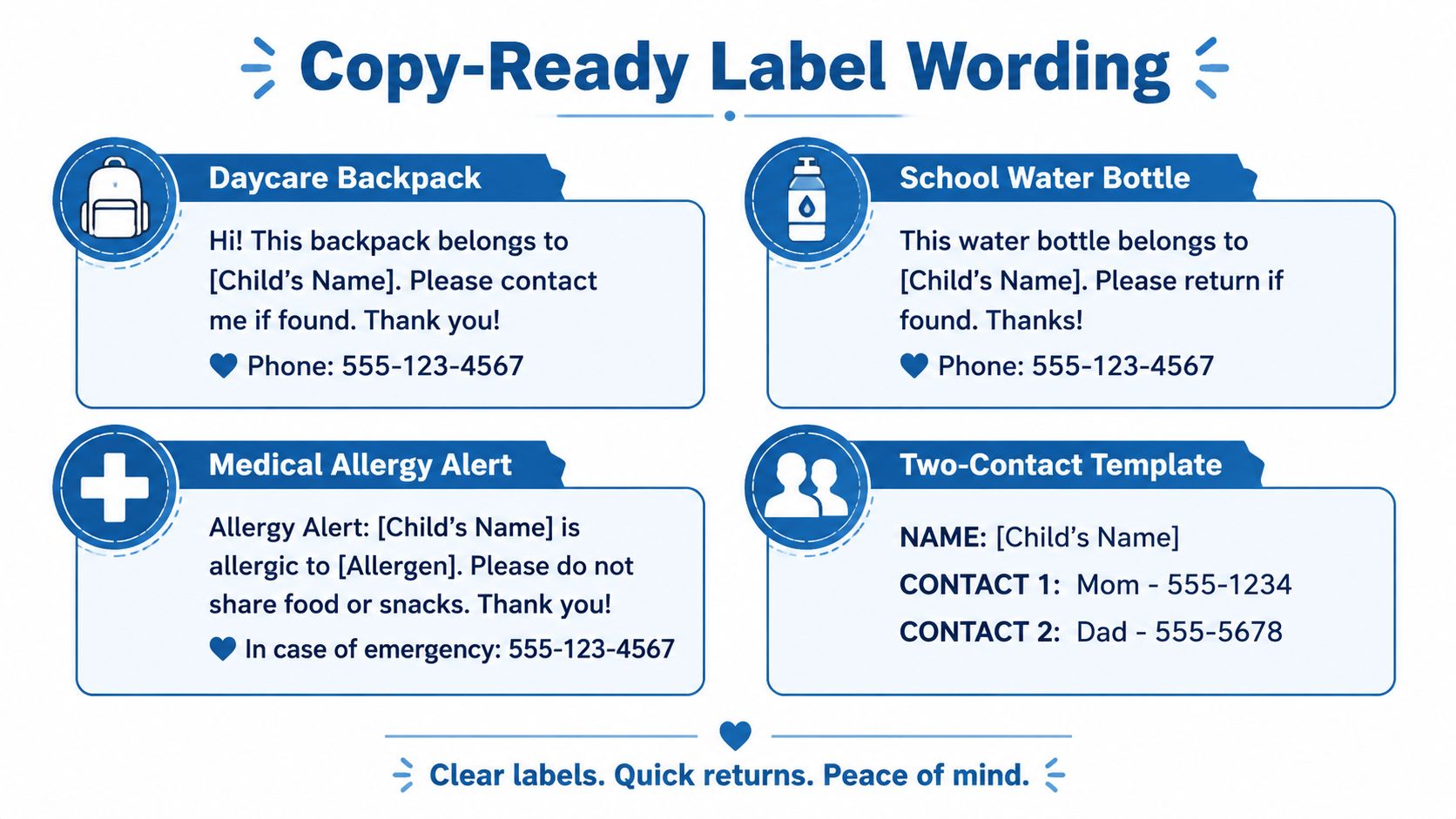
Basic two-contact wording
Line 1: NAME: [Child's First Name]
Line 2: CALL: [Primary Adult] [Phone]
Line 3: BACKUP: [Second Adult] [Phone]
For a small circular bottle label, use the name at the top and place each contact on its own line. Don't squeeze a third number into tiny text. Put the additional contact on the backpack card instead.
One-line medical alert
ALLERGY: PEANUT
CALL: [Phone Number]
Use the actual allergen or condition, not a vague phrase such as “medical issue.” If the child needs a specific response, keep the label wording short and place full instructions in the caregiver record.
Consistent wording across a label set
For bottles:
[Child's First Name]
CALL [Phone]
For jackets and shoes:
[Child's First Name]
[Backup Phone]
For a backpack:
[Child's First Name]
CALL [Primary Phone]
BACKUP [Secondary Phone]
Consistency helps a teacher recognize the same child across several belongings. A small medical cross or allergen symbol can draw attention, but it shouldn't replace readable words.
Back-to-school version
[Child's First Name]
ROOM [Classroom Code]
TEACHER [Name]
CALL [Phone]
Only include classroom information if the school is comfortable with it being visible. Before ordering, families can fill out your emergency list and use the same verified names and numbers for labels, cards, and caregiver forms.
Save the final wording as a reusable note. When a phone number changes, you can update one source instead of rewriting every label from memory.
Ordering, Combos, and Yearly Label Habits
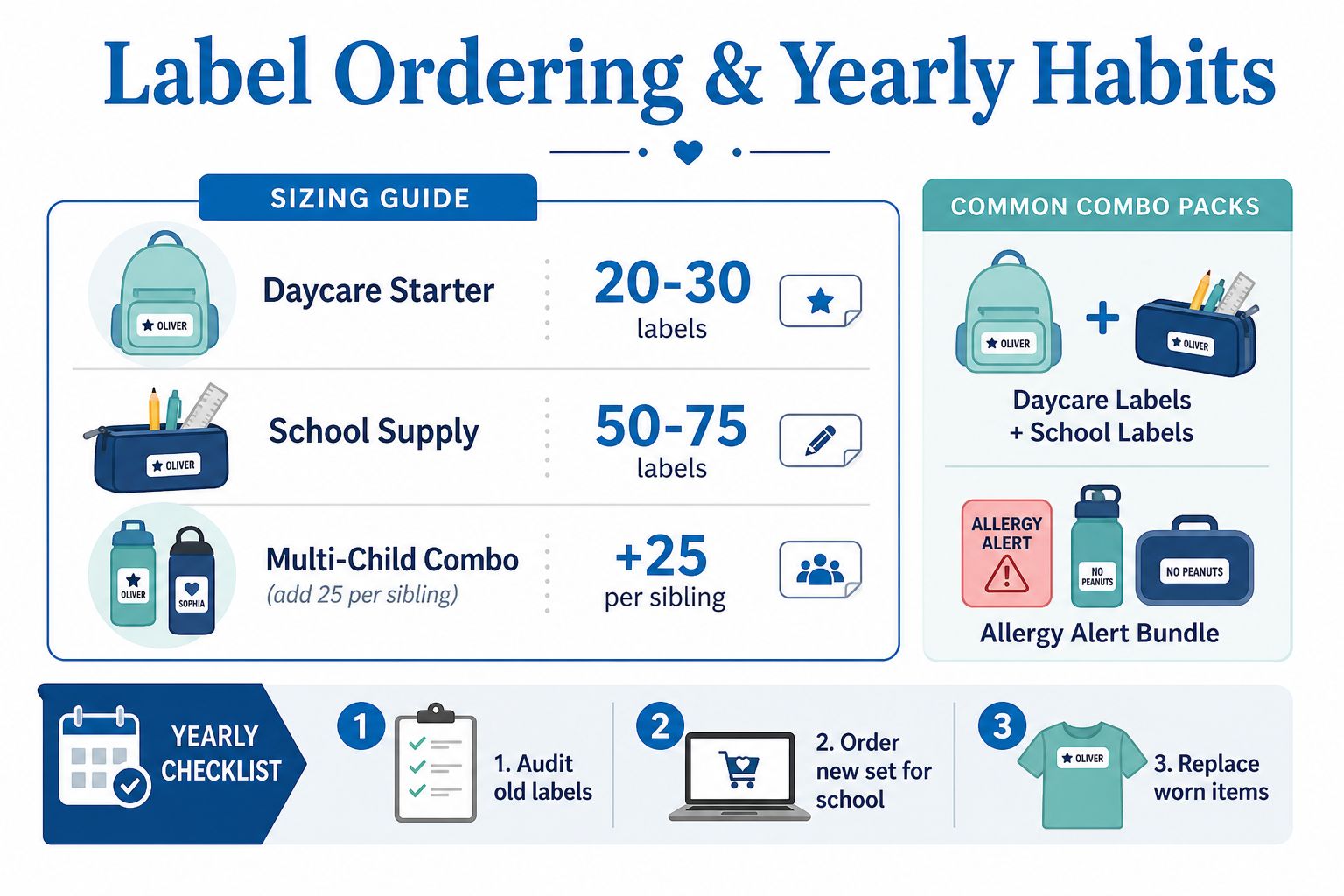
Ordering works better when you begin with the child's routine rather than a generic bundle. List the items that travel to daycare or school, then separate them into hard surfaces, fabric, footwear, and medical alerts. A toddler may need labels for bottles, cups, lunch containers, spare clothes, shoes, and a backpack. A school-age child may need a different mix because supplies move between classrooms, sports, and aftercare.
Build the order around use
Before checkout, review:
- Item count: Include daily items, replacements, and belongings that rotate between households.
- Material fit: Select adhesive labels for smooth containers, fabric labels for clothing, and bands for items that flex or sweat.
- Text size: Choose the largest readable type that fits the item.
- Medical wording: Proofread every allergen and phone digit separately.
- Household consistency: Give co-parents and backup caregivers the same approved wording.
Combo packs can simplify that sorting process by grouping daycare labels, school labels, or allergy identifiers. InchBug offers personalized labels and tags for children's belongings, including options for bottles, clothing, shoes, bags, and allergy alerts. Use the product details to match the label to the surface, then confirm the final proof before placing the order.
A repeatable seasonal routine
At the start of the school year, inspect old labels and remove anything with faded text or lifting edges. Before camp, travel, or a new childcare arrangement, check that the displayed contact details still point to adults who can respond. After a phone, address, custody, or medical change, update the master record first, then replace the affected labels and cards.
For a practical example of how bundled label sets can be organized, see InchBug's overview of combo packs. The exact contents should follow your child's items, not the other way around.
Keep a short order note with the child's approved identifier, contact sequence, allergy wording, and preferred materials. That habit makes the next refresh a review task rather than a complete restart.
Quick Answers for Busy Parents
How often should emergency contact labels be replaced?
Replace a label when it's no longer readable, the adhesive is lifting, or the item has changed. Review the full set at the start of a new school routine and after any contact or medical update. Durability depends on the material, surface, cleaning routine, and exposure to sunscreen or heat.
What should I do if my phone number changes mid-year?
Update the daycare or school record first, then change the digital profile and backpack card. Replace any visible label that carries the old number. Tell co-parents and regular caregivers which version is current so an outdated card doesn't remain in a diaper bag or car.
Does daycare or school require specific wording?
Policies vary. Ask the center or school whether it wants a child's full name, classroom identifier, allergy wording, or a particular emergency contact format. A label supports the institution's system, but it doesn't override enrollment paperwork or official medical instructions.
How does a label work with a backpack card or app?
Use each layer for a different job. The label offers quick identification, the backpack card carries fuller instructions, and the digital profile stores information that needs controlled access or regular updating. A bracelet, card, QR code, or NFC tag can add another layer, but test access and keep a non-digital fallback.
Will labels survive dishwashers, freezers, and sunscreen?
Some materials are designed for repeated cleaning, while others suit dry or fabric surfaces. Follow the product care instructions, place labels on smooth areas, and inspect them after exposure to heat, moisture, and sunscreen. Replace any label that can't be read at a glance.
What's the difference between a child safety label, a name label, and a medical alert label?
A name label identifies ownership. An emergency contact label adds a way to reach a trusted adult. A medical alert label highlights a critical health concern, and it should work alongside detailed medical instructions rather than replace them.
Before the next school year, revisit your contact wording, inspect every label, and refresh the layers that caregivers rely on.
InchBug offers personalized labels and tags for bottles, lunch gear, clothing, shoes, bags, and allergy alerts, giving families a practical way to keep daily belongings identifiable. Visit InchBug to choose label types that fit your child's routine and build a clearer safety system around the items they carry.