

The backpack is packed, the daycare cup is in the side pocket, and someone is already looking for the missing navy cardigan. Then you notice that three children have nearly identical bottles, jackets, and lunch bags. A name label would help, but the right kind of label depends on whether that item will stay with one child or keep moving between people.
Custom name tapes with Velcro-style hook-and-loop closures are useful when identification needs to be visible but not permanent. You can attach a name tape to a compatible loop panel, remove it before handing down a uniform, and reuse it on another item without sewing a new label every time. That reversibility makes these tapes especially practical for shared gear, borrowed equipment, changing classroom assignments, and families managing hand-me-downs.
This guide explains how the fastening system works, how materials and backing choices affect performance, where removable labels make the most sense, and how to order readable tapes for short, long, hyphenated, accented, or multilingual names.
Why Parents Are Choosing Removable Name Tapes
The most frustrating mix-ups usually happen during transitions. A child comes home from nursery with the wrong coat, a school bag looks familiar but belongs to someone else, or a sports jersey returns from practice without a clear owner. Permanent labels can solve the identification problem, but they can create another one when the garment changes hands.
A Velcro name tape offers a different approach. The soft loop panel stays on the garment or bag, while the personalized tape attaches to it and can be peeled away when needed. A jacket passed from an older sibling to a younger one doesn't need a new sewn label covering the previous name. You can swap the tape.
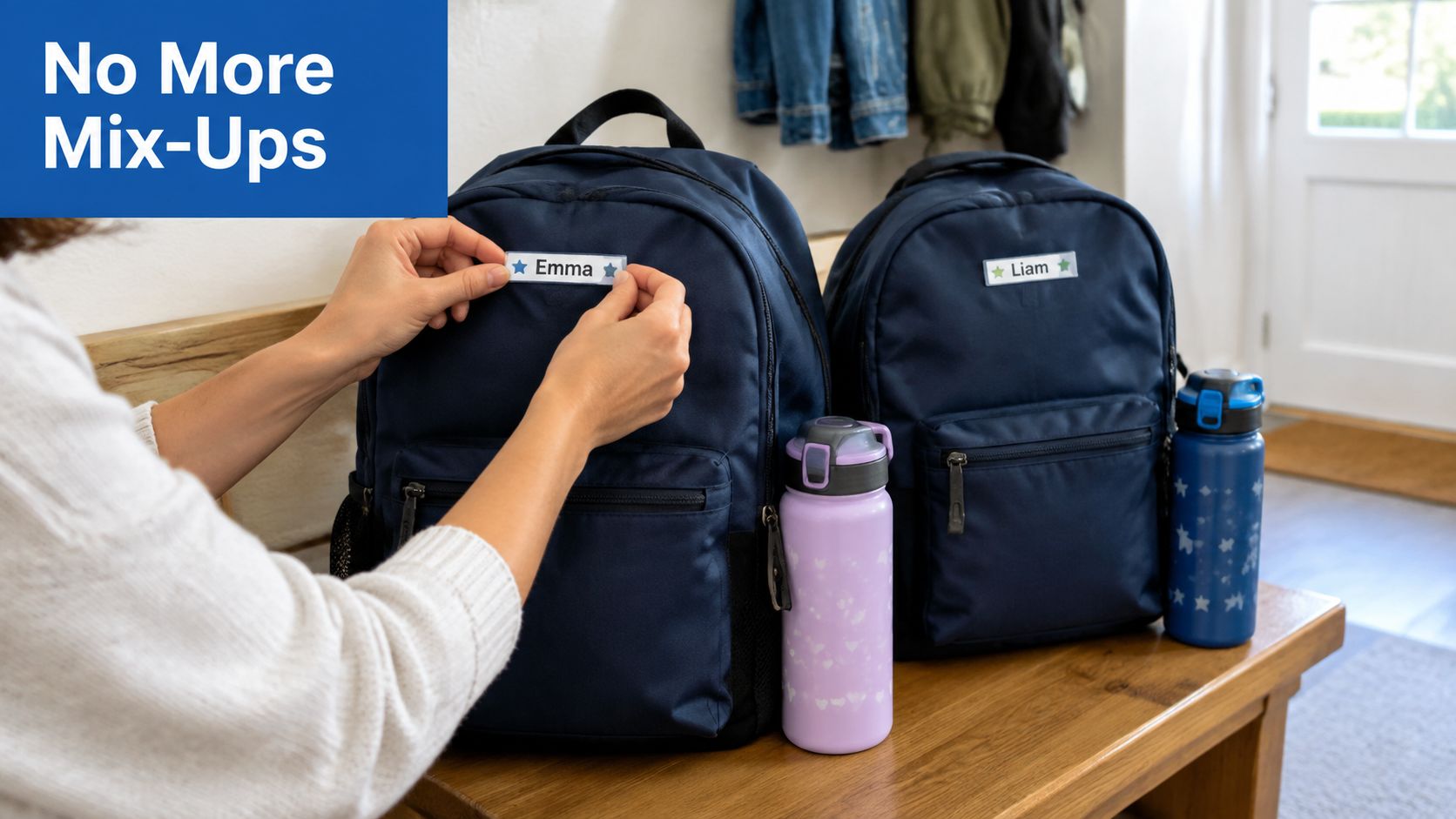
Reversibility is the main advantage
Parents often compare removable tapes with stickers, iron-on labels, and sewn tags as though one option must work for every belonging. In practice, a mixed labeling system is usually more sensible.
- Shared uniforms: Remove one child's name before the garment goes to a sibling.
- Borrowed items: Add temporary identification to a school trip bag or loaned sports kit.
- Changing assignments: Move a label when daycare cubbies, nap mats, or classroom storage changes.
- Growing children: Reuse a compatible tape as clothing and equipment are replaced.
That distinction is also useful if you're trying to reduce disposable labeling. Reusable label guidance from InchBug offers broader context on choosing labels that can remain useful beyond a single item or short period.
Removability does come with a tradeoff. A permanent label is generally simpler for an item that will stay with one child for years, while a Velcro tape needs a compatible loop surface and periodic checking. The smart question isn't “Which label is universally best?” It's “Will this item need a new owner, a new role, or a new location?”
How Hook and Loop Fasteners Actually Work
Hook-and-loop fastening uses two matching textile surfaces. One side has many small, stiff hooks. The other has soft loops made from fabric. Press the two sides together and the hooks catch the loops, much like thousands of tiny fingers reaching into a soft net.
To remove the tape, you peel it back rather than pulling the whole surface straight apart. Peeling separates the connection gradually, so the tape can come away without the heat, stitching, or residue associated with more permanent attachment methods.
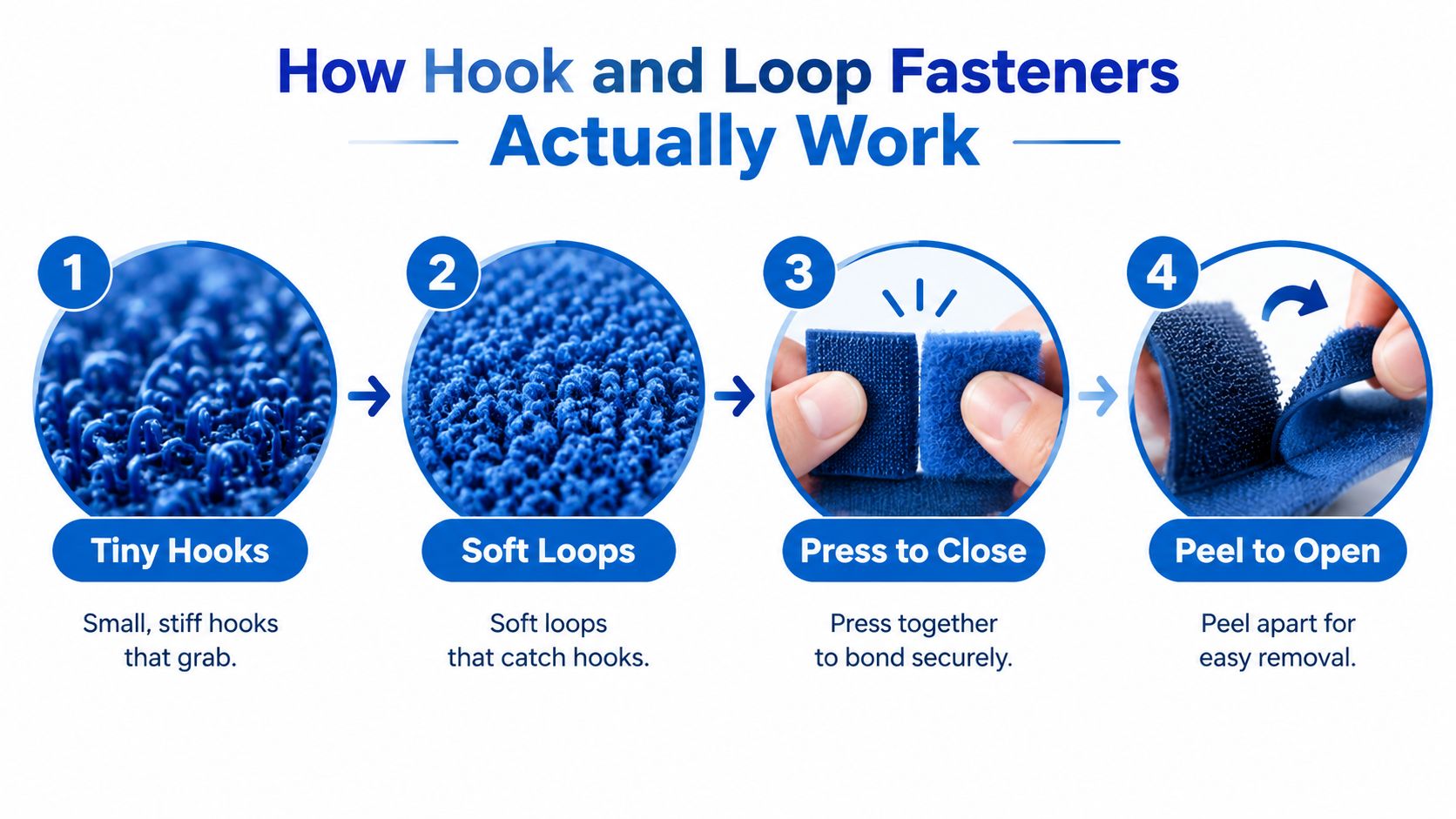
From an Alpine observation to everyday labels
The technology behind these tapes dates to 1941, when Swiss engineer George de Mestral noticed burrs clinging to clothing and his dog after a hunting trip in the Alps. He filed the original Swiss patent in 1951, and the patent was granted in 1954 or 1955, depending on the source. The name VELCRO came from the French words velour and crochet, referring to the fabric and hook elements (VELCRO's account of the invention).
The original patent expired in 1978, helping hook-and-loop closures become broadly available rather than remaining limited to one patent holder (the history of hook-and-loop fastening). The system later became strongly associated with military and uniform applications, where people needed identification that could be changed without replacing an entire garment panel.
For parents, that history matters because the same detachable logic suits modern school life. A name tape isn't fused into the fabric. It becomes one part of a reusable identification system.
Practical rule: The loop panel is the host surface, and the hook side belongs on the removable name tape. If both pieces have the same side, they won't connect properly.
A simple test helps before you order several tapes. Press the rough side of the tape against the soft, fuzzy panel. It should engage across the contact area, lie flat, and release by peeling from one corner. For more practical information about testing label performance, see InchBug's label durability testing guide.
Material Options and Sizing for Every Need
A name tape must suit both the item and the child who will use it. Material, dimensions, backing, and lettering determine whether the label stays readable and secure through ordinary school wear. Because the tape can be removed, parents can also change the identification when a uniform becomes a hand-me-down or school requirements shift.
| Material | Durability | Wash Performance | Best For |
|---|---|---|---|
| Woven polyester | Smooth lettering and a structured finish | Suitable for regular garment care when attached to a compatible textile panel | Uniforms, jackets, bags, and school clothing |
| Embroidered cotton blend | Textured appearance with visible stitched lettering | Can work well on clothing, but texture and thread care need consideration | Traditional uniform-style identification |
| Printed synthetic material | Flexible surface with clear printed text | Useful where a smooth, lightweight label is preferred | Bags, equipment, and compact belongings |
Match the tape to the item
A wider uniform tape gives a full name more room, which helps with hyphenated surnames or accented letters that become difficult to distinguish when crowded. A narrow tape may fit a shoe strap, small pouch, or pacifier clip more neatly, though its text area is limited.
Measure the actual placement area before choosing a size. Product photographs can make a tape look smaller than it will on a narrow clothing tag. A short tape may also require lettering that is too small to read quickly in a busy classroom. InchBug's guide to custom label size offers a useful way to assess available space before finalizing the design.
Understand the backing options
A sewn-on loop panel suits clothing and equipment that will be handled often. Sew the soft panel to the item once, then attach or remove the personalized tape as ownership changes. The panel stays with the garment, while the name tape can move to another compatible item.
An adhesive-backed strip is convenient for a quick setup and may suit a smooth surface that receives limited handling. Adhesive alone is less suitable for washable fabric because laundering, flexing, and moisture can loosen the bond.
An iron-on loop panel may work on heat-compatible fabric. Check the garment's care instructions before applying heat, and follow any school requirement about label placement or format.
Text limits vary by supplier. Some note a cap of around 16 characters. Treat that as a supplier-specific limit, not a universal rule. Ask how spaces, hyphens, accents, and non-Latin characters are counted, and request a proof when clear reading matters.
Best Use Cases for Velcro Name Tapes
Removable identification works best when ownership is temporary, shared, or likely to change. It isn't merely a convenient alternative to sewing. Its real value appears when the label needs to move.
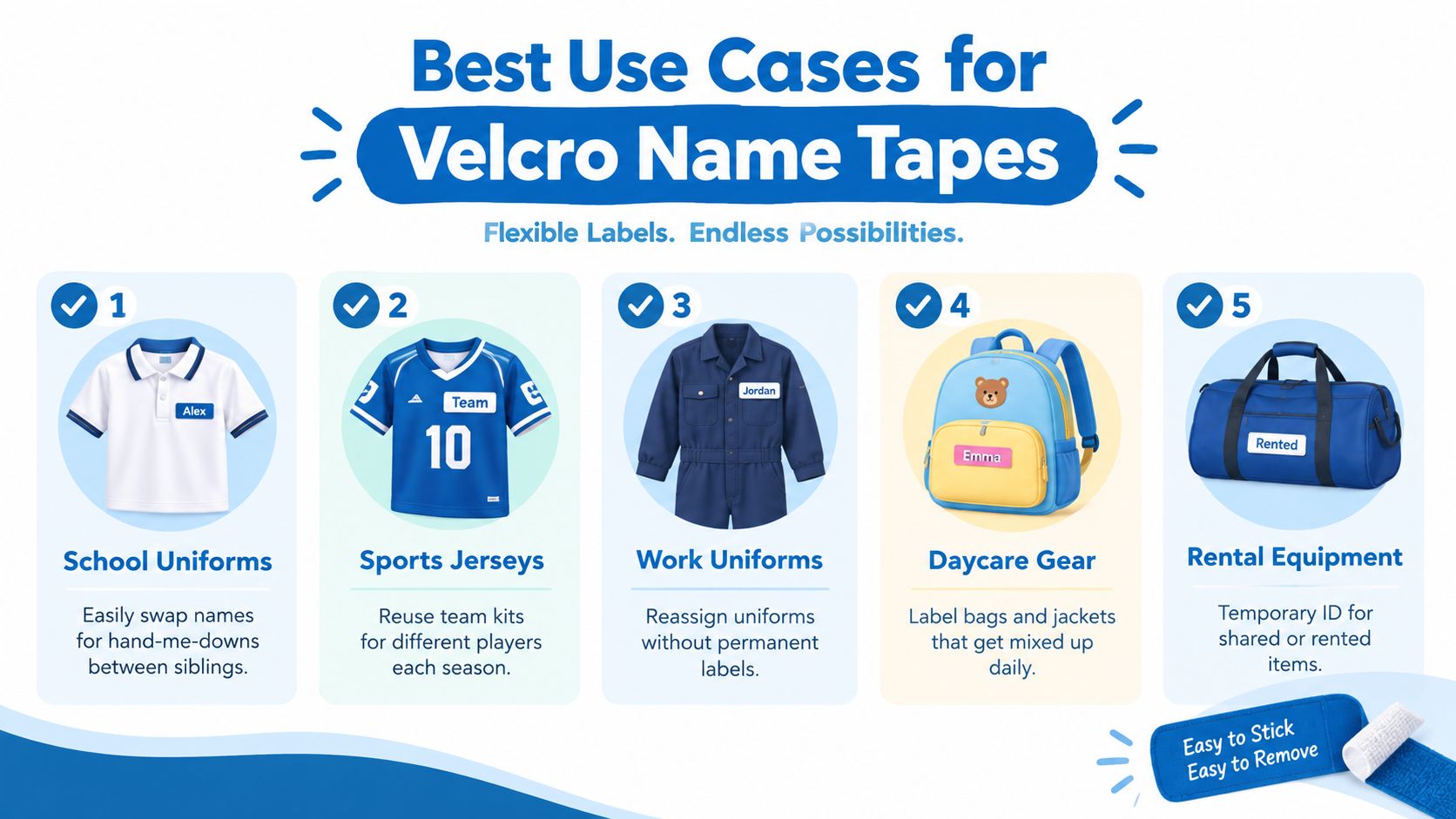
Where the reversible system earns its place
Hand-me-down uniforms are an obvious example. A school sweatshirt may be worn by one child, stored for a while, and then used by a sibling. A removable tape lets the family change the identifier without stitching over an old name or accepting a permanent label that no longer matches the wearer.
Sports gear follows a similar pattern. Jerseys rotate between seasons, teams, and children. A tape can identify the current player while leaving the garment available for future use.
Daycare equipment creates a different kind of problem. Bags, jackets, nap mats, and comfort items may move through crowded storage areas every day. If a nursery is new to your family, guidance on choosing a nursery setting can provide useful preparation context, while a removable label helps once the daily routine begins.
The strongest case for Velcro is not permanence. It's the ability to reverse a decision without damaging the item.
Shared classroom supplies and borrowed equipment also benefit. A teacher may need to identify a kit for a particular student, then return it to a common pool. Rental items, trip bags, and temporary activity clothing have the same requirement.
Multilingual names need room and flexibility
Families may need labels that include accented letters, hyphenated names, or more than one writing system. A removable format doesn't automatically solve spacing or character limitations, but it makes future updates less wasteful if the family changes the wording, adds a second identifier, or needs a role-based label instead of a personal name.
Use the label's purpose to decide what to print:
- Personal belongings: A first name may be enough when staff already know the child.
- Shared equipment: A full name or family identifier can reduce confusion.
- Role-based gear: “Art helper” or “Team kit” may be more useful than an individual name.
- Temporary use: Choose wording that remains relevant only for the period you need it.
Permanent labels are usually better for shoes, underwear, or objects that will remain with one child and face constant handling. Velcro tapes can also fall short on items without a suitable attachment area or equipment exposed to severe abrasion, heat, or outdoor conditions. Use the reversible option where change is the problem, not because it sounds more flexible.
Attachment Methods and Long-Term Care
A name tape works best when its attachment matches the item's daily use. A securely sewn textile loop panel usually handles bending, stretching, and laundering better than glue alone. Adhesive can suit a smooth, stable surface, but fabric movement puts more strain on a glued bond.
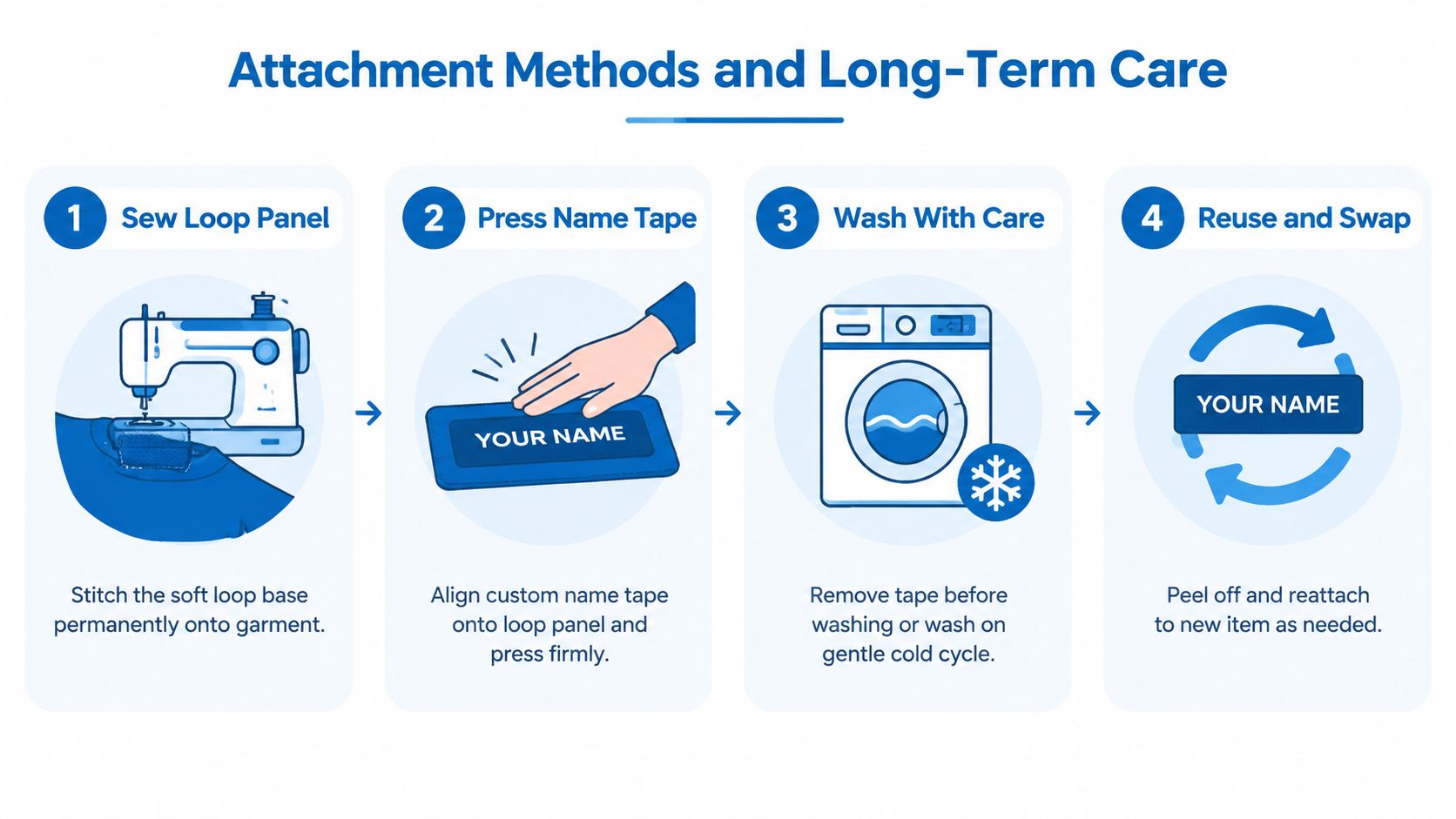
Attach it for the life you expect
With a sewn panel, place the soft loop side where teachers can read the name without opening a bag or turning clothing inside out. Sew around the perimeter with an even line, close enough to keep the corners flat. A textile-compatible backing is a better choice than adhesive-only attachment for items washed often.
For an adhesive-backed panel, clean and dry the surface before applying it. Press firmly across the panel, then let the adhesive settle according to the supplier's instructions. Do not treat it as a permanent fabric solution unless the product specifically supports laundering.
Align the name tape carefully and press across its full surface. Full contact distributes the pull during dressing, play, and packing. If only one edge connects, that edge carries the strain and may lift sooner.
Launder with the tape removed when possible
Removing the tape before washing limits its exposure to water, heat, detergent, and lint. Keep removed tapes in a small pouch or household organizer, especially when several children use similar bags or jackets. For washing and storage guidance, see InchBug's label care instructions.
If the tape must stay attached, follow care suited to the garment. Washing it inside out can reduce rubbing, while lower heat helps protect the textile parts. Inspect the hook side afterward. Lint and loose fibers can fill the tiny hooks, much like dust clogging a brush, and reduce the grip between the two sides.
Repeated opening also changes performance. One industrial-grade tape reported average peel strength of 376.85 g/cm and shear strength of 1.24 kgf/cm² initially. After 2,000 open-close cycles, peel strength fell to 240.36 g/cm, a 36% decrease, while shear strength fell by 18% (the technical data sheet). Consumer name tapes may use different materials, but frequent removal still makes inspection worthwhile.
Care check: If the tape lifts at the corners, feels loose across a clean panel, or has hooks packed with lint, clean or replace it before the next busy school week.
Formal specifications also examine hook-and-loop materials after laundering and dry cleaning. MIL-F-21840G lists minimum thicknesses of 0.050 inch for hook tape and 0.095 inch for loop pile tape. Another technical sheet describes 2,000 peel cycles with less than 10% closure-strength loss as a durability benchmark for textile use (hook-and-loop performance specifications). These figures do not promise the same result for every consumer tape. They do show why backing, stitching, and care matter more than initial stickiness alone.
Ordering and Personalizing Your Name Tapes
A child arrives at daycare with a borrowed coat, a shared sports bag, and a lunch container that resembles three others. Ordering is easier when you first decide which belongings need removable identification, then measure each loop panel before choosing a tape format or supplier.
Check minimum quantities, production lead times, and whether the supplier provides a proof before production. Families labeling several children can compare pack sizes, but a larger order helps only when the wording remains readable and the backing fits the intended gear. Removable tapes are especially practical when uniforms, bags, or equipment will pass between siblings or change during the school year.
Plan the wording before you design
Short names are simple. Longer names require a clear purpose. A school coat may need a full name, a shared classroom item may use a first name and initial, and equipment used by siblings may work better with the family name.
Hyphens, accents, and non-Latin scripts need checking before payment. Confirm that the supplier supports the required characters, ask whether the font keeps their shapes clear, and review the proof for substitutions. Some suppliers cap text at around 16 characters, so a long name may call for a larger tape, smaller lettering, or a shortened identifier that caregivers can still recognize. Read the supplier's custom name tape ordering details before finalizing the layout.
Treat the proof as a practical test
Before approval, check four details:
- Spelling: Match every letter to the child's official name.
- Readability: View the smallest lettering from a normal standing distance.
- Contrast: Make sure thread or print color stands out against the tape.
- Placement: Confirm that the finished size fits the loop panel without covering a zipper, seam, or handle.
Ask another caregiver to read the proof without prompting. If they hesitate, the design may be too small, crowded, or low-contrast for a busy classroom.
Save the approved artwork, wording, font, and supplier details in a family folder. That record simplifies reordering after a lost tape and helps another child receive the same format. For families comparing removable and permanent labels across clothing, bottles, bags, and school gear, InchBug's label selection guide organizes choices by item and labeling need. Order for how the gear will be shared and reused, not only for the first school morning.
Making the Right Choice for Your Family
Choose custom Velcro name tapes when reversibility solves a real problem. Hand-me-down uniforms, shared bags, rotating jerseys, borrowed equipment, and temporary daycare or classroom assignments all benefit from a label that can move without leaving a permanent mark.
Choose a sewn, iron-on, or other permanent label when the item will stay with one child, has no compatible loop surface, or needs identification that won't be removed during frequent handling. Material quality and attachment method still matter. A durable tape attached to a weak adhesive panel won't perform as well as a simpler tape mounted on a secure sewn loop base.
Start with a small order and test it on the item that causes the most mix-ups. Check visibility, comfort, laundering, and how easily your child or caregiver can remove and reattach it. A thoughtful combination of removable and permanent labels can reduce daily searching, prevent avoidable swaps, and help children take responsibility for their belongings.
InchBug offers reusable personalized options for bottles and cups, along with adhesive name labels for items such as clothing tags, bags, and school gear. Visit InchBug to compare labeling choices and build a system that fits the belongings your family shares, swaps, and uses every day.