

Have you ever wanted your shifter to feel more precise, only to realize that the question isn't how it looks, but whether it fits the way the transmission moves? A custom gear lever sits right at that gap between style and engineering. If you get that distinction wrong, you can end up with a lever that looks right in photos and feels wrong in your hand.
A good starting point is simple. A gear lever is a driver control interface that turns hand movement into selector movement, and a custom version changes some part of that interface, shape, length, material, pivot behavior, mounting, or finish. The earliest automobiles used simple lever-based controls, and over time the system became standardized into the familiar driver control many people use today, with milestones like synchromesh in 1919, Hydra-Matic in the 1940s, and widespread four- and five-speed manuals by the 1980s shaping what “normal” feels like now source.
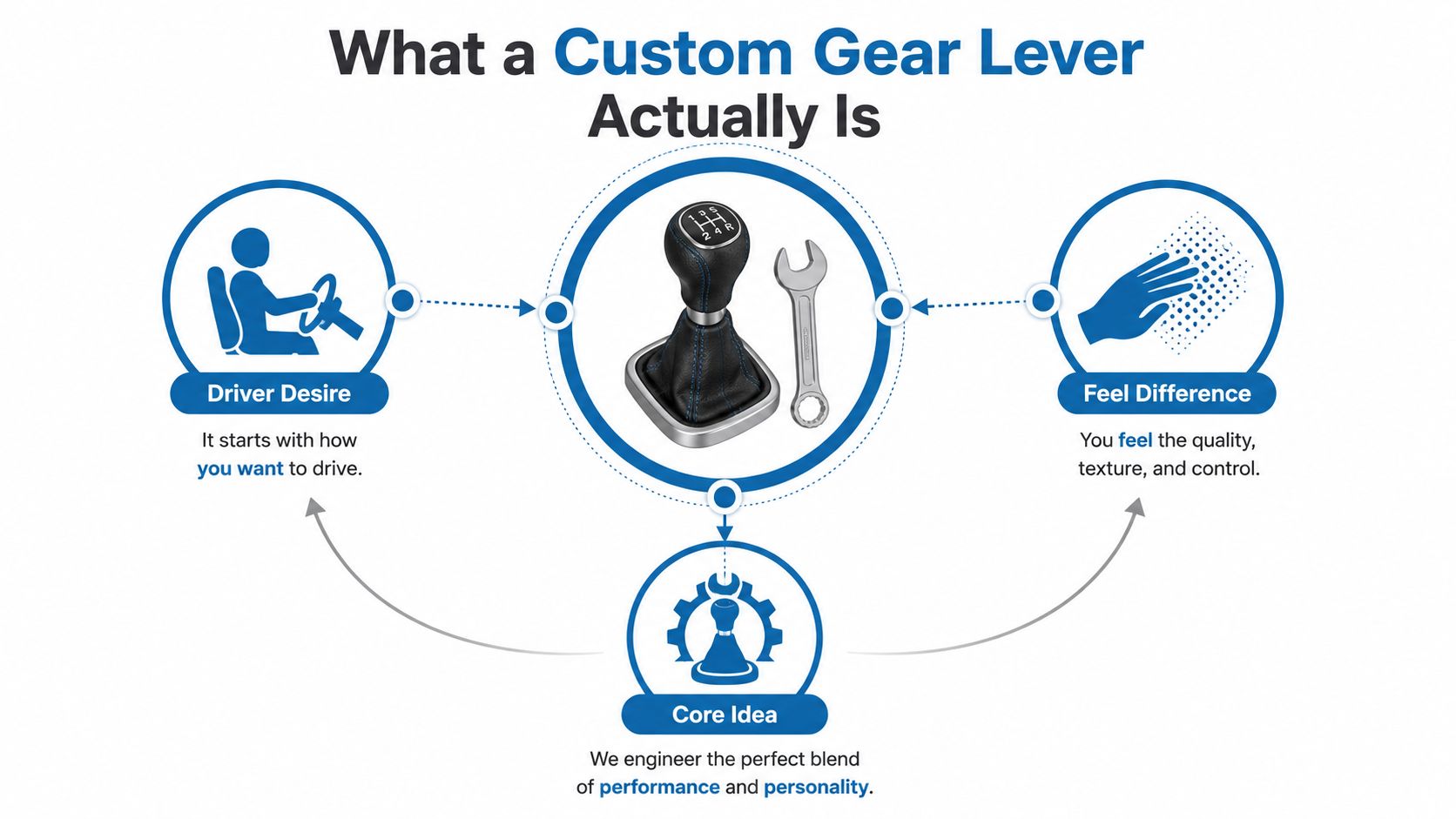
What a Custom Gear Lever Is
A driver usually starts with a feeling, not a specification. Maybe the stock lever sits too low, the throw feels vague, or the grip shape never quite matches the hand. A custom gear lever sits in that space between personal preference and mechanical fit, and “custom” can point to two very different changes, a cosmetic change or a functional one.
The mechanical parts that matter
The lever is one link in a chain. Your hand moves the knob or handle, the lever pivots, and the transmission or shift linkage receives that motion. If the lever geometry is off, the difference shows up right away in effort, travel, and accuracy. If the lever only looks different, the shift may feel almost unchanged.
That is why first-time buyers should separate the visible pieces from the hidden ones. The visible pieces include the knob, handle, texture, and finish. The hidden pieces include the pivot point, mounting hardware, and stroke, and those details often decide whether the lever feels crisp or awkward.
Practical rule: if a listing only talks about appearance, you still do not know enough about fitment.
A simple way to organize the topic is to separate feel, fit, and function. Feel covers comfort and hand placement. Fit covers whether the part physically installs on your vehicle. Function covers how the lever changes the actual shift action. A buyer who keeps those three separate is much less likely to buy the wrong part.
A Brief History of the Gear Lever
Why does a modern shift lever still feel like a piece of old machinery, even in a refined cabin? The answer sits in the car's early hardware. The first automobiles, including the 1886 Benz Patent-Motorwagen, used simple lever-based controls that moved directly with the mechanism itself. That early setup matters because many custom parts still use the same basic vocabulary, even though the internal engineering has become much more precise source.
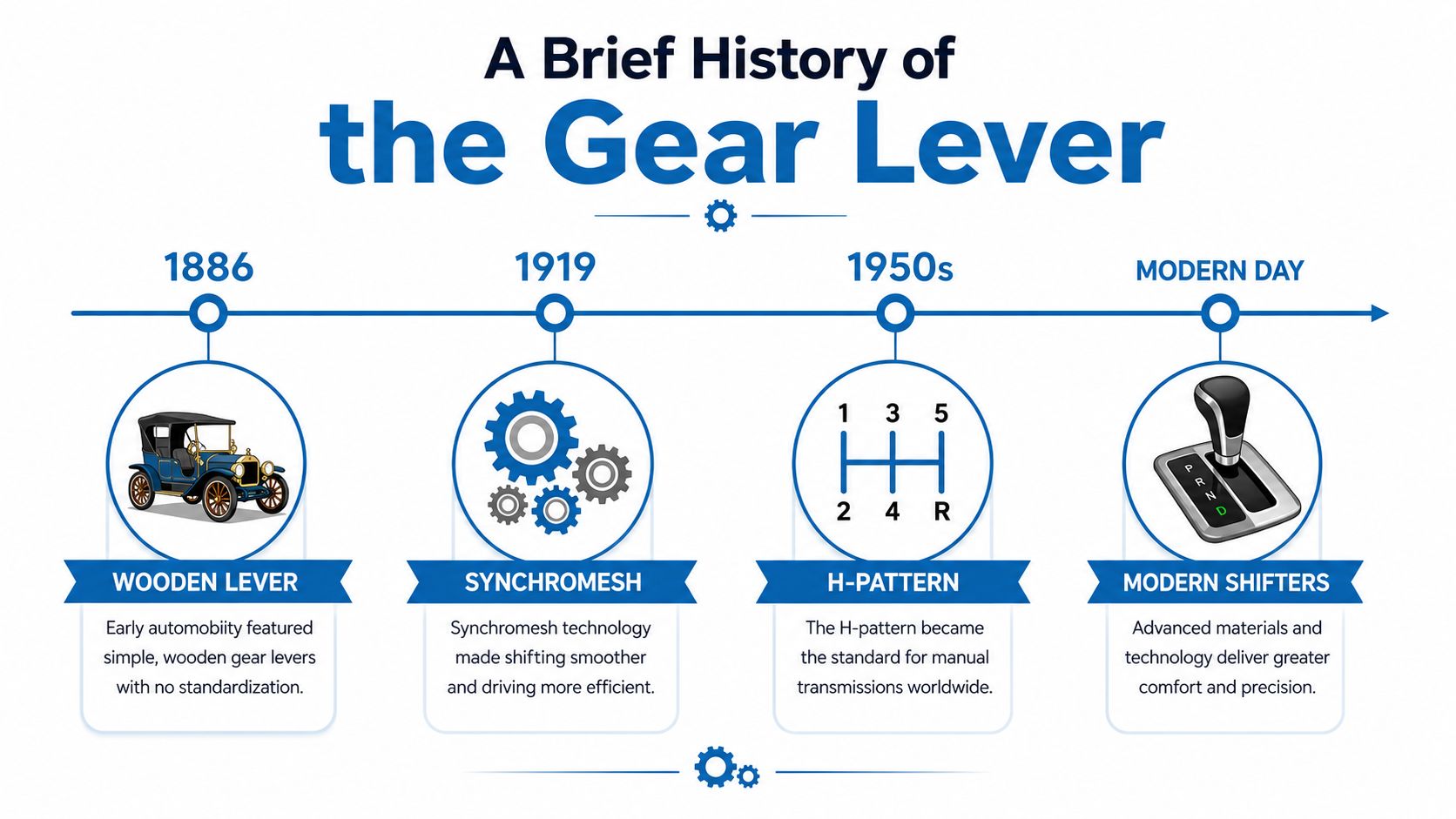
The old layout was not built for convenience. It was built for direct mechanical control, so the driver had to work with the transmission's behavior instead of expecting the car to smooth everything out. That is the reason modern custom levers still have to be judged on two levels, how they look and how faithfully they preserve the shift action.
Why standard shapes became common
The first major shift in the lever's story came with synchromesh, which synchronized gear speeds and reduced the need for exact manual rev-matching source. That change made the familiar H-pattern manual layout easier to live with, because the shift no longer demanded such precise timing from the driver. In practical terms, the lever could keep the same basic path while the transmission became more forgiving.
Automatic gear sticks gained wider acceptance in the 1940s after General Motors introduced Hydra-Matic, which pushed the lever from a purely mechanical control toward a more standardized cabin interface source. The driver was still selecting a mode, but the physical relationship between hand movement and gear change became less direct than it had been in earlier cars.
By the late 1970s, most transmissions used three or four forward gears, and by the 1980s synchromesh in all forward gears and four- and five-speed manuals had become standard in many markets source. That history still shapes the aftermarket. Some custom levers fit cleanly because the platform followed a common pattern for years, while others need adaptation because the vehicle's shift architecture developed along a different path. For buyers comparing fitment details across vehicles, a practical starting point is a travel gear and accessory collection that shows how products can be organized around use case and compatibility rather than appearance alone.
Why that history matters to buyers
The old mechanical logic still shapes expectations. Drivers tend to expect a lever to sit in a familiar place, travel through a familiar arc, and return with a familiar feel. A custom part works best when it respects that baseline instead of fighting it.
That is why history is useful even for someone choosing a modern custom lever. A lever can be shortened, weighted, or reshaped, but the transmission still has to receive the movement in a way that feels natural to the driver. The strongest designs are the ones that understand the original job of the lever first, then change only the parts that need to change.
Aesthetic Versus Functional Customization
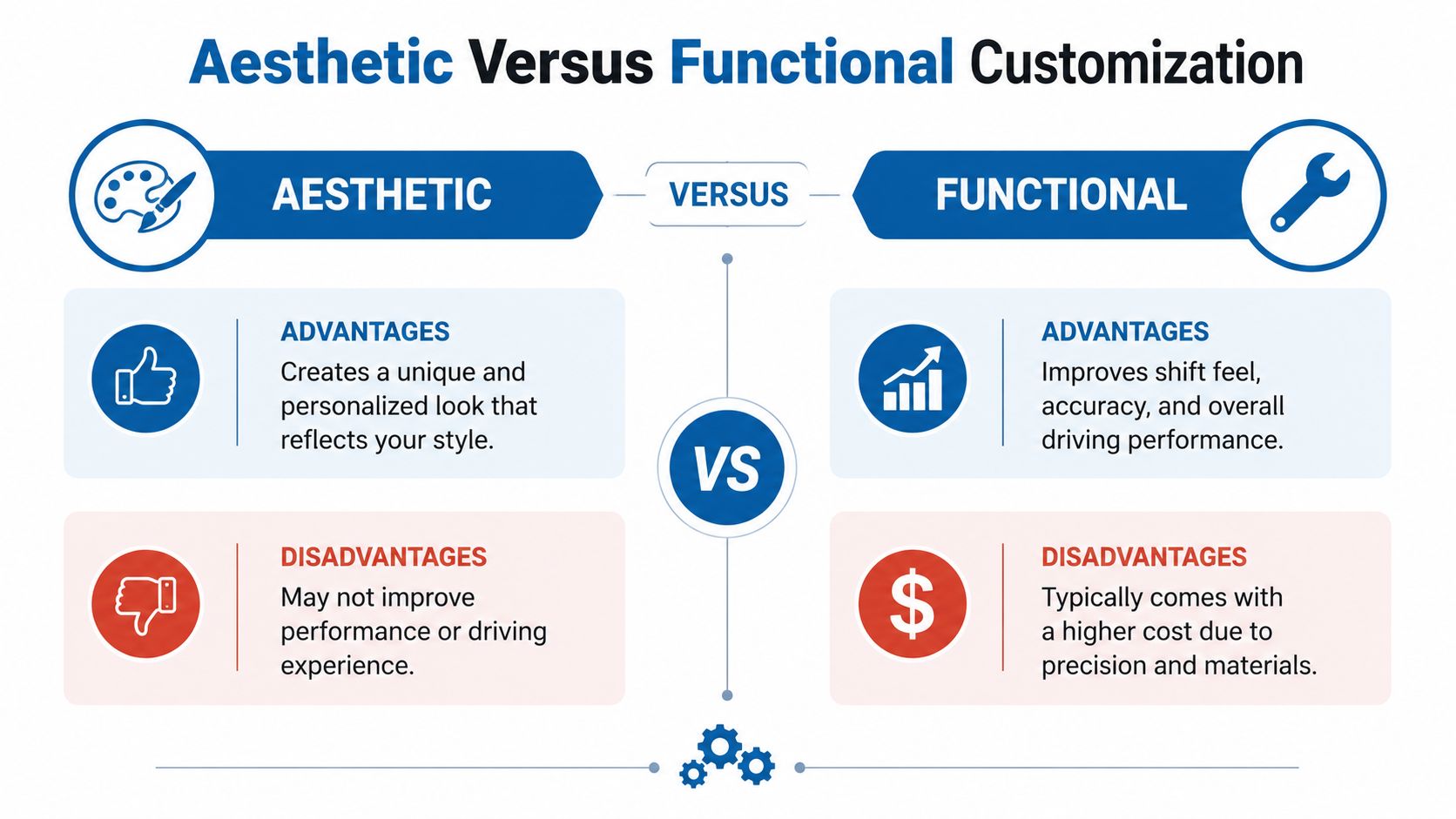
A carbon-look knob and a short-throw kit can both be called “custom,” but they solve different problems. The first changes how the lever looks and, sometimes, how it feels in the hand. The second changes how the shift itself behaves.
What aesthetic customization really does
Aesthetic changes are about appearance, surface, and touch points. That can include anodized finishes, engraved patterns, leather wrapping, or a reshaped knob that sits better in the palm. For a lot of owners, that's enough. The cabin feels more personal, and the shift lever becomes part of the car's identity instead of just a standard factory piece.
The trade-off is simple. A prettier lever does not automatically improve the shift. If the internal geometry stays the same, the driving experience may stay nearly the same too. That's fine if your main goal is visual. It's disappointing if you expected sharper engagement.
What functional customization changes
Functional customization targets the mechanics. It changes stroke, ratio, weight, or pivot design so the lever moves differently under your hand. That can make the lever feel shorter, firmer, or more deliberate. On motorcycles and some manual cars, that's often the reason people upgrade in the first place.
The key mistake is buying one category while expecting the other. A lever with a premium finish can still have the wrong reach. A short-throw setup can feel great yet look plain. If you're shopping, ask one question before anything else, do you want a different look, or do you want a different shift action?
A custom part is only as good as the problem it solves.
For extra context on how buyers often evaluate adjustment and form factors in physical accessories, this practical collection of travel gear shows how product choices often start with fit and use case rather than looks alone.
Common Types of Custom Gear Levers
The easiest way to compare options is by how they change the shift experience. A short-throw lever reduces travel, a tall lever usually gives the hand more power and a different reach, a weighted lever can make motion feel more planted, and foldable or adjustable designs focus on protection and fit. The names sound simple, but the driving feel can be very different.
Short, tall, weighted, foldable, and adjustable
A short-throw lever appeals to drivers who want a tighter, quicker motion between gears. It suits people who like a more direct feel, especially in performance-minded builds. The downside is that a shorter throw can feel less forgiving if the rest of the linkage isn't in good condition.
A tall lever changes hand position more than it changes technical behavior. Some drivers like the higher placement because it reduces the sense of reaching down toward the console. Others dislike it because it can feel bulky or intrusive in a tight cabin.
A weighted lever is about momentum and feel. Extra mass can make shifts feel smoother and more deliberate, though it may not suit every vehicle or every driver. A foldable lever is common in motorcycle contexts, where crash resistance and clearance matter. An adjustable lever tries to bridge preferences by giving the owner some control over reach and position.
For motorcycle buyers, the same logic applies to folding and adjustable-tip designs. The lever still has to match the rider's hand position, clearance needs, and control style. The shape can differ, but the engineering trade-offs are the same.
Buying shortcut: choose the lever type that solves your main annoyance, not the one that sounds most exciting in the listing.
If you're comparing custom parts in a broader family context, InchBug's gear for mom collection is a reminder that product selection always starts with the user's actual routine, not the catalog label.
Lever Ratio and Stroke Explained
The engineering behind a custom gear lever starts with lever ratio and stroke. Those two terms tell you how hand movement turns into selector movement, and they're the numbers that separate a meaningful upgrade from a cosmetic one. If a seller can't explain them, you probably don't have enough information yet.
Reading the geometry without getting lost
One modified motorcycle gear lever is specified with a 1:1.5 lever ratio source. That kind of spec tells you the hand and selector do not move the same distance, the mechanism is trading motion for mechanical advantage. A heavy-duty manual shift lever assembly lists 180 mm or 205 mm installation stroke and 75 mm effective stroke, which shows how designers tune the physical travel of the part source.
The practical rule is straightforward. Longer levers generally lower hand effort but increase travel. Shorter levers generally reduce travel but increase effort. That's why the lever ratio matters so much. It tells you whether the part is changing the shift mechanics or just reshaping the handle.
If you want to estimate the force and motion relationship in a mechanical system, practical leverage and gear calculations is a useful reference point. The underlying idea is the same one you feel at the shifter, mechanical advantage always comes with a trade-off in travel.
How to judge a “short throw” claim
A marketing phrase is not enough. A genuine short-throw setup should explain the before-and-after relationship in geometry, not just promise a sharper feel. Ask whether the lever changes pivot position, arm length, or selector motion. Those details tell you more than adjectives ever will.
If the listing gives no ratio, no stroke, and no fitment detail, treat the claim as incomplete.
That's the part many first-time buyers miss. The lever doesn't become better just because it moves less. It becomes better when the reduced movement still matches your hand, your cabin layout, and your transmission's expectations.
Materials and Pivot Design Choices
Material choice matters because the lever is repeatedly loaded by the driver's hand. Pivot design matters because even a strong lever can feel sloppy if the joint flexes or binds. In a performance or heavy-use setting, those details shape both durability and shift precision.
Why alloy choice shows up in product specs
A custom gear lever built from 7075-T6 aluminum with a 6061-T6 base plate is trying to balance stiffness, weight, and compatibility source. That combination makes sense because 7075-T6 offers a high strength-to-weight profile, while 6061-T6 is often used where a base structure or interface needs to pair well with the rest of the assembly. Another adjustable lever uses 7075-T6 CNC-milled aluminum and offers a 30 mm adjustment range, roughly +20 mm extension and -10 mm shortening source.
That kind of range matters more than most product photos suggest. A small adjustment can change ankle angle, wrist angle, or hand reach enough to make the lever feel natural instead of forced. It's a fine example of how customization is partly ergonomic and partly mechanical.
Why the pivot matters as much as the arm
Roller bearings at the pivot reduce slop and friction, which helps the lever return more consistently and keeps the motion repeatable under load source. That also helps wear life, because the joint isn't relying on a loose, rubbing connection to stay precise. If you've ever used a lever that felt vague in the middle of the throw, the pivot is often the reason.
A seller photo can't show that well. Look for the wording instead. If the listing names the alloy, the pivot type, and the adjustment range, it's usually doing real engineering work. If it only shows a polished surface, you're mostly shopping for appearance.
Fitment, Installation, and Maintenance
Fitment is where a lot of buyers get burned. A lever can be beautifully made and still be wrong for the vehicle if the mounting pattern, linkage style, or electronics don't match. The practical checklist matters more than the product story.
What to verify before you buy
Start with the basics. Check the thread pattern, the shift linkage type, reverse-lockout behavior if your vehicle uses it, and any electronics integration on newer platforms. If the lever interfaces with sensors or shift-by-wire hardware, the part needs to match the system, not just the cabin opening.
Compatibility also depends on the transmission layout. A lever that works in one model year may not work in another if the linkage or trim console changes. That's why fitment notes matter more than “universal” language.
A sensible install sequence
- Prep the area. Disconnect power where needed, clear the console, and inspect the old hardware for wear.
- Fit the lever carefully. Confirm alignment before tightening anything fully, because forcing the part into place can create side load.
- Check the result after installation. Make sure the lever returns cleanly, clears surrounding trim, and moves through each gear without binding.
The first drive should feel normal, not just possible.
Maintenance is simple but easy to skip. Keep the pivot lubricated if the design calls for it, recheck fasteners after the first few hundred miles, and inspect the assembly for looseness or noise. If a shift cable or linkage issue shows up during diagnosis, T1A Auto's shift cable repair guide is a practical reference for understanding how cable condition affects shifting behavior.
For owners who also think about organized vehicle accessories and storage, InchBug's auto travel accessories reflects the same mindset, choose gear that fits the use case and stays reliable over time.
Buyer FAQs and Final Recommendations
The best custom gear lever is the one that solves a specific problem. If you want appearance, buy for finish and shape. If you want feel, buy for ratio, stroke, and pivot quality. If you want both, make sure the product description covers both, because one does not automatically imply the other.
A few practical answers help most buyers make the call. Does it affect warranty? It can, depending on the vehicle and the part, so check the manufacturer's terms before you install anything. Is professional installation worth it? Yes, when the lever interacts with tight packaging, electronic shift systems, or hard-to-access linkage hardware. What matters most in quality? Fitment clarity, solid materials, and a pivot that doesn't feel loose.
The simplest decision framework is this, define your goal, verify fitment numerically, and choose the lever that matches how you drive. If that sounds unglamorous, it is, but that's what keeps a custom part from becoming an expensive ornament.
If you want more practical, everyday ways to match the right product to the right user, visit InchBug and explore the kind of thoughtful customization that starts with fit, comfort, and real-world use.