

The scramble starts before anyone has found a missing bag. Wet towels spill from mesh sacks, goggles fog in the changing room, and several nearly identical backpacks land in the same pickup area. Your child grabs the wrong one, another parent checks the lost-and-found bin, and a small label that looked perfectly waterproof at home is now peeling away from damp nylon.
Bag tags for swimming have a tougher job than ordinary school labels. They face repeated wet-dry cycles, chlorinated air and water, salt residue, sunscreen, crowded storage areas, and the rough handling that comes with being dragged across pool tiles. A useful tag must remain readable, stay attached, and reveal only the information a finder needs.
Why Swim Bags Need Specialized Tags
A swimming bag lives in conditions that expose weak points quickly. A paper insert can soften, ink can run, and an adhesive label can lose its grip when moisture works beneath its edges. Even a generic vinyl label designed for lunch boxes or school supplies may not be built for a bag that is opened while wet, packed with damp gear, and left in a humid locker area.
Schools already treat visible labeling as a practical part of lost-property control. One school policy requires clothing and equipment, including the outside of PE and swimming bags, to carry the student's full name, while warning that unlabelled belongings or items marked only with initials may be held until the end of a term or year. That policy reflects the daily problem: many swim bags look alike, and staff must sort them under time pressure.
Public aquatic facilities face the same identification challenge. Vancouver's lost-and-found process says owners of identified items will be contacted within 24 hours, while other belongings may be discarded after 30 days. Those rules make a visible, durable tag more than a decorative accessory. It gives staff a practical route to return an item before it disappears into a crowded storage system. This guide to personalized kids' bag tags also illustrates why parents often choose a separate, highly visible marker instead of relying only on an internal label.
What generic waterproof tags miss
The word “waterproof” usually describes exposure to water, not the complete life of a swim bag. Chlorine can affect printed surfaces and polymer materials, while salt crystals can remain around hardware and adhesive seams after an ocean swim. Indoor pools add persistent humidity and chemical vapors, and outdoor pools add ultraviolet exposure.
Attachment creates another failure point. A tag may remain perfectly legible while its loop stretches, its clasp snaps, or its metal ring corrodes. That's why the useful questions are practical:
- Can the face stay readable? Look for rigid, water-resistant plastic or another substrate designed for repeated handling.
- Can the attachment survive movement? The loop should accommodate the bag's handle or zipper without forcing the tag against the fabric.
- Can a child use it safely? Avoid bulky decorations and sharp edges that snag mesh or catch on clothing.
- Can a finder act quickly? Include enough contact information for reunification, but not unnecessary private details.
The best swim tag addresses the whole lifecycle, not just the first splash. Material, print method, loop design, placement, and maintenance all matter.
Materials That Survive Chlorine and Saltwater
A tag's lifespan depends on more than whether its surface repels water. In a pool environment, chlorine resistance and print durability deserve separate attention. Chlorine can attack polyurethane and printed-ink systems, contributing to embrittlement, micro-cracking, delamination, and loss of legibility. A tag that tolerates brief submersion may still fail after repeated exposure to treated water and damp storage.
Stabilized TPU constructions have shown retention above 90% after 150 or more chlorine hours, while silicone-based transfers have shown near-zero degradation after 200 or more hours, according to the material comparison provided by this analysis of chlorine exposure in printed labels. Those figures apply to the tested constructions described in that source, not to every silicone or TPU tag on the market. The practical lesson is straightforward: ask what material and ink system were tested instead of accepting “waterproof” as a complete specification.
Comparing practical tag materials
| Material | Chlorine Resistance | Saltwater Resistance | Durability | Best For |
|---|---|---|---|---|
| Silicone | Strong when formulated for pool use, remains flexible | Strong, with no metal surface to corrode | Long service when the print or transfer is also durable | Mesh bags, children's everyday gear |
| Rigid PVC or plastic laminate | Useful as a water-resistant face, but performance depends on the ink and construction | Generally suitable, with attention to hardware | Varies by print, coating, and attachment | General practice bags and custom tags |
| Anodized aluminum | Resistant surface, but edges and engraving quality matter | Good surface resistance, hardware may still corrode | Can be durable if finished smoothly | Travel bags and hard-wearing equipment |
| Marine-grade stainless steel | Strong hardware choice | Stronger corrosion resistance than ordinary metal | Long service with a secure closure | Heavy duffels and shared gear |
| Laminated polyester | Can protect printed content, but seams and adhesive remain vulnerable | Moderate, depending on laminate and bond | Better for lighter use than constant pool abuse | Interior backup labels and low-stress bags |
A rigid 20 mil PVC face or similar water-resistant plastic, paired with a silicone loop, is a sensible construction for ordinary swim-bag use. The rigid face resists deformation and abrasion, while the loop avoids depending on adhesive alone. Guidance on waterproof vinyl labels and bag identification is useful for understanding why the face material and protective finish need to match the object's actual use.
Print technology matters just as much. Printed text sits on the surface and can fade, scratch, or separate from its substrate. Engraving or a properly bonded transfer can provide a more durable mark, but an engraved tag still needs smooth edges and a reliable attachment. For an outdoor pool or travel bag, prioritize high contrast, a protected print area, and a sealed or mechanically secure loop rather than choosing a material by appearance alone.
Attachment Methods That Actually Hold Up
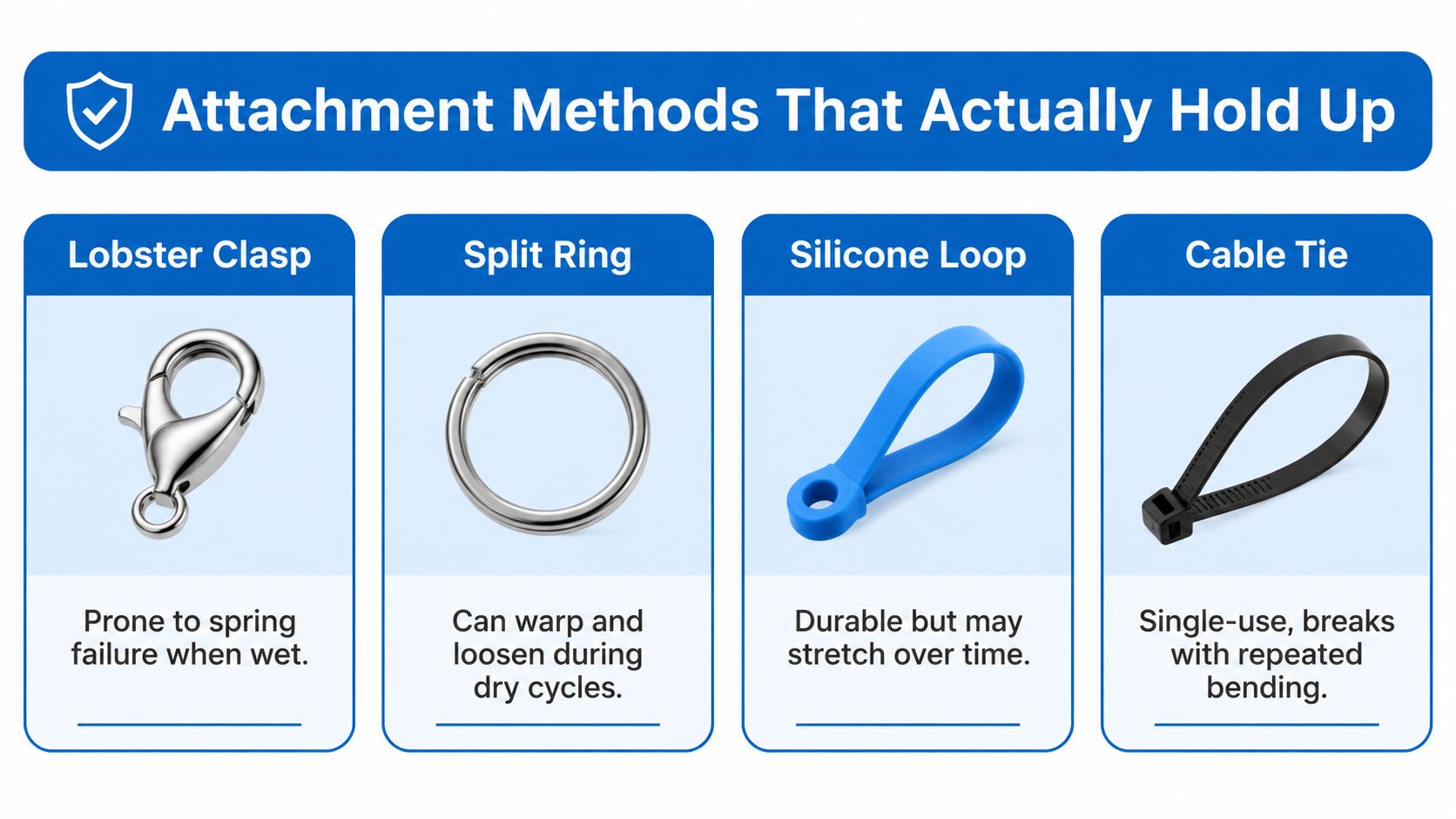
A tag usually fails at the attachment before the face becomes unusable. Wet nylon flexes, mesh stretches, zipper pulls twist, and children test every accessory by pulling it. The right mechanism depends on the bag, the child's age, and whether the bag will stay beside the swimmer or travel through buses and airports.
How common attachments fail
Lobster clasps are convenient on a rigid D-ring, but their spring and hinge create small moving parts. Moisture, chlorine residue, and repeated twisting can make the spring less reliable, while plastic versions may become brittle after chemical and ultraviolet exposure.
Split rings hold well when properly closed, yet the coil gap is a weak point. A ring can catch on mesh, spread during repeated bending, or corrode at the most exposed opening. Ordinary metal is a poor choice for a bag that stays wet.
Silicone loops are usually the most forgiving option for mesh swim bags. They stretch over a zipper pull or handle without metal-on-metal contact, accommodate wet fabric, and avoid a hinge that can seize. They can stretch over time, so inspect the loop rather than treating it as permanent.
Cable ties work when you want a semi-permanent connection, especially on a small backpack with a tiny D-ring. They're inexpensive and difficult for a child to open accidentally, but a single-use tie must be cut for removal and can break if it bends repeatedly at the same point. A smooth tie, trimmed flush, and protected with heat-shrink tubing can reduce snagging.
Match the mechanism to the bag
For a mesh equipment bag, use a silicone loop through the upper handle or a reinforced zipper pull. For a toddler backpack, a narrow cable tie can be more secure than a bulky clasp if the D-ring is too small for a loop. For a heavy travel duffel, choose a strong metal loop with a smooth finish, then check it regularly for corrosion.
A useful failure sequence is mechanical rather than calendar-based:
- First risk, weak adhesive: Damp nylon and trapped moisture can lift an adhesive-only label.
- Next risk, exposed metal: Ordinary rings may corrode or seize around their opening.
- Then, brittle plastic: Clasp hinges and thin plastic loops can snap after repeated chemical, ultraviolet, and bending exposure.
- Longer-term risk, stretched elastomer: Silicone may remain intact but lose tension after sustained pulling.
Practical rule: If the tag must flex with mesh, choose a flexible loop. If the tag must carry a heavy duffel, choose hardware designed for load and inspect the closure.
A construction such as a rigid plastic face with a silicone loop is also described in this practical guide to durable bag name tags. Whatever you choose, attach the tag where staff can see it without rummaging through the bag, but not where it will drag across the floor.
Personalization and Privacy for Kids
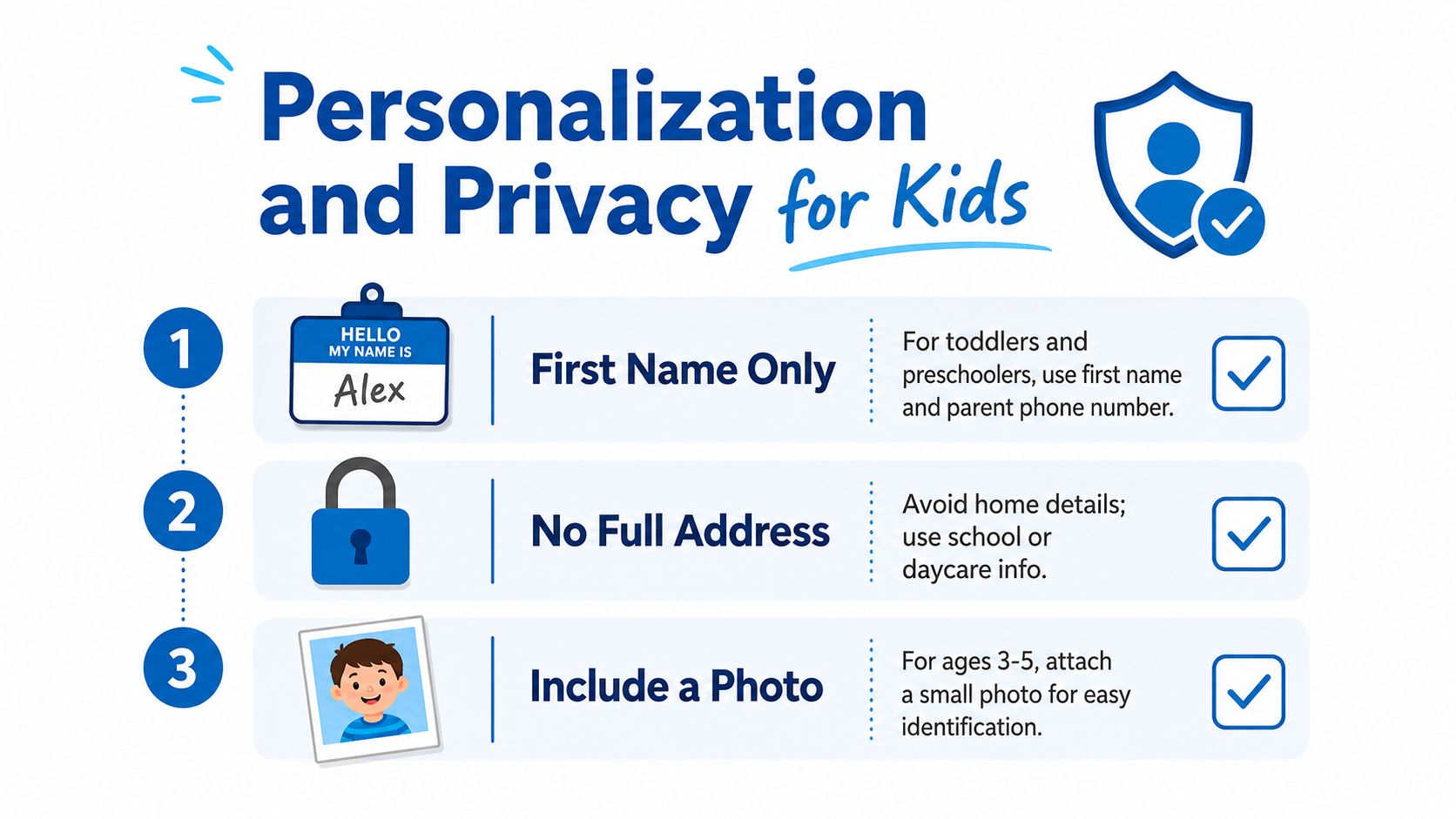
A visible tag should help a parent, instructor, or facility employee identify the bag without exposing more information than necessary. The safest design usually separates recognition from recovery. A child can recognize a color or animal icon, while an adult finder uses a parent's contact method.
For toddlers and preschoolers, a first name plus a parent or guardian phone number is often enough for practical recovery. Older children may need a surname or class identifier when several children share the same first name, but the tag still doesn't need a home address. Guidance on what information belongs on a luggage tag supports keeping visible details limited and useful.
Build the tag around the child
Use these choices as a starting point:
- Toddlers: First name, parent mobile number, and a simple icon such as a star or favorite animal.
- Preschoolers: First name, recognizable color or symbol, and parent contact information.
- School-age swimmers: Name, team or class, and a parent or guardian contact.
- Traveling athletes: Team identity, city or club information, and a recovery route such as a controlled QR page, if the family is comfortable using one.
Avoid printing a full home address on an item that will sit in a public pool area. A parent's mobile number is more useful for quick contact than a landline, especially when the child is away at a lesson or meet. If you use a QR code, make sure it leads to a page that reveals only the information needed to return the bag.
Make identification easy at a glance
Wet surfaces reflect light, and a small tag may be viewed across a crowded deck. Choose bold lettering, strong contrast, and a layout with one dominant line. A colorful symbol can help a child find the right bag before they can read, while a restrained design reduces snagging and keeps the tag from becoming a distraction.
Review the information whenever a phone number, team, class, or childcare arrangement changes. Laminated or engraved formats make updates more reliable than handwritten notes that smear or fade. The best personalization is not the one with the most detail. It's the one that makes the correct bag obvious and gives a finder a safe, direct way to contact an adult.
Care and Maintenance for Longevity
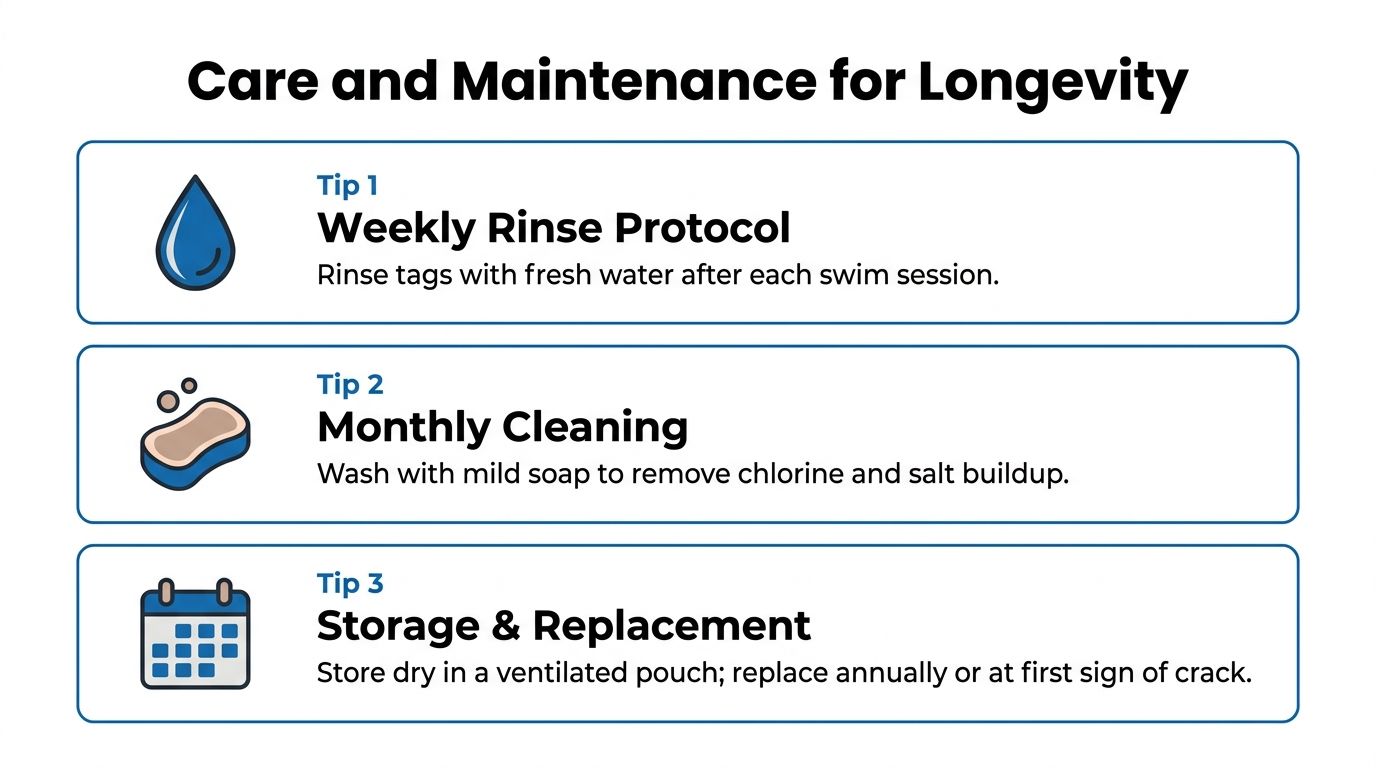
Even a well-built tag needs routine care. Chlorine, salt, sunscreen, and damp fabric leave residue that can cloud the surface, weaken some bonds, and make attachment points harder to inspect. A quick rinse after swimming costs little time and removes the residue before it dries.
A simple upkeep routine
- After each swim: Rinse or wipe the tag with fresh water, especially after saltwater use. Dry it before the bag goes into storage.
- During monthly cleaning: Use mild soap and a soft cloth. Don't use abrasive pads, strong solvents, or rough brushes on printed surfaces.
- During storage: Keep the bag and tag in a dry, ventilated place away from direct sunlight. Sealed damp compartments encourage lingering moisture.
- At seasonal changes: Examine the face, edges, hole, loop, clasp, and ring before a new lesson block or team term begins.
These label-care instructions provide a useful reminder that cleaning methods should match the label surface. Scratches create places for moisture and residue to collect, so gentle cleaning is more protective than aggressive scrubbing.
Replace a tag when the name can't be read quickly, the face has cracked, an edge is peeling, or the attachment shows fraying, stretching, rust, or a loose closure. Don't wait for the tag to vanish from the bag. A short inspection while packing goggles and towels can prevent a lost item from becoming a lost-and-found search.
Daycare and School Swim Class Strategies
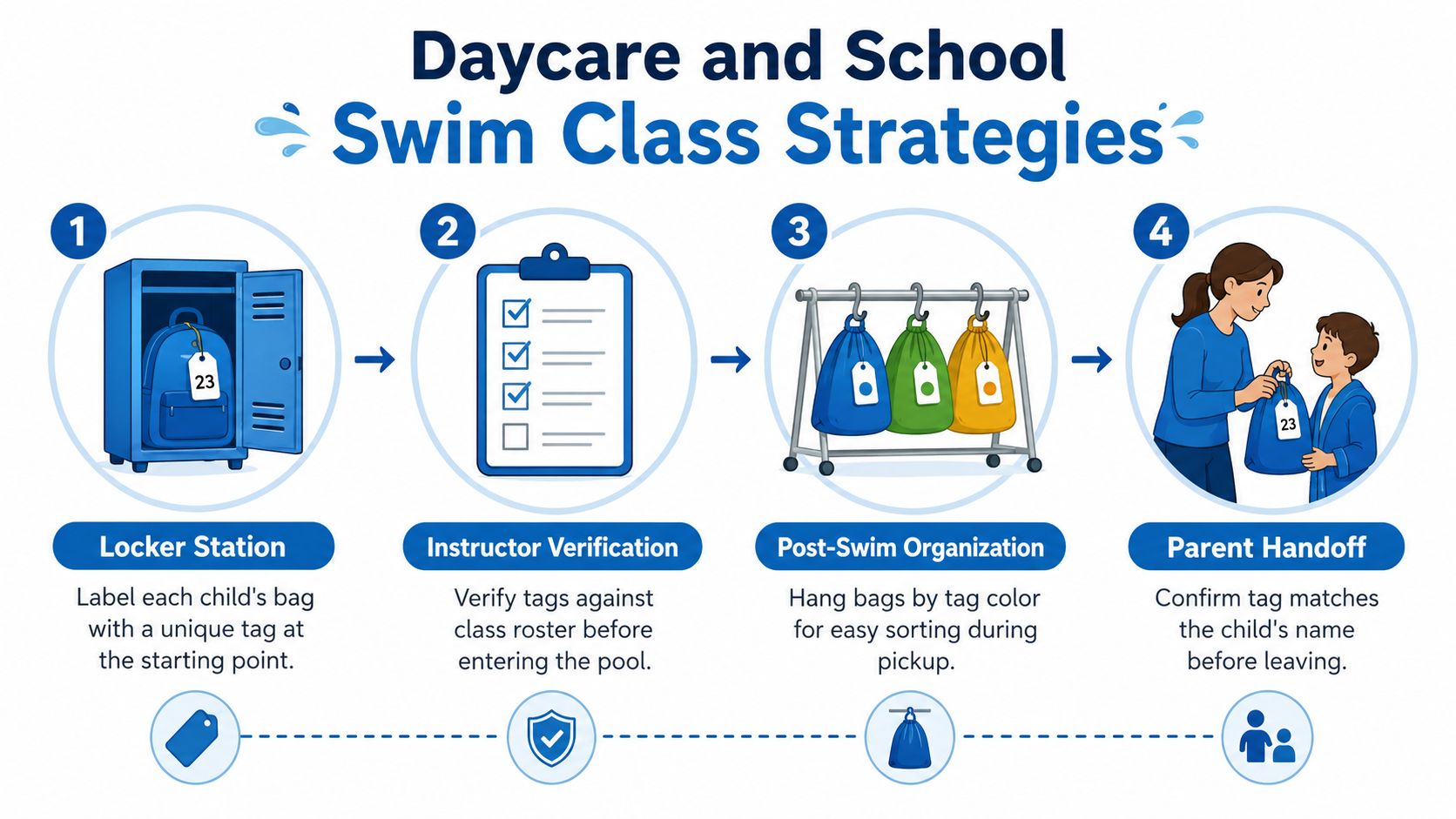
A daycare or school swim program adds a sorting problem that individual family use doesn't. Staff may receive dozens of similar bags, move them between changing areas, and return them while children are wet, tired, and ready to leave. A tag that is technically present but hidden behind a side pocket doesn't help much during that handoff.
Attach the main tag to the top carry handle or another consistent, visible location. Keep the child's name large, then add the class, lane, group, or ability level if the program uses those identifiers. A color band can separate siblings or classes, but color should support the printed name rather than replace it.
Create a system staff can use quickly
Families with more than one swimmer can assign a different color or icon to each child. That visual cue helps a parent spot the correct bag, while the name and class information give staff a reliable confirmation. Put a second label inside the bag as backup, such as a fabric label on the lining or an interior pocket, because external attachments can still be lost during transport.
A practical morning check takes only a few moments:
- Find the tag: Confirm it's still attached to the intended handle.
- Read the name: Make sure water, scratches, or wear haven't reduced legibility.
- Check the contact detail: Verify the parent number is current.
- Confirm the class marker: Match the group, lane, or class information to that day's lesson.
- Pack with visibility in mind: Don't bury the handle beneath a towel or coat.
Swimming programs also benefit from wider safeguarding procedures. Parents evaluating a daycare or school program can review resources such as this explanation of a swim instructor background check, alongside the facility's own supervision, pickup, and lost-property policies. A bag tag won't replace those controls, but it can make everyday gear handoffs clearer and less error-prone.
A durable personalized option for sports bags, such as InchBug's Sports Kids Circle Bag Tags or Sports Kids Rectangle Bag Tags, can provide an external identification point with kid-friendly personalization. Choose the format based on the bag's handle, the available space, and how much information the family needs to display.
Before the next lesson, inspect the attachment, rinse away residue, and make sure the child's name and parent contact are easy to read. Visit InchBug to compare personalized sports bag tags and other labels for children's swim, daycare, and school gear, then choose the tag and attachment style that fit your family's actual pool routine.